When it comes to getting a good night’s rest, the kind of mattress you sleep on matters especially if you’re concerned about your spine. Many healthcare professionals advise patients to use a firm memory foam mattress rather than a soft one. In this blog we’ll explore why that recommendation exists, how a firm memory foam mattress supports your spine, and how to choose the best one for you.
What do we mean by “firm memory foam mattress”?

A firm memory foam is a mattress whose comfort layer is made of memory foam visco-elastic foam that conforms gently to the body combined with a high support layer underneath, and whose overall feel is firmer (less “sink-in”) than a soft. The “firm” part means the surface gives relatively less under your weight and helps keep your spine from bending into unnatural curves.
Variations:
- Medium-firm memory foam mattress: Slightly softer than firm, more contouring.
- Extra firm memory foam mattress: Even stiffer feeling, minimal give.
- Memory foam 2000 pocket sprung hybrid mattress: A hybrid configuration of memory foam plus pocket sprung coils, sometimes marketed as “firm memory foam”.
Why spine support matters?
Your spine has curves cervical (neck), thoracic (upper back), lumbar (lower back). When you lie down, whether spine (on your back), on your side or stomach, the mattress should allow your spine to maintain a neutral alignment (not too curved, not too twisted).
If the mattress is too soft, your hips or ribs may sink too much, causing your spine to sag or twist, which can lead to low-back pain or stiffness in the morning. Conversely, if the mattress is too hard, it may create pressure points and fail to relieve stress on joints.
Why a “firm memory foam mattress” is often recommended?
Let’s break down how a firm memory foam mattress supports your spine and why doctors might suggest it.
1. Balanced support and contouring
Memory foam is known for contouring to the body’s shape, reducing pressure points. But if the foam layer is too soft or the mattress lacks firm support underneath, you may sink too much, losing spinal alignment. A firm memory foam mattress gives enough support so your midsection doesn’t collapse while still allowing some contouring.
In effect, it helps the lumbar region (lower back) stay supported rather than hanging in a gap between support points.
2. Maintains neutral spine alignment
With a firm memory foam mattress, the spine is less likely to sag or twist. Studies show that sleeping surfaces which promote neutral spine posture correlate with lower low-back pain.
The “firm” aspect prevents excessive sink-in; the memory foam layer ensures that your shoulders, hips and other curves are still cushioned.
3. Minimises low back stress and disc loading
In a study focused on lumbar support and mattress firmness, researchers measured that a lack of support in the lumbar region increases shear and compressive forces on the lower spine.
By using a firm memory foam, the load is distributed more evenly and lumbar stress can be reduced.
4. Better sleep quality and less pain
Back pain disturbs sleep; poor sleep may worsen back pain in a vicious cycle. Data suggests that mattresses of appropriate firmness improved sleep quality and reduced pain in many cases.
While the studies emphasise “medium‐firm” as the sweet spot for many, a firm memory foam often sits within that effective range depending on material and layering.
5. Durable support over time
Memory foam mattresses, when properly constructed, maintain shape and support longer than some older innerspring models that sag. A firm memory foam tends to withstand body impressions better, which helps maintain correct support. When a mattress sags, your spine can lose alignment. So part of the reason doctors may recommend one is the longevity of good support.
Key considerations when selecting a “firm memory foam mattress”
Not all firm memory foam mattresses are created equal. Here are important factors:
| Factor | Key Point |
|---|---|
| Firmness | Choose supportive, not rock-hard. |
| Foam Quality | High-density foam lasts longer. |
| Support Core | Strong base prevents sagging. |
| Sleep Position | Back/stomach = firm; side = medium-firm. |
| Mattress Age | Replace if it sags or loses shape. |
| Trial Period | Test comfort for a few weeks. |
| Size | King/Double gives balanced support. |
Is “extra firm memory foam mattress” ever better?
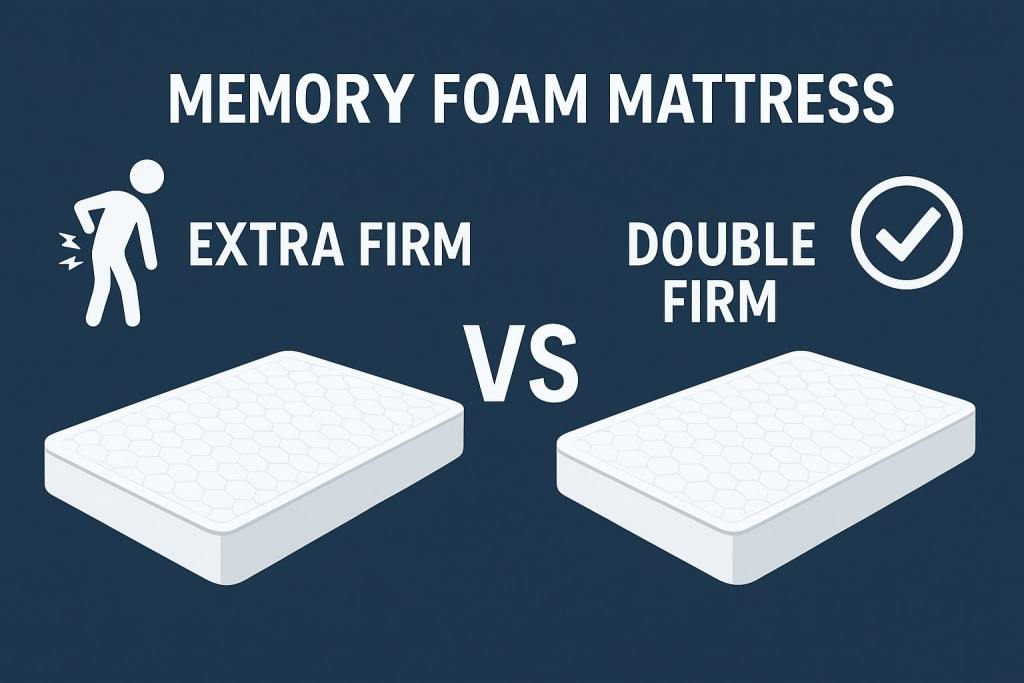
In some marketing, you’ll see “extra firm memory foam” or “double firm memory foam mattresses”. While extra firm means even less give, this may be too hard for many people. Research indicates that very hard mattresses are not automatically superior for back pain. For example, Harvard’s review noted that very hard mattresses were associated with worst sleep quality in one study.
In short, for most people a firm memory foam (rather than extra firm) is a better choice enough support without creating uncomfortable pressure points. That said, individual preferences, body weight, sleep position and existing back problems will influence the best choice.
How a firm memory foam mattress compares with other mattress types?
- Soft mattress: too much sink, hips or shoulders may drop, spine alignment may suffer.
- Medium-firm mattress: often found in studies to be optimal for many people with back pain.
- Firm memory foam mattress: tries to hit the supportive sweet-spot for spine alignment while providing contouring comfort via memory foam.
- Extra firm mattress: may support ultra-heavy sleepers or stomach sleepers, but for many can feel too rigid and produce pressure points.
- Memory foam + springs (hybrid): A “memory foam 2000 pocket sprung hybrid mattress” or “firm memory foam hybrid” may combine benefits of firmness and bounce/edge support.
When doctors recommend a firm memory foam mattress
Doctors (orthopaedic, spine specialists, physical therapists) may recommend a firm memory foam mattress in the following scenarios:
- Patients with chronic low back pain and evidence of poor support from their current mattress.
- Back or stomach sleepers whose hips or midsection are sinking too much into their mattress, causing lumbar strain.
- People whose mattress is old, sagging or giving poor support (i.e., the firmness has degraded).
- Patients with a heavier body weight who require stronger support to maintain spinal alignment without sagging.
- When cushions or soft surfaces have failed to relieve back stiffness and the goal is better core lumbar support.
Practical tips for using a firm memory foam mattress for spine support
- Replace your mattress if you notice excessive sagging (more than approx. 2 inches in a zone) or if you wake stiff in the morning.
- Lie in your normal sleep positions on the new mattress for at least 2–4 weeks (give your body time to adjust) and note how you feel: Do you wake without low back stiffness? Does your spine feel aligned?
- Use a proper bed base/foundation. A firm memory foam mattress needs a supportive base to work properly.
- Consider body weight and sleep position: If you sleep on your side most of the time, you might need a slightly softer top layer even within a firm mattress. If you stomach-sleep, heavier body, a firmer surface may be better.
- Rotate the mattress (head to foot) if the manufacturer allows, to promote even wear.
- Use pillows and other supports to maintain spinal alignment: e.g., a pillow under the knees if on your back, or between knees if on your side, to complement mattress support.
- Give yourself time: Switching from a very soft mattress to a firm memory foam mattress may feel different initially; your back and muscles may need a short adjustment period.
Common concerns and misconceptions

- “Firm means hard and uncomfortable”: Not necessarily. A well-designed firm memory foam still provides comfort through the foam layer but remains supportive underneath.
- “One firmness works for everyone”: No. While many studies point to medium-firm/firm as ideal for spine support, individual differences (sleep position, body weight, pain status) matter. For example, a side sleeper with narrow shoulders might need slightly more give.
- “Soft mattresses are always bad”: Not always. For very light individuals, side sleepers needing shoulder/hip contouring, or people with certain joint conditions, a softer mattress might feel better but may sacrifice spinal alignment support.
- “Extra firm is best for all back pain”: As noted above, extra firm can be too inflexible for many and may create pressure points or discomfort. Most research supports medium-firm or firm rather than ultra-hard.
- “Memory foam alone fixes back pain”: Mattress alone is not the full solution. Back pain also depends on posture, weight, activity level, pillow support, medical condition, mattress age, etc. The mattress is one element of many.
Conclusion
Doctors recommend a firm memory foam because it can better maintain proper spinal alignment, provide balanced contouring and support, reduce stress on lumbar structures, and improve sleep quality especially for people with back pain, those who sleep on their back or stomach, and those who need a stable sleep surface.
From research we see that mattress firmness plays a leading role in spinal comfort, sleep quality and pain relief, and that too soft or too hard surfaces both carry risks. Although some studies favour “medium‐firm”, a firm memory foam that is well designed and properly supported may hit the right sweet-spot for many users. Explore our website to find the best mattresses designed with the perfect firmness level for your comfort and spine support.
FAQs
A firm memory foam has a denser, less-yielding comfort layer and a stronger support core, so your body doesn’t sink deeply and your spine remains aligned. A soft mattress allows more sink-in, which may lead your midsection or hips to drop out of alignment with your lower back.
Not necessarily “cure” but it can help reduce back pain by supporting spinal alignment, reducing stress on discs and joints, and improving sleep quality. Other factors (exercise, posture, medical condition) also matter.
Not always. For many people, extra firm may feel too unyielding and cause pressure points, especially if they sleep on their side. The evidence suggests that “firm” or “medium-firm” often offers the best balance for spinal health rather than “extra firm”.
Consider your sleep position, body weight, partner’s weight (if sharing a bed), and mattress size (e.g., king size firm memory gives more space and less motion transfer). Also check the mattress’s warranty, materials, base support, and trial period.

I’m Zainab, and I write to help people choose the right mattresses. I share clear, useful information about everything from comfort to materials, so you can pick the one that’s best for you.