
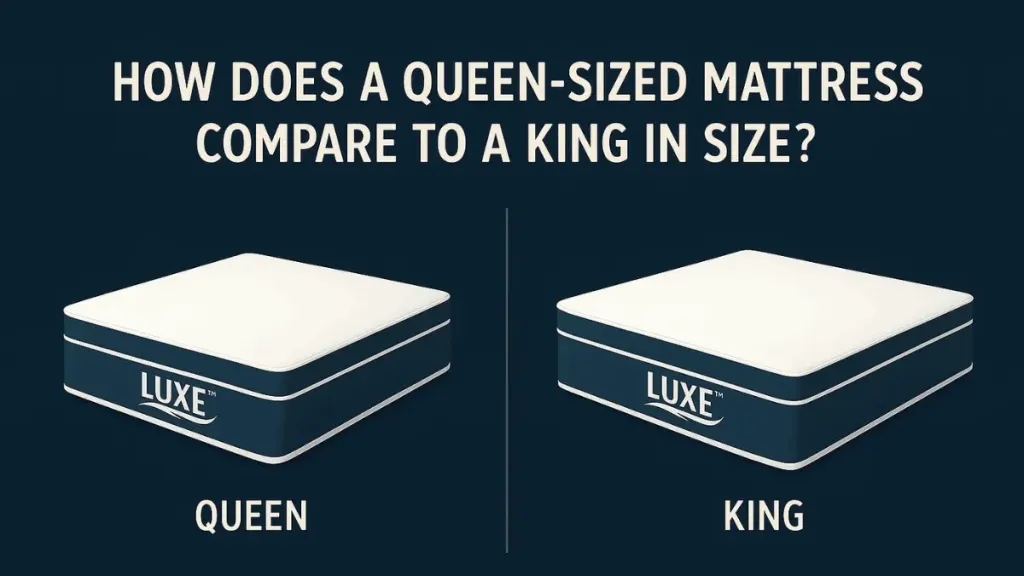
When you’re designing your dream bedroom, few choices impact comfort and elegance like the right mattress size. The queen sized mattress size and the king are the two most sought-after options in the UK, both offering luxury, comfort, and an aesthetic statement. Yet, subtle differences in width, length, and layout can make one a better fit depending on your lifestyle, space, and sleeping preferences.
At Luxe Mattresses, we understand that choosing between a queen and king isn’t just about size, it’s about crafting a balanced space where comfort meets sophistication. This guide explains the detailed specifications, practical room-fit advice, and comfort distinctions between these two premium mattress sizes.
Understanding UK Mattress Size Standards
Why Mattress Sizing Varies Between Regions
Mattress standards differ across countries due to variations in measurement systems and housing styles.
In the UK, measurements are based on centimeters, while the US uses inches. European models, meanwhile, often follow broader continental sizing. These differences affect everything from sheet compatibility to frame design.
| Region | Queen Mattress (cm) | King Mattress (cm) | Measurement System |
| UK | 150 × 200 | 180 × 200 | Metric (cm) |
| US | 152 × 203 | 193 × 203 | Imperial (inches) |
| EU | 160 × 200 | 180 × 200 | Metric (cm) |
A bed width comparison UK study by luxury bedding retailers found that British homes favor smaller dimensions than American standards due to compact room sizes, making the queen sized mattress size (UK King equivalent) the most balanced option for everyday luxury.
What Defines a Queen Sized Mattress in the UK Context
In the UK, “queen” isn’t an official size category. It’s commonly used to describe what manufacturers classify as a King size mattress, 150 cm wide and 200 cm long.
This dimension sits perfectly between a Double (135 × 190 cm) and a Super King (180 × 200 cm).
The queen sized mattress size thus refers to the UK King, spacious enough for couples, efficient for modern homes, and compatible with the majority of British bed frames and bedding sets.
Overview of Bed Width Comparison in the UK
Understanding the bed width comparison UK framework helps you visualize just how much space a queen and king occupy.
| Mattress Type | Width (cm) | Length (cm) | Ideal User |
| Double | 135 | 190 | Couples or guest rooms |
| Queen / UK King | 150 | 200 | Couples wanting balance |
| Super King | 180 | 200 | Spacious master suites |
In essence, the difference lies mainly in width, not length. Those additional 30 cm between queen and king can feel like an extra world of comfort for couples who prefer more personal space during sleep.
The Exact Dimensions Queen vs King Mattress
Queen Mattress Measurements in cm and Inches
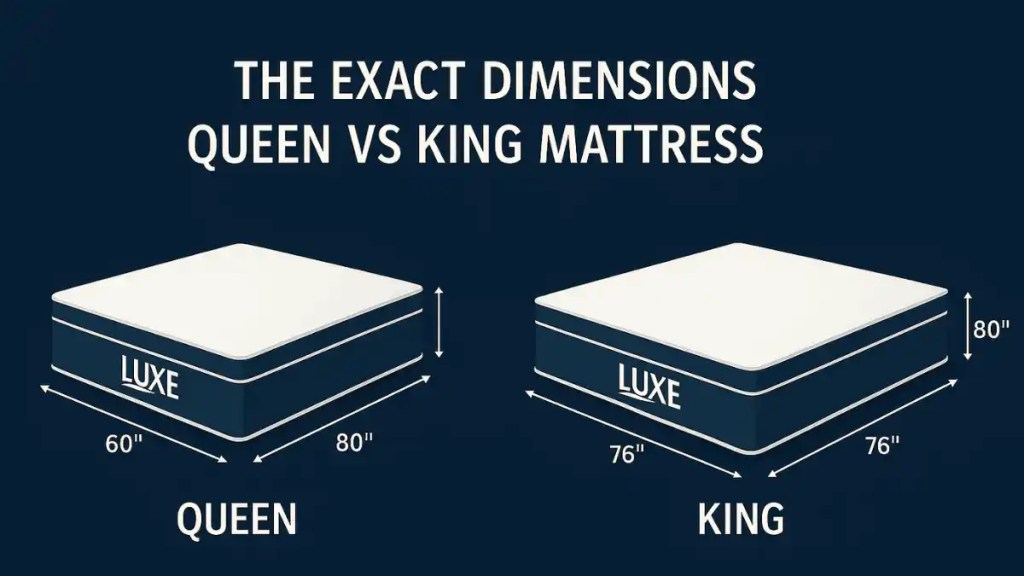
The queen sized mattress size measures 150 cm × 200 cm (5 ft × 6 ft 6 in), offering a perfect equilibrium between floor coverage and sleeping surface. It comfortably accommodates two sleepers without overwhelming medium-sized bedrooms.
King Mattress Measurements in cm and Inches
A UK King mattress (sometimes called “Super King” in other markets) measures 180 cm × 200 cm (6 ft × 6 ft 6 in), offering 30 cm of additional width compared to the queen. That’s roughly 15 cm more space per person, a noticeable difference for restless or taller sleepers.
Mattress Length Chart: Quick Comparison
| Size | Width (cm) | Length (cm) | Sleeping Space Per Person |
| Double | 135 | 190 | 67.5 cm |
| Queen (UK King) | 150 | 200 | 75 cm |
| King (Super King) | 180 | 200 | 90 cm |
This mattress length chart helps highlight how the queen gives each sleeper about 7.5 cm more width than a double, while a king offers an additional 15 cm.
How Thickness and Depth Differ
Most luxury mattresses range between 25–35 cm thick. While both queen and king models share similar depth profiles, king versions tend to include enhanced edge support and multiple comfort zones to distribute body weight evenly.
Luxe Mattresses offer consistent depth across both, ensuring your comfort level sizes remain optimal regardless of your bed frame style.
Bed Width Comparison UK: How Much Bigger Is a King?
Visual Difference in Bed Width and Space Usage
When placed side-by-side, the extra 30 cm of width in a king mattress might not sound dramatic but visually, it changes the entire layout of a room. In bedrooms where space symmetry and accessibility are priorities, a queen sized mattress size fits more harmoniously.
Floor Area Coverage
| Mattress | Floor Space (m²) | Recommended Room Size |
| Queen (150 × 200 cm) | 3.0 m² | 11 × 11 ft |
| King (180 × 200 cm) | 3.6 m² | 12 × 12 ft |
The bed width comparison UK data shows that the king demands at least 0.6 m² more room — a crucial factor for compact London or apartment bedrooms.
Who Benefits from Extra Width?
- Couples who toss and turn appreciate the added elbow room.
- Families sharing sleep space with toddlers gain comfort.
- Tall sleepers feel more relaxed, as kings prevent overlap near bed edges.
Practical Fit Bedroom Size Requirements
Interior designers often recommend maintaining 60 cm of clearance on all sides. For a queen, that fits comfortably in most urban master bedrooms; for a king, you’ll need slightly larger dimensions to avoid crowding.
Comfort Level Sizes: What Difference Does It Make?
Sleep Position and Motion Transfer
In comfort level sizes analysis, both mattresses provide excellent pressure distribution when paired with hybrid or memory foam materials. However, the wider surface of the king minimizes partner motion transfer, especially for light sleepers.
Pressure Distribution and Edge Support Differences
A queen mattress already offers strong edge support, but kings distribute pressure more evenly due to increased width. Luxe Mattresses’ premium hybrid models integrate zoned support layers to reduce spinal tension across both size categories.
Why Comfort Level Sizes Vary Across Materials
Foam-based models adapt closely to the body, making smaller beds feel more spacious. In contrast, spring and hybrid builds emphasize airflow and bounce, where width and surface area play a bigger comfort role.
Shared Sleeping Comfort
Each person on a queen sized mattress size gets approximately 75 cm of space. That’s more than enough for comfortable side or back sleeping, but a king gives couples 20% more width per person, perfect for families or restless sleepers.
Mattress Length Chart: A Complete UK Reference
| Mattress Size | Width (cm) | Length (cm) | Ideal Height Range |
| Single | 90 | 190 | Up to 6 ft |
| Double | 135 | 190 | Up to 6 ft 2 in |
| Queen (UK King) | 150 | 200 | Up to 6 ft 5 in |
| King (Super King) | 180 | 200 | Up to 6 ft 6 in |
Using this mattress length chart, shoppers can visualize how each size accommodates their height and sleeping posture, avoiding cramped feet or uneven coverage.
Factors to Consider Before Choosing Between Queen and King
- Room Dimensions: Smaller rooms benefit from queen setups, while spacious homes suit king layouts.
- Frame Compatibility: Check your bed base and headboard width before upgrading.
- Bedding Availability: UK markets primarily stock UK King (queen equivalent) bedding, making accessories easier to source.
- Mobility and Delivery: A queen sized mattress size is lighter and easier to transport through doorways or stairs compared to a king.
Comfort and Aesthetic Differences
Proportion and Balance
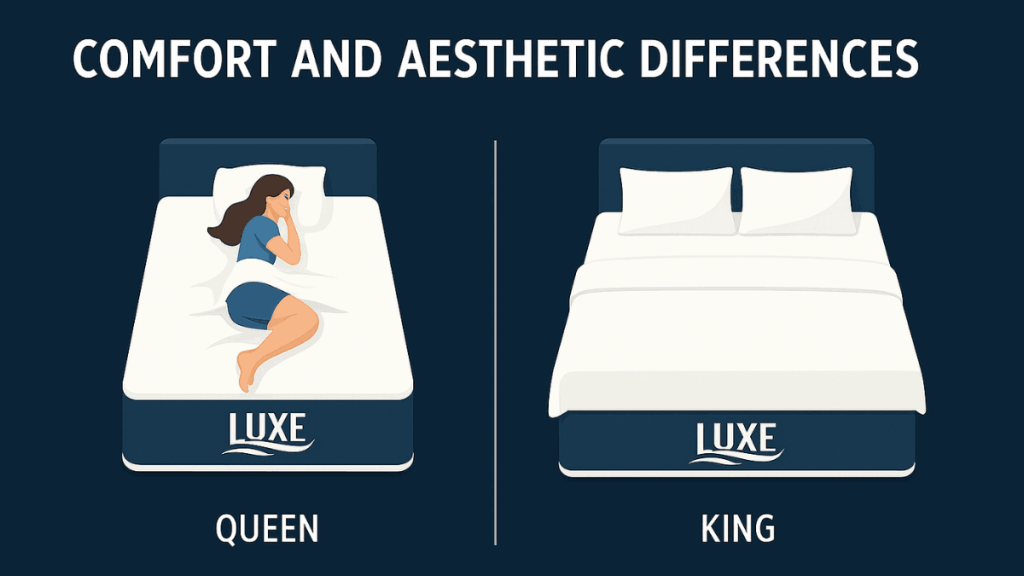
A queen complements symmetrical bedroom layouts, maintaining proportion between furniture pieces. The king, however, dominates visually, ideal for open master suites with minimalist décor.
Couple Comfort
Couples sharing a queen sized mattress size experience intimate yet comfortable sleep. A king enhances personal freedom, reducing body heat transfer and rolling disturbance.
Bedding Styling and Furniture Pairing
Bedding styling options increase with king beds due to broader sheet availability. Yet, the queen remains the most elegant proportion for design harmony in typical UK bedrooms.
The Psychological Comfort of “Extra Space”
For many, a king size brings a subconscious sense of luxury and personal freedom. Yet research suggests that sleep quality relies more on mattress material and support system than width alone, proving that true comfort lies in balance, not excess.
Cost, Value, and Longevity, Is Bigger Always Better?
| Mattress Size | Average Price (Premium Range) | Durability (Years) |
| Queen | £700–£1,200 | 8–10 |
| King | £900–£1,500 | 8–10 |
The king’s extra width increases material and shipping costs. However, both sizes last equally long when made with quality foams and reinforced coils.
Tip: If you value proportion and easy bedding availability, a queen sized mattress size offers superior cost-efficiency without compromise.
Expert Insights: Choosing the Right Mattress
Leading UK mattress specialists recommend evaluating your:
- Body frame: Taller or broader individuals benefit from king size.
- Sleeping habits: If one partner moves frequently, extra space enhances comfort.
- Bedroom ratio: Maintain at least a 1:2 ratio between mattress width and room width for visual flow.
Ultimately, experts agree that the queen sized mattress size remains the most balanced choice, blending comfort, elegance, and practicality for most UK homes.
Conclusion
Choosing between a queen and king comes down to more than numbers. It’s about balance — between comfort, space, and design harmony. The queen sized mattress size fits most UK bedrooms perfectly, providing ample space for couples without overwhelming the layout.
A king mattress, on the other hand, delivers visual grandeur and unmatched personal room for movement, ideal for expansive master suites.
At LuxeMattresses.co.uk, we craft every mattress with precision to UK standards, blending artistry with advanced sleep technology. Whether you choose queen or king, your mattress should reflect your lifestyle, sophisticated, serene, and built to last.
FAQs
A UK queen (king equivalent) is 150 × 200 cm, while a king (super king) is 180 × 200 cm.
Exactly 30 cm wider, giving each sleeper an extra 15 cm of space.
Couples in standard UK bedrooms find the queen more practical; larger spaces favor the king.
Yes, a wider frame and headboard are needed for full support.
Not necessarily, with quality materials, both offer equal comfort level sizes; it depends on your room and preferences.

I’m a professional sleep health and mattress content specialist with extensive experience writing about orthopedic mattresses, back pain relief, pressure-point support, and overall sleep comfort. I collaborate with industry research, sleep studies, and mattress performance insights to deliver accurate, trustworthy, and reader-focused content. I’m known for simplifying complex mattress technologies such as memory foam, motion isolation, and firmness levels, making them easy to understand for everyday buyers. My goal is to help readers choose mattresses that match their lifestyle, sleep posture, and health needs empowering them to achieve deeper, healthier, and pain-free sleep through informed decisions.