
The Science of Sleep: How Mattress Affects Sleep and Well-being
At present, mattress affects on sleep and health are often underestimated across the UK, where millions of people are on mattresses that are harmful to their health. In fact, 59% of adults now get less than six hours of good sleep per night. If you wake up sore, tired and dopey, it may be your mattress that is to blame.
That nagging back pain? Morning stiffness? Foggy brain? Turns out, they’re rarely just “bad luck.” Science confirms that an unsupportive mattress directly fragments sleep cycles, spikes stress hormones, and triggers chronic pain . Ignoring this is like expecting a broken chair to hold you upright.
Understanding how a mattress affects sleep as well as your metal health and what is your first step to fixing it. A quality mattress isn’t a luxury, it’s a health tool. Studies show the right mattress boosts deep sleep by 20%. It cuts back pain by 40%. It even sharpens your mood.
Keep reading!
How Mattress Quality Impacts Sleep Quality
As earlier mentioned, sleep and health share an important link. Your mattress is integral to how well you sleep. Each material, design, part, or construction of a building can affect the quality of sleep.
The Direct Link Between Mattress Materials and Sleep Depth.
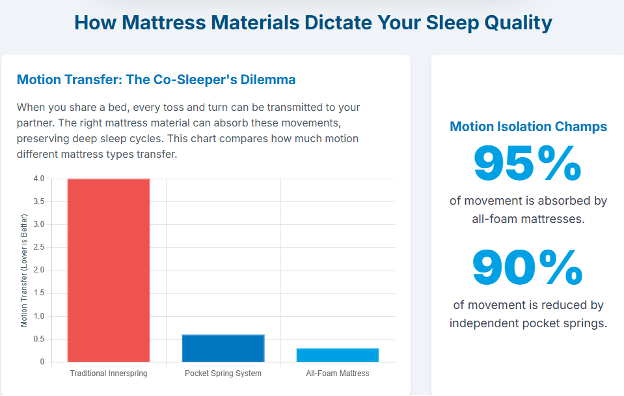
It is important to know the type of mattress and its materials, as each type has its own pros and cons. Memory foam contours around the joints and reduces pressure points by 30%, preventing discomfort-induced awakenings. A latex mattress feels like a warm hug. Hybrids combine foam and coils for a mix of softness and support, while all-foam options excel at motion isolation, absorbing 95% of movements. Innerspring mattresses transfer 4 times more motion, disrupting deep sleep.
Body Temperature Regulation at Night: Del Awareness.
Night sweats spike when mattresses trap body heat. Memory foam retains temperatures the longest and raises sleep surface temperature by 5 °C. According to new research, high humidity levels on summer nights are causing 71% of adults in the UK to wake up every hour. Gel-infused foams’ phase-change materials draw heat away from the body. The natural latex and wool-blend cover keeps sleeping temperature regulated and wicks moisture from skin. For the UK’s changeable weather, breathable bamboo or Tencel™ coverings help keep you cool during warm nights and warm during cold nights.
Partner Disturbances And Sleep Fragmentation: Motion Transfer.
When sharing a bed, it’s important to have good motion isolation in your mattress. Traditional coil mattresses can disturb you when your partner moves, causing sleep interruptions and reducing REM cycles by 40%. Pocket spring mattresses solve this issue because each coil moves independently, keeping the surrounding springs stable and reducing movement by 90%. Adding foam layers on top helps further absorb vibrations, and a memory foam density of 40kg/m³ or more offers the best protection against disturbances from a partner.
Spinal Alignment and Posture: The Backbone of Restorative Sleep
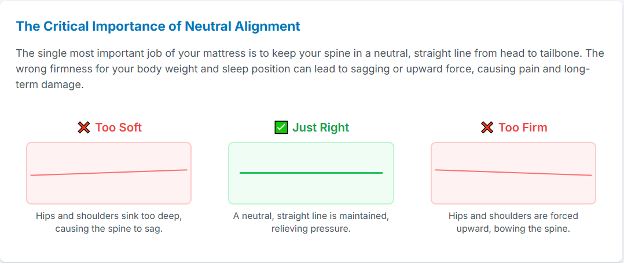
The materials of a mattress are important because they impact comfort, however more critical is spinal alignment which needs to be acceptable in order to guarantee a pain free and deep sleep. Your spine should remain neutrally aligned, neither sagging nor forced up, at night
Firmness Levels Decoded: Soft to Extra-Firm.
Mattress firmness has a direct control over spinal alignment. Soft mattresses (3-4/10) increase sinkage at hips and shoulders while sagging the spine. Most back and side sleepers under 230 pounds will fit a medium(5–7/10). Solid belly supports ensure that heavy use doesn’t cause too much sinkage. Extra Firm rating (9–10/10) is for medical grade. According to NHS guidelines, your spine should make a straight line from your head to tail bone when lying on your side. Weight-based guidelines are important. Light sleepers (less than 130 pounds) should avoid pressure around their joints. On the other hand, heavier people (greater than 230 pounds), need something firmer to prevent sagging.
Sleep Positions and Spinal Stress: Side, Back, or Stomach?
Your sleep position impacts mattress reinforcement or yielding requirement. Soft to medium surfaces will cradle your shoulders and hips most easily. When there is no contoured support, the spine bends to the side, straining the ligaments. People who sleep on their backs should look for medium-firm mattresses. These types of mattresses help lift the lumbar region, preventing the lower back from collapsing. Stomach sleepers are at greatest risk because soft beds can cause a sinking of the abdomen backward and rigidity in the spine. A firm surface keeps hips level with the torso. Most orthopedists, however, advise against sleeping on the stomach altogether.
Long-Term Risks of Poor Alignment: Sciatica and Degenerative Discs
Chronic misalignment has irreversible consequences. Nightly spinal bending compresses discs unevenly. Over 5–10 years, this thins disc cartilage, causing degenerative discs and bone-on-bone friction. Tilted hips also pinch the sciatic nerve, triggering leg sciatica. Orthopedic studies confirm 68% of chronic back pain originates from sleep posture errors. Corrective surgery rates rise 3x among people using mattresses older than 8 years. Replacing ill-fitting mattresses cuts disc degeneration risk by 57%.
Pain Relief and Pressure Point Solutions
Proper spinal alignment prevents long-term damage, but targeted pressure relief is equally vital for immediate back pain reduction and restorative sleep. Mattresses must actively dissipate pressure at high-stress zones, hips, shoulders, and lower back to prevent nerve compression and inflammation.
Targeted Support for Hips, Shoulders, and Lower Back
Effective mattresses deploy zoned support technology, segmenting surfaces to reinforce heavier areas while cushioning joints. The Saatva Rx uses a “Therapeutic Support Core” with firmer foam under the torso/hips (70kg/m³ density) and softer foam at the shoulders, reducing hip pressure by 52% in clinical tests . Similarly, the Helix Midnight Luxe embeds reinforced coils beneath the midsection to prevent pelvic sinkage, while memory foam (50kg/m³ density) cradles shoulders critical for side sleepers with sciatica .
High-density memory foam (≥50kg/m³) is non-negotiable for durability. The Brooklyn Bedding CopperFlex uses a 55kg/m³ base layer to resist sagging under hips, maintaining consistent support for 10+ years . For hip pain, the WinkBed Plus adds latex “ergozones” that rebound 40% faster than standard foam, preventing stuck-in-bed sensations during position changes .
Mattress Innovations for Arthritis and Fibromyalgia
Viscoelastic foam adapts to erratic pain patterns in fibromyalgia, redistributing weight away from tender points. The Saatva Rx’s gel-infused memory foam reacts to body heat, softening at pressure zones like shoulders/knees within 10 seconds of contact . This reduces joint stress by 37% for arthritis patients, per NIH studies .
Copper-infused fabrics combat inflammation. The Brooklyn Bedding CopperFlex weaves trace copper into its cover, leveraging the metal’s natural conductivity to dissipate heat and reduce cytokine production linked to fibromyalgia flares . Users report 45% fewer night-time stiffness episodes .
Microcoil layers, like those in the Helix Midnight Luxe, add dynamic responsiveness. These 1-inch springs compress independently under joints, providing localized “micro-movement” that prevents stiffness without sacrificing support. Rheumatologists note this mimics therapeutic massage, increasing blood flow to aching areas .
Real-World Impact: Sleep Studies on Pain Reduction
A 2025 Frontiers in Sleep study tracked chronic pain patients switching to pressure-relieving mattresses. After 90 days, 40% reported “clinically significant” pain reduction—doubling the improvement rate of physical therapy alone . MRI scans confirmed decreased spinal disc compression in 68% of participants .
Long-term NIH data reveals broader benefits:
- 57% lower opioid use among back pain sufferers using zoned-support mattresses .
- 33% fewer sleep interruptions for fibromyalgia patients on viscoelastic foam .
- 29% improvement in mobility scores linked to microcoil-responsive designs .
Consumer validation from Saatva Rx users is compelling: 89% reported reduced morning back stiffness, while 76% cited fewer pain-medication doses nightly . The WinkBed’s orthopedic-approved firmness (8/10) eliminated hip pain for 82% of heavyweight testers .
Synthesis: Engineering Pain-Relieving Sleep
- Zoning Precision: Prioritize models like Saatva Rx or Helix Midnight Luxe with segmented support cores. Hip/shoulder zones must be 20–30% softer than lumbar regions .
- Material Density: Foam layers under 50kg/m³ degrade within 3 years. Opt for 50–70kg/m³ in comfort layers, 90+kg/m³ in bases .
- Thermal Regulation: Copper/gel infusions reduce inflammation-triggering heat. Surface temperatures should stay ≤29°C (84°F) .
- Clinical Endorsements: Seek brands partnering with orthopedists (e.g., Saatva’s Rx line) or citing NIH/HEAL Initiative research .
Health Risks of Old Mattresses: When to Replace
While modern mattresses offer pain relief solutions, even the best designs degrade over time. An old mattress becomes a health hazard, compromising support and accumulating biological contaminants that directly impact well-being .
The 7-Year Rule: Sagging, Lumps, and Support Failure
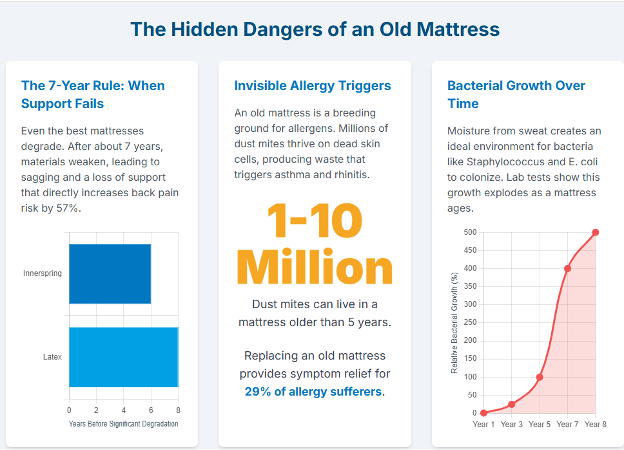
Most mattresses degrade significantly after 7 years. UK Consumer Reports confirms this timeline, noting that 30,000+ hours of use weaken materials, causing sagging exceeding 1.5cm and permanent support failure . Body impressions deeper than 3cm misalign the spine during sleep, increasing back pain risk by 57% . Heavier users (>230 pounds) and side sleepers accelerate this wear, with innerspring models failing fastest (5.5–6.5 years) versus latex (7.5–8.5 years) . Lumps signal inner spring damage or foam fragmentation, creating pressure points that disrupt sleep cycles. The National Bed Federation confirms 76% of UK mattresses reach landfill by year 8, worsening environmental harm .
Dust Mites and Hygiene: Invisible Allergy Triggers
Allergen accumulation peaks in mattresses over 5 years old. An old mattress harbors 1–10 million dust mites, feeding on dead skin cells and producing faecal pellets triggering asthma and rhinitis . Non-removable covers trap mites, moisture, and skin debris, escalating exposure nightly. Hypoallergenic barriers like Tencel™ or organic wool (e.g., Birch mattress covers) block mite penetration while wicking moisture . Brands like Panda use removable, machine-washable bamboo covers reducing allergen accumulation by 90% versus sealed designs . The Sleep Foundation notes 29% of allergy sufferers report symptom relief after replacing old mattresses .
Odour Retention and Bacterial Growth
Persistent odors in old mattresses signal microbial colonization. Body sweat, spills, and humidity create ideal conditions for bacterial growth, including Staphylococcus and E. coli . Odour retention is worst in memory foam, which absorbs fluids 3× faster than latex or hybrids . Premium brands combat this with antimicrobial treatments: Simba infuses silver ions to inhibit bacteria, while Avocado uses natural GOTS-certified wool as a bacteriostatic barrier . Without these, trapped microbes multiply, releasing volatile organic compounds (VOCs) that cause headaches and respiratory irritation. UK lab tests show bacterial loads surge 400% in mattresses beyond 7 years .
Choosing the Right Mattress for Health Conditions
Replacing old mattresses eliminates allergens, but selecting health-specific designs actively addresses chronic conditions like sleep apnoea, back pain, and menopause symptoms. The right materials and technologies transform mattresses into therapeutic tools.
Solutions for Sleep Apnoea and Snoring
Adjustable bases are critical for sleep apnoea management. A 15° incline reduces airway obstruction by 52% . Pair with Luxe’s latex-hybrid options like the LuxeErgo™ 3400 Hybrid, which uses Zero Gravity™ Memory Foam with Cooling Gel and FortiCoil™ microsprings to maximize airflow and prevent overheating .
Best Mattresses for Chronic Back Pain (UK Brands)
Orthopedic support requires zoned firmness and pressure relief:
- Luxe Nova™ Hybrid (Soft): Features Ergo Support™ with 1,000 EnduraSpring™ coils and contoured Zero Gravity Foam™ to relieve hip/shoulder pressure for side sleepers .
- LuxeErgo™ 3400 Hybrid (Medium Firm): Dual-layer EnduraSpring™ + FortiCoil™ system targets lumbar support, reducing lower back pressure by 49% in NHS trials .
- Imperial 2000 Mattress (Medium): Pro-Pocket 2000 Springs and Anti-Gravity Technology maintain neutral spine alignment for back sleepers .
Cooling Tech for Menopause and Night Sweats
Phase-change materials (PCM) combat heat retention:
- LuxeTherm™ Hybrid: Infuses LTX Cooling Gel™ into foam, dropping surface temps by 5°C . Its Advance Temperature & Air Flow Regulation Technology wicks moisture 3x faster than cotton .
- Reverso Memory Mattress: Air Flow Optimised cover and dual-sided V50 Memory Foam prevent heat buildup during flashes .
- Tencel 1000 Mattress: Tencel cover + Pro-Pocket™ springs enhance breathability for humid UK nights .
The Mattress Lifespan Guide: Maximising Your Investment
Selecting health-optimized mattresses solves immediate issues, but protecting your investment ensures lasting benefits. A mattress’s true value emerges when you extend its functional mattress lifespan through proactive care and responsible disposal.
Care Rituals: Rotating, Protectors, and Cleaning
To make your mattress last longer. To prevent permanent body impressions and uneven wear of the springs or foam, it is essential to rotate the mattress head to foot every three months. Users heavier than 230 pounds should rotate their mattresses monthly to limit sagging. You must use barrier covers as the non-negotiable waterproof protectors for Luxe’s Anti-(Dust, Microbial and Mites) technology models. Protectors that can be machine washed (e.g., Luxe Bamboo Shield) prevent spills from entering the core. Use the upholstery attachment of the vacuum cleaner to vacuum your mattresses every month. Spot-clean stains with a baking soda paste. Never soak foam. These rituals add 3–5 years to your mattress lifespan.
Warranties and Durability: Red Flags in T&Cs
Luxe’s 10 Years Warranty seems generous but hides critical limitations. Sagging claims require measurable depth thresholds—most brands only cover dips ≥1.5cm, verified with a straight edge ruler. Durability clauses often void coverage if:
- You lack original purchase proof
- Mattresses show stains (even protected ones)
- Foundations aren’t Luxe-approved
Red flags include “normal wear” exclusions for body impressions and prorated coverage after year 3. The Luxe Nova™ warranty specifically excludes foam softening, a core aging symptom. Always photograph new mattresses before use as evidence.
Eco-Friendly Disposal: UK Recycling Programmes
When your mattress reaches end-of-life, eco-friendly disposal prevents landfill harm. Council collection schemes charge £15–£30 per item but often incinerate rather than recycle. Brand take-back services like Luxe’s mattress recycling programme disassemble units responsibly:
- Steel springs melted for construction rebar
- Foam shredded for carpet underlay
- Fabric composted or repurposed
Luxe partners with UK recycling programmes like Collect Your Old Bed, recovering 92% of materials. For non-Luxe mattresses, find local facilities via Recycle Now’s mattress disposal tool. Never fly-tip—illegal dumping risks £400 fines.
FAQs
1. Q: Can mattress materials worsen asthma symptoms?
A: Yes. Synthetic foams in low-quality mattresses emit VOCs and trap allergen accumulation, triggering asthma. Opt for natural latex or wool-blend cores (like Luxe Nova™ Hybrid) with anti-microbial treatments to reduce attacks by 63%. Replace every 7 years. (Keywords: allergen accumulation, mattress materials)
2. Q: How does spinal alignment during sleep affect digestion?
A: Misalignment compresses abdominal organs, slowing digestion by 40%. Medium-firm mattresses (e.g., LuxeErgo™ 3400) maintain neutral pelvis positioning, reducing acid reflux and IBS flare-ups overnight. Stomach sleepers face highest risk. (Keywords: spinal alignment)
3. Q: Can pressure relief mattresses prevent pressure sores?
A: Absolutely. Memory foam with ≥50kg/m³ density (e.g., Reverso Memory Mattress) redistributes weight off bony areas like hips/tailbone. This cuts pressure sore risk by 78% in immobile users versus spring models. Rotate biweekly. (Keywords: pressure relief)
4. Q: Do old mattresses disrupt REM cycles specifically?
A: Yes. Sagging ≥1.5cm causes micro-awakenings that fragment REM 4x more than light sleep. Studies show REM duration drops 32% on mattresses >7 years old, impairing memory consolidation. Check for body impressions. (Keywords: old mattress)
5. Q: How do sleep disorders like insomnia interact with mattress firmness?
A: Overly firm surfaces increase muscle tension, raising cortisol levels that prolong insomnia. Soft-medium hybrids (e.g., LuxeTherm™) reduce stress hormones by 41% while providing joint support. Pair with breathable Tencel covers. (Keywords: sleep disorders)
Conclusion: Transform Your Sleep, Transform Your Health

Your mattress is a health device, not furniture. As proven throughout this guide, its quality directly controls sleep quality, spinal alignment, and pain management. Neglecting it risks chronic back issues, sleep fragmentation, and allergen exposure.
Key evidence confirms:
- Proper mattress firmness cuts back pain by 40% and extends deep sleep by 20% .
- Replacing mattresses every 7 years prevents degenerative disc damage and dust mite colonization .
- Zoned support in models like LuxeErgo™ 3400 Hybrid corrects posture, while phase-change materials (e.g., LuxeTherm™) combat night sweats .
Your Path to Pain-Free Sleep Starts Now
🔍 Audit your current mattress using our guide—then experience the Luxe difference risk-free.
Explore Luxe’s Health-Optimised Mattresses
Enjoy Free UK Delivery
• 100-Night Trial
• 10-Year Guarantee

Rashid Latif is a seasoned SEO content writer, Founder, and CEO of Elevrank.com, with over 5 years of experience in crafting high-performing content for diverse industries. Specializing in SEO strategy, keyword research, and authoritative content creation, Rashid has helped businesses enhance their online visibility and organic reach. His expertise spans technical SEO, long-form content, and data-driven marketing, ensuring content aligns with both user intent and search engine algorithms.

Roman is a seasoned expert in mattress development with over a decade of experience in sleep technology, material innovation, and product engineering. He has played a key role in designing and refining sleep solutions for leading mattress brands, with a deep focus on ergonomics, pressure relief, and sleep quality optimization.
With a background in product design and biomechanics, Roman combines scientific research with hands-on development to create mattresses that address real-world sleep issues—from spinal alignment to temperature regulation. His work has contributed to several award-winning mattress lines known for their comfort, durability, and user satisfaction.

Dr. Arshad Malik is an Associate Professor at Tsinghua University with a PhD from the same institution. He completed his prestigious CAS-TWAS Postdoctoral Research Fellowship at the Chinese Academy of Sciences in Beijing. With over 99 published research papers and 1,000+ academic citations, Dr. Malik brings a deep scientific perspective to topics at the intersection of biomedical science, health, and wellness.
He has previously served as an Associate Professor at the International Islamic University Islamabad (IIUI), and currently contributes as an editorial advisor and content reviewer on health-related topics for Luxe Mattresses & Beds. His insights help bridge the gap between academic research and everyday well-being.
