
When it comes to creating the perfect bedroom, the mattress plays the biggest role. Comfort, design, and sleep quality all depend on picking the right mattress size. Many people only focus on firmness or style, but forget that size is just as important. With the right size, you can enjoy restful nights without feeling cramped or overwhelmed by a bed that is too large. This detailed mattress size guide UK will help you choose the perfect fit for your room and lifestyle.
Why Mattress Size Matters
The right mattress size is more than just a matter of space. It influences your posture, movement, and sleep quality. If your mattress is too small, you may find yourself tossing and turning. If it is too large for your room, it can make your bedroom look cluttered and leave little space for other furniture. That’s why choosing the right size is essential. In the UK,mattress sizes come in several standard dimensions, each designed for different needs.
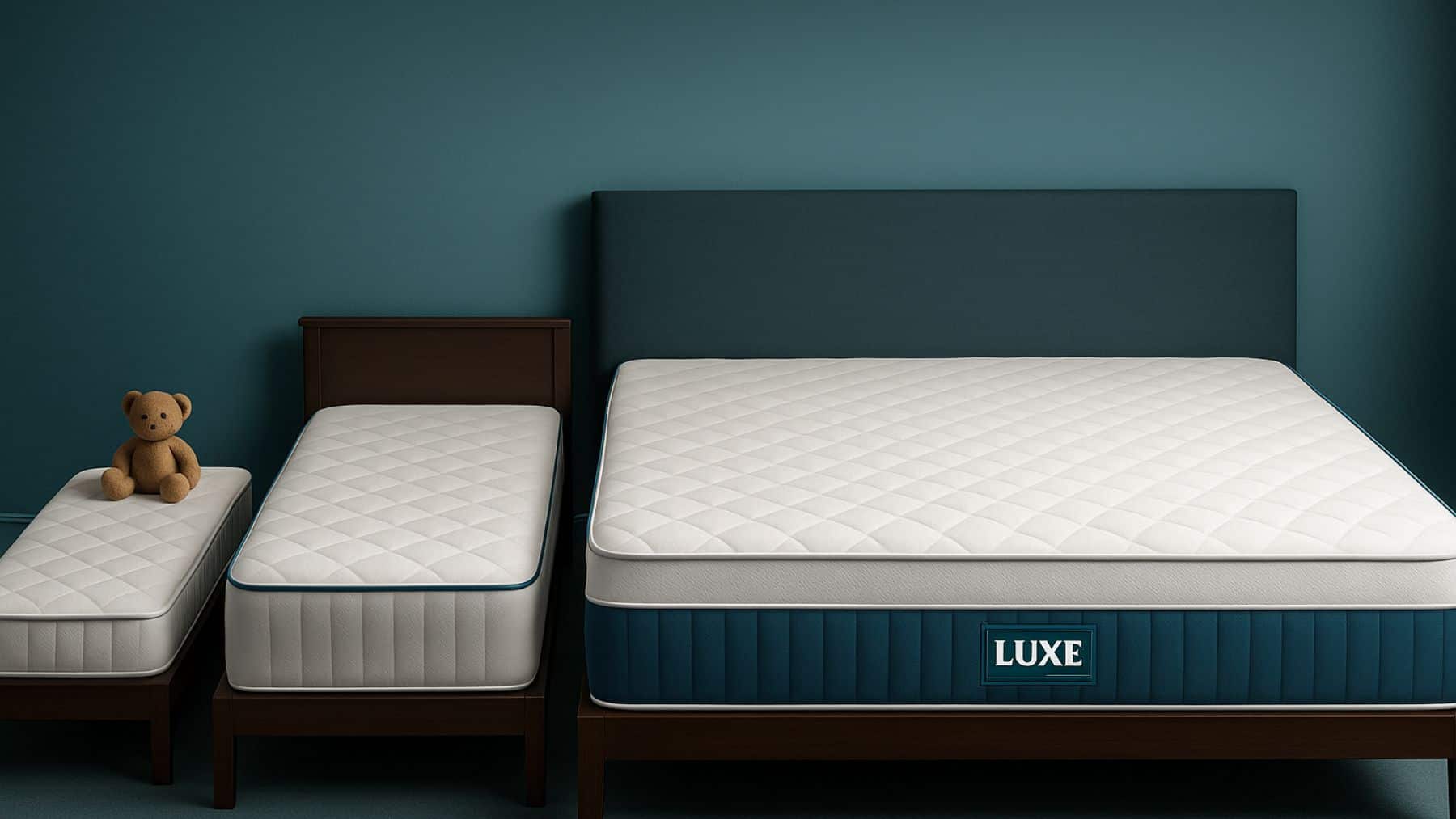
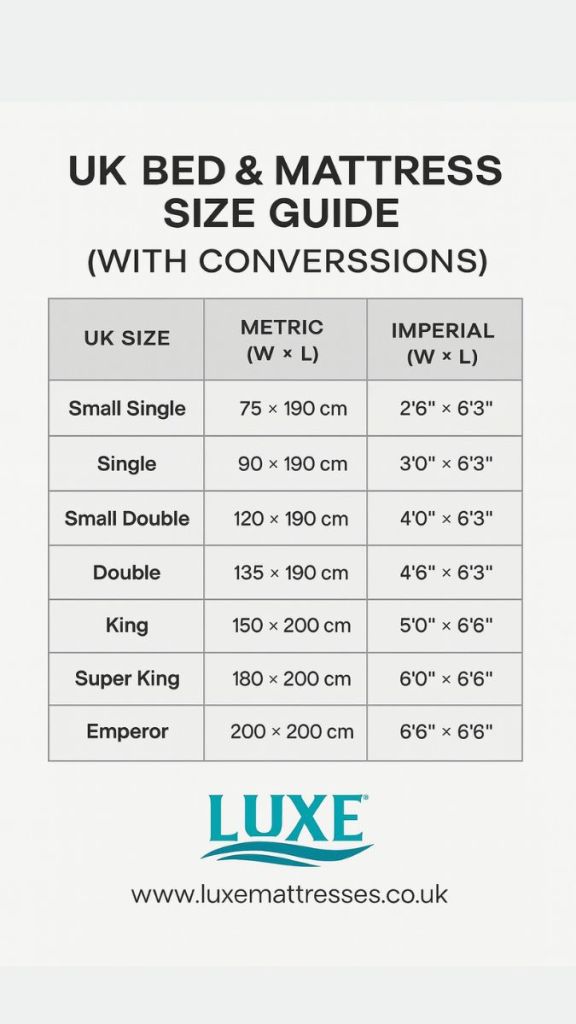
UK Mattress Size Guide
Before buying, it’s important to understand the standard mattress sizes available in the UK. This will give you a clear idea of what works best for your bedroom.
Small Single (75 x 190 cm): Ideal for young children or guest rooms with limited space.
Single (90 x 190 cm): A great choice for teenagers, students, or solo sleepers who don’t need much space.
Small Double (120 x 190 cm): Known as a “three-quarter†bed, this option works for smaller bedrooms and couples who don’t mind sleeping close.
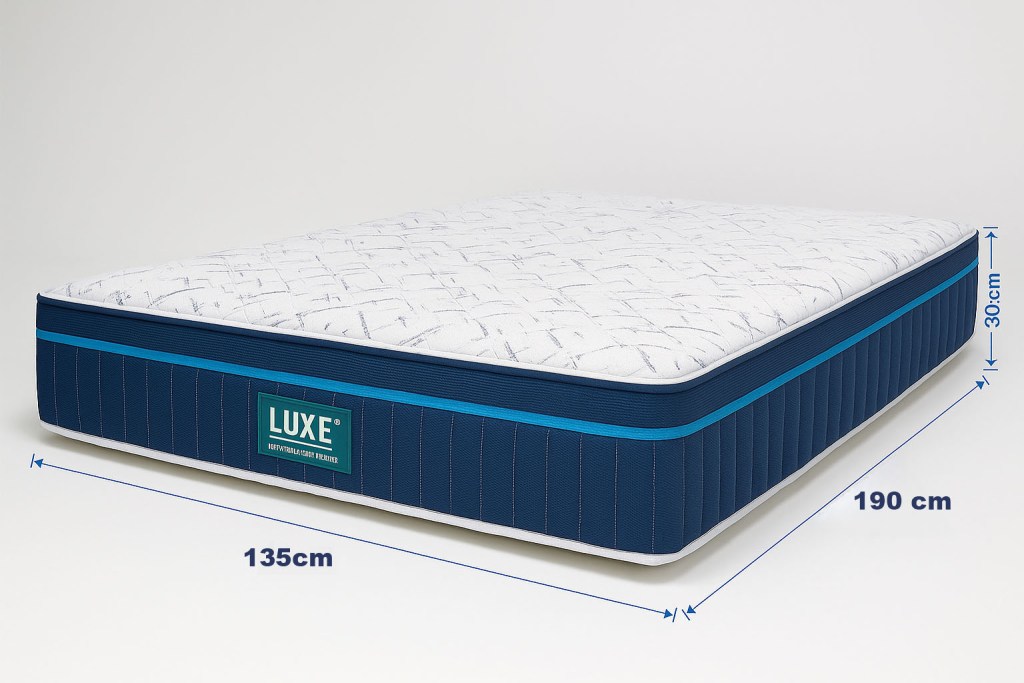
Double (135 x 190 cm): The most popular size in the UK, offering comfort for couples while fitting well in medium-sized rooms.
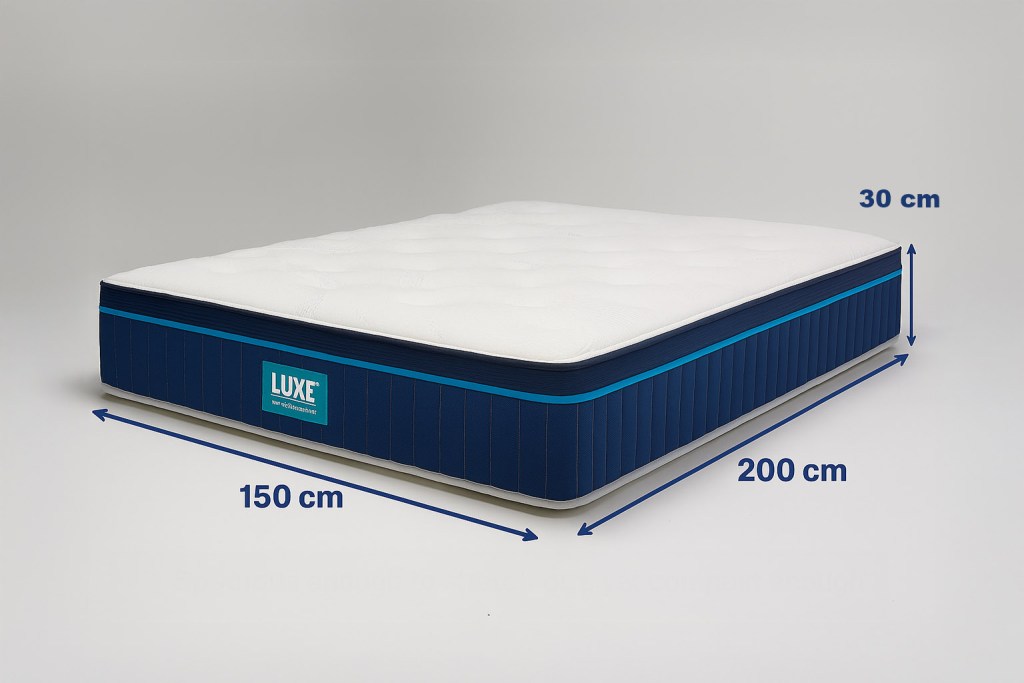
King (150 x 200 cm): Provides more sleeping space, making it perfect for couples who like extra room.
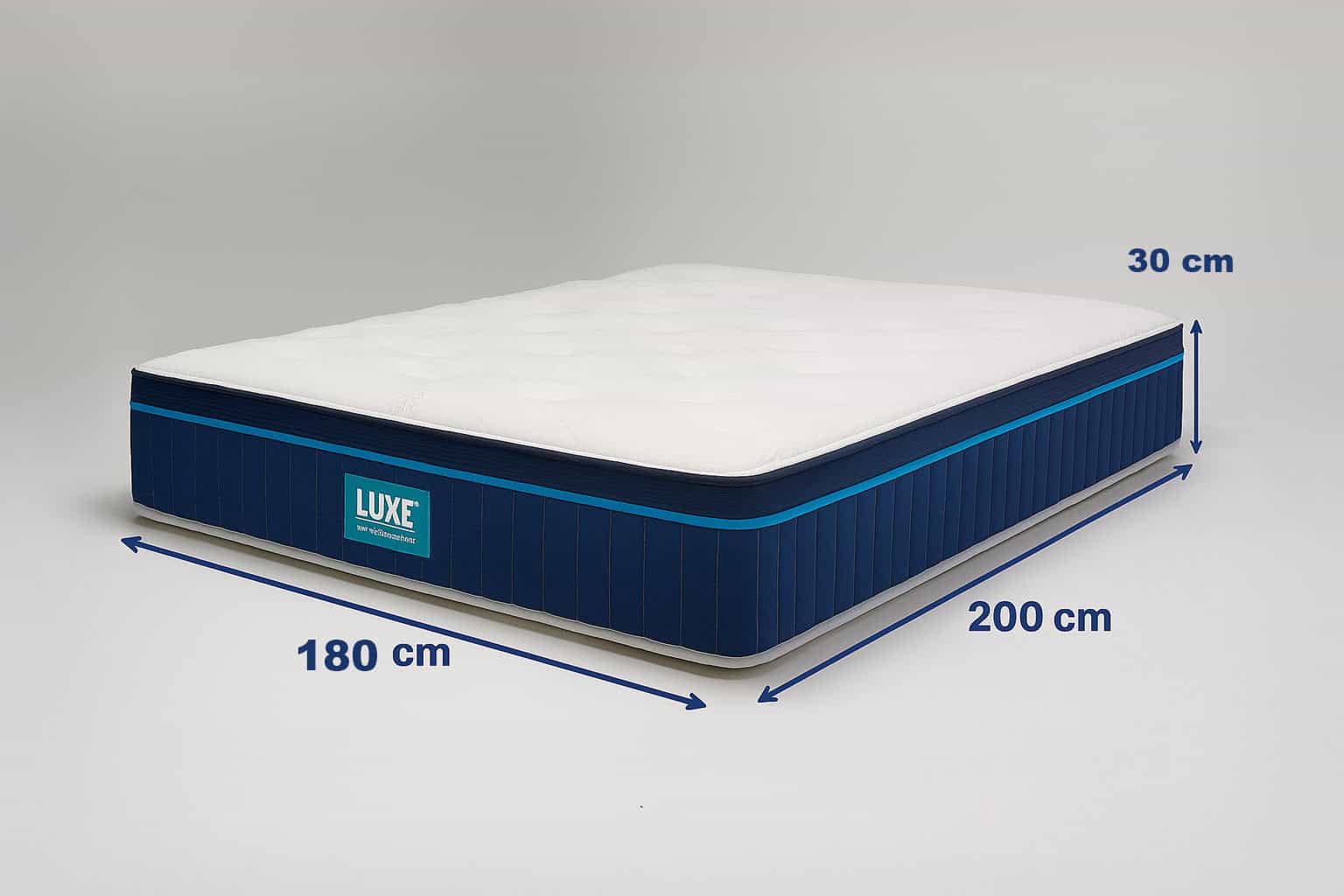
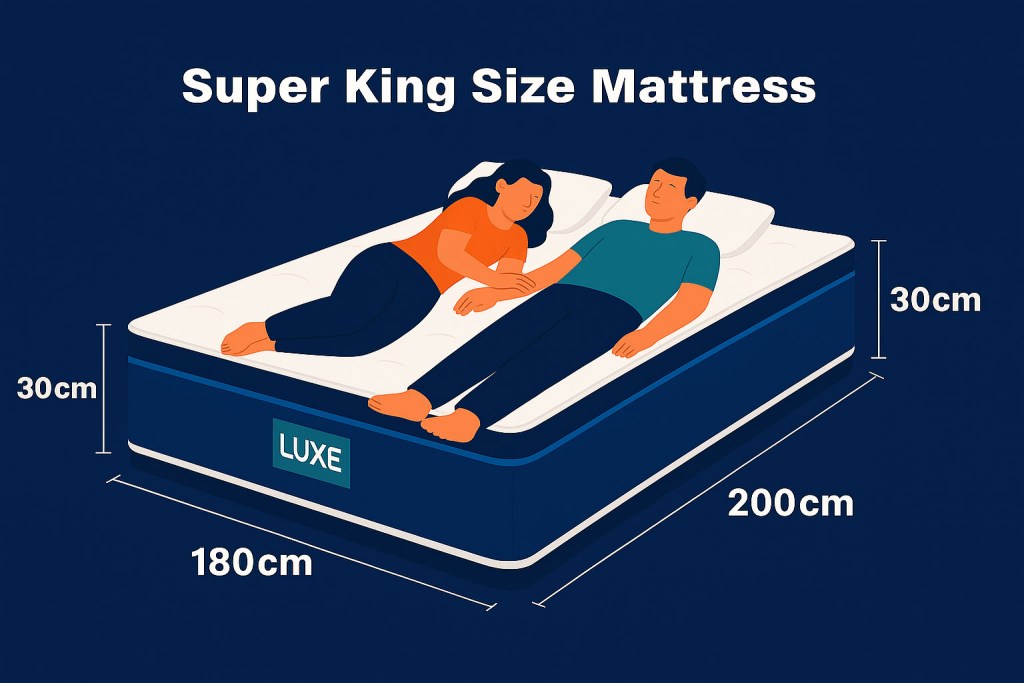
Super King (180 x 200 cm): The largest standard mattress in the UK, giving luxury space for couples and families who co-sleep.
UK Size
Dimensions (W × L)
Min Room Width*
Best For
Notes
Small Single
75 × 190 cm
≈ 2.0–2.2 m
Young children, narrow guest rooms
Space-saving
Single
90 × 190 cm
≈ 2.2–2.4 m
Teens, solo sleepers, box rooms
Good with storage bases
Small Double
120 × 190 cm
≈ 2.6–2.8 m
Solo sleepers who sprawl, cosy couples
“Three-quarterâ€
Double
135 × 190 cm
≈ 2.8–3.0 m
Most couples, standard UK bedrooms
Balanced footprint vs. space
King
150 × 200 cm
≈ 3.1–3.3 m
Taller sleepers, couples needing extra room
Longer length helps >180 cm height
Super King
180 × 200 cm
≈ 3.4–3.6 m
Max comfort for couples, co-sleeping families
Luxury space
*Min Room Width = mattress width + ~60–80 cm walkway clearance on each accessible side.
This mattress size chart shows that every option has its own purpose. The choice depends on your room layout, sleeping style, and comfort preferences.
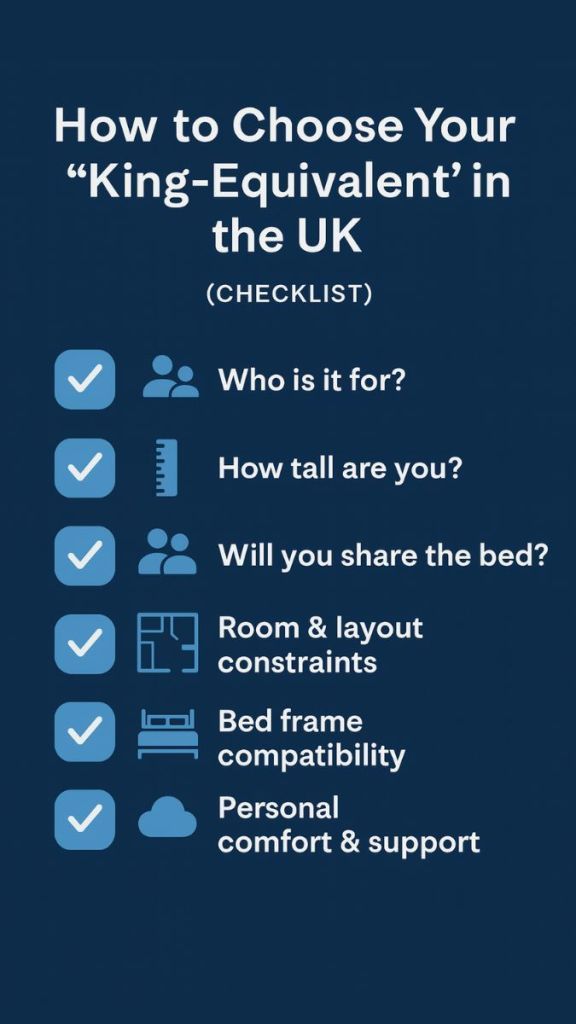
Consider the Size of Your Bedroom
When choosing a mattress, start by looking at your room size. A large bed in a small room can make it difficult to move around, while a small bed in a large room may look odd. For smaller bedrooms, single or small double sizes often work best. For master bedrooms, a king or super king adds a luxurious touch without compromising space. Always measure your room and leave enough walking space around your bed.
Think About Your Sleeping Style
Your personal sleeping style also influences the size you should choose. Solo sleepers can enjoy a single or double, but couples often prefer a king for extra space. If you tend to spread out while sleeping, a larger bed will give you comfort. Families with children who like to climb into bed may find a super king the most practical. This mattress size guide UK suggests matching bed size with lifestyle habits for the best results.
Sharing the Bed: Couples and Families
If you share your bed with a partner, mattress size becomes even more important. A small double may feel cramped, especially if one person moves a lot during the night. A double can work, but many couples find more comfort in a king. For families who co-sleep with children, a super king offers plenty of space. Choosing a comfortable mattress UK is not just about material; the size plays a huge role in how well you both sleep.
Matching Mattress Size with Bed Frames
Before purchasing, check that your chosen mattress size fits the bed frame you own or plan to buy. Some bed frames are slightly different in size, so always confirm the measurements. A mismatch can lead to gaps, discomfort, and wasted money. In the UK, most bed frames follow standard sizes, but custom designs may vary. Always double-check before ordering your mattress.
Storage and Furniture Placement
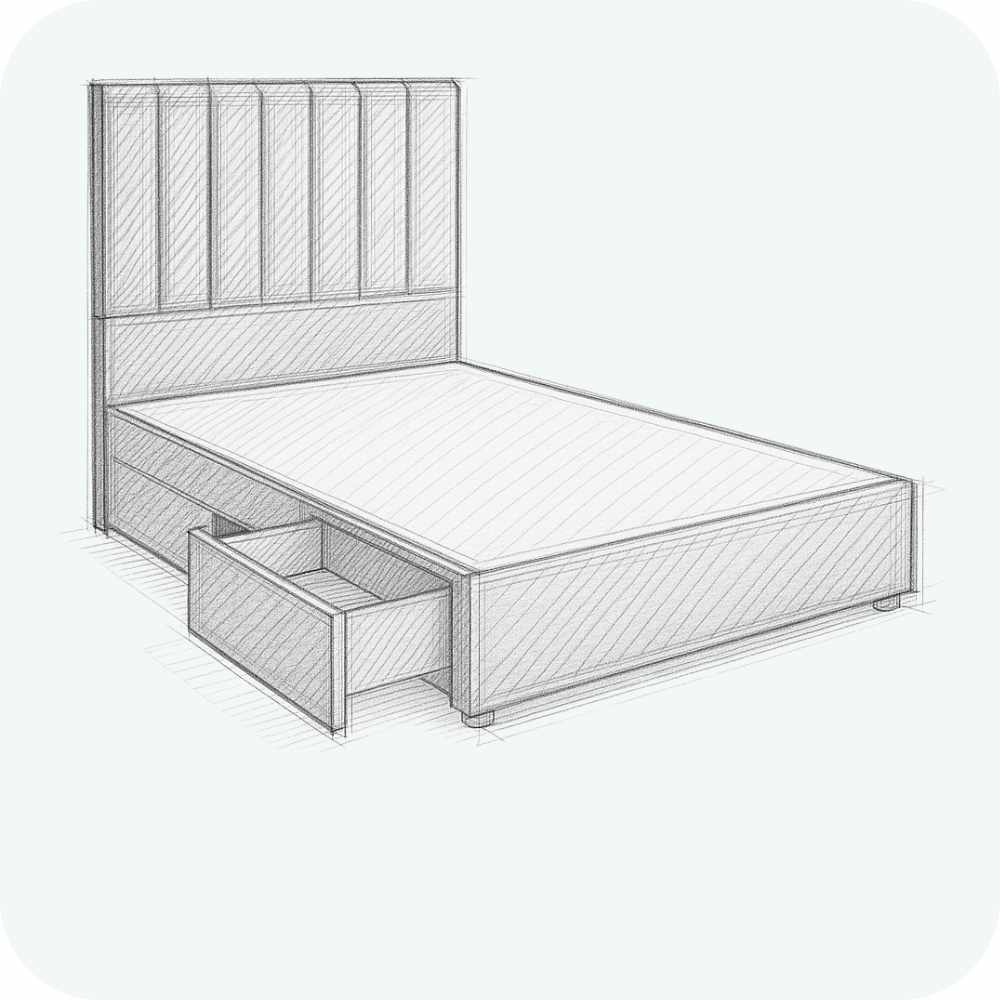
A mattress isn’t just about sleeping it affects how the entire room feels. If you choose a larger size, make sure it doesn’t block wardrobes, drawers, or walking paths. In smaller homes or apartments, storage beds with built-in drawers can help save space. A mattress that fits your lifestyle ensures comfort and convenience at the same time.
Choosing for Children and Teenagers
When buying for children, a small single or single mattress is usually enough. As they grow, you might consider upgrading to a small double or double for extra comfort. Teenagers, especially, may need larger beds as they develop. Using this mattress size guide UK, parents can plan ahead and avoid frequent replacements.
Luxury and Comfort in Bigger Sizes
If space is not a problem, choosing a king or super king adds a sense of luxury to your bedroom. These sizes provide unmatched comfort and are especially beneficial for taller people or couples who want extra room. A comfortable mattress in a larger size not only improves sleep but also enhances the overall look of your bedroom.
Practical Tips for Mattress Shopping
When shopping, always keep these practical points in mind:
Measure your bedroom and bed frame before buying.
Consider your sleeping style and the number of sleepers.
Think about storage and furniture placement.
Test the mattress in-store if possible for comfort.
Choose a size that suits your lifestyle, not just your budget.
This simple mattress size guide UK helps you avoid common mistakes and ensures your purchase matches your long-term needs.
Conclusion
Choosing the right mattress size is one of the most important decisions for your bedroom. A perfect mattress should match your comfort needs, room size, and lifestyle. Whether you need a small single for a child’s room, a double for convenience, or a super king for ultimate luxury, this mattress size guide UK helps you make the right choice. Pairing the right size with a comfortable mattress UK ensures restful sleep and a stylish, well-balanced bedroom.
Choosing the right bed size is crucial for comfort, space planning, and overall sleep quality. Understanding the super king size dimension can help in making your choice. The Super King bed is a popular choice in the UK for those who crave extra room and luxury sleep space. Whether you’re a couple needing more sleeping area or just want to elevate your bedroom with a larger, statement bed, this guide covers everything you need to know about Super King beds.
What Is a Super King Bed?
A Super King bed is one of the largest standard bed sizes available in the UK. It provides exceptional space for couples or individuals who prefer an expansive sleep surface.
Standard Super King Size Dimensions (UK):
Centimetres (cm):Â 180 cm wide x 200 cm long
Millimetres (mm):Â 1800 mm x 2000 mm
Inches (in):Â 71 in x 79 in
Feet (ft):Â 5.9 ft x 6.6 ft
Metres (m):Â 1.8 m x 2.0 m
These dimensions apply to both the mattress and the bed frame, though the overall footprint may be slightly larger depending on the design.
Who Should Buy a Super King Mattress or Bed?
A Super King bed is ideal for:
Couples who value extra space:Â If you or your partner move around a lot during sleep or prefer more personal space, a Super King prevents disruptions.
Tall individuals:Â At 200 cm in length, it provides plenty of legroom.
Families with young children:Â If your kids occasionally join you in bed, the additional width is a blessing.
Pet owners: Pets that sleep on your bed won’t cramp your space.
Luxury seekers:Â A Super King bed makes a visual statement and adds a touch of opulence to any bedroom.
Bedroom Size Recommendations
While a Super King bed offers more space, it does require adequate room to fit comfortably.
Minimum room size recommendations:
Ideal room size:Â 12 ft x 12 ft (3.65 m x 3.65 m) or larger
Absolute minimum:Â 11 ft x 11 ft (3.35 m x 3.35 m)
Allow at least 60 cm (2 ft) of clearance on each side of the bed for ease of movement.
Super King Bed Types & Styles
Super King beds come in various styles to suit your decor and storage needs:
1. Divan Base Beds
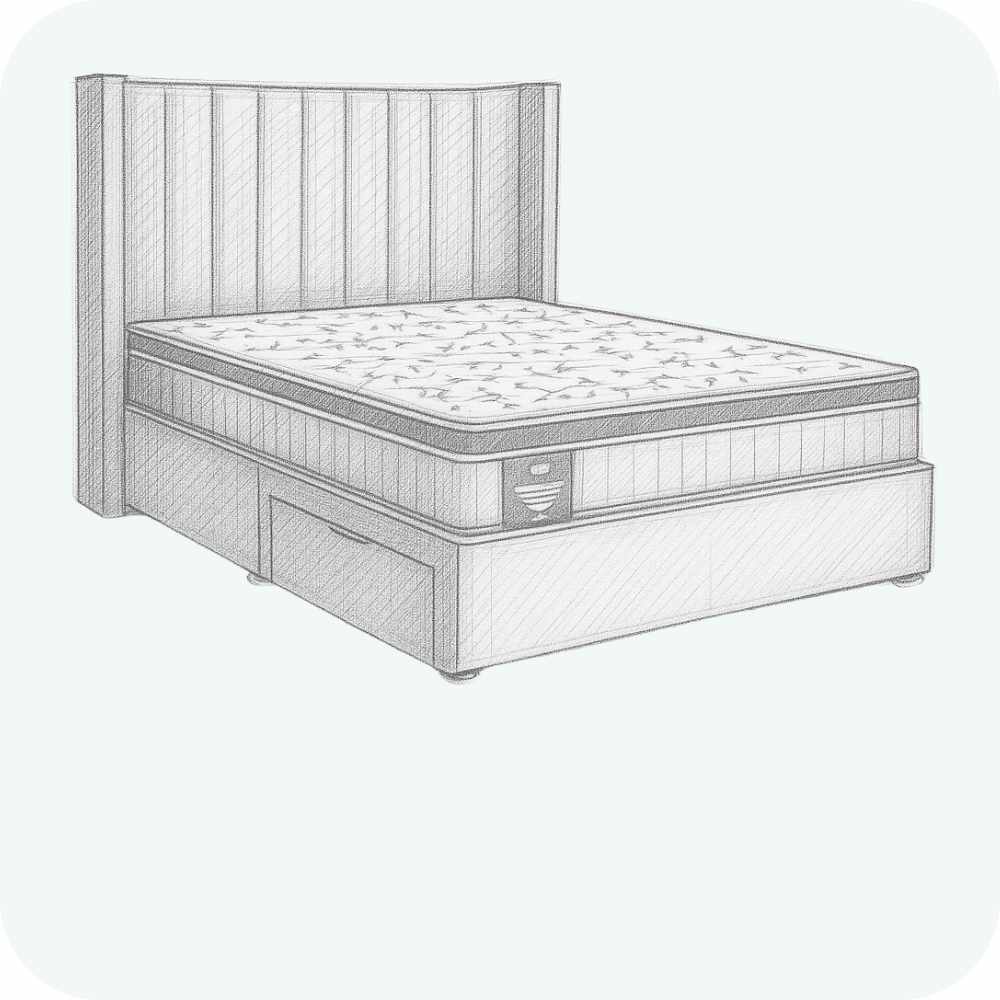
Often include built-in drawers
Great for small rooms needing extra storage
2. Ottoman Beds
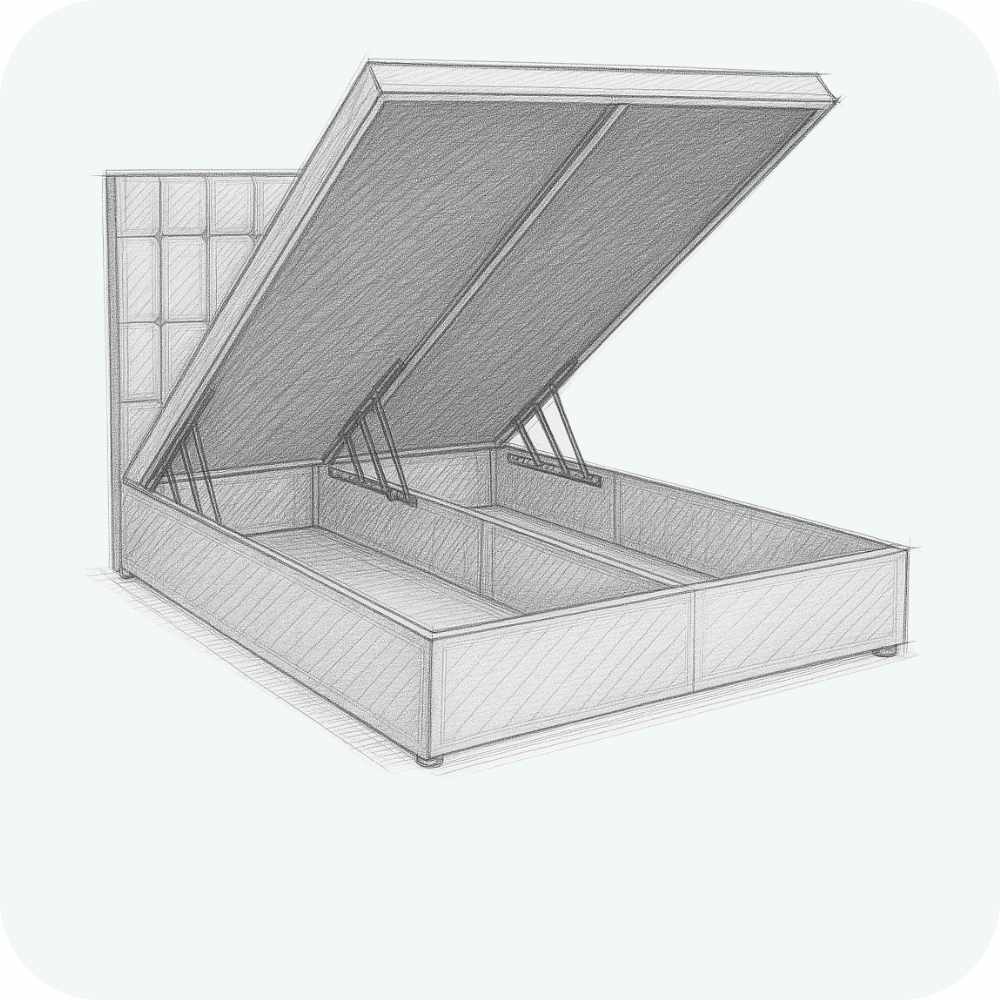
Lift-up storage under the entire mattress
Best for hidden, clutter-free storage
3. Bed Frames
Available in wood, metal, upholstered styles
Adds visual interest and can match other furniture
4. Adjustable Beds
Suitable for people with medical needs or elderly couples
Allows you to raise head/feet for better support
Best Mattress Types for Super King Beds
Choosing the right mattress is just as important as the size. Here are top options that pair well with Super King beds:
Often available in Super King for full-body alignment
Tip: Luxe Mattresses offers Super King sizes across hybrid, memory foam, and natural options. Their mattresses include breathable fabrics, edge support, and premium materials for deep sleep comfort.
Bedding Essentials for Super King Beds
Because of their size, Super King beds require appropriately sized bedding:
Duvet size:Â 260 cm x 220 cm (102 in x 87 in)
Fitted sheet size:Â 180 cm x 200 cm (plus depth of mattress)
Pillow types:Â Use 2 to 4 king-size pillows (50 x 90 cm)
Bedspread or blanket:Â Look for “Super King” label or oversized throws (at least 270 cm wide)
Using the correct bedding size enhances comfort and ensures a tidy, hotel-like appearance.
Styling Ideas for Super King Beds
A Super King bed is a statement piece. Here’s how to style it like a pro:
Headboard
Opt for a tall, upholstered or tufted headboard for drama
Colour Scheme
Use neutral tones or soft palettes to avoid overwhelming the room
Layering
Add throws, blankets, and multiple pillows to create a plush, inviting look
Side Tables
Choose wide or double-drawer nightstands to match the scale of the bed
Wall Art
Hang large artwork or a gallery above the bed for balance
How Big Is a Super King Mattress Compared to a King Mattress?
A Super King mattress is wider than a standard King mattress by 30 centimeters (about 12 inches), making it a more spacious and luxurious option. While both mattresses share the same length of 200 cm (6 feet 6 inches), the Super King measures 180 cm in width, compared to the King’s 150 cm.
This extra width provides significantly more room for couples, especially those who prefer not to feel crowded during sleep. It’s also ideal for families with young children or pets who occasionally share the bed. The Super King’s generous dimensions make it a standout choice for master bedrooms that can comfortably accommodate its larger footprint.
King vs Super King Mattress Size Comparison
Feature
King Mattress
Super King Mattress
Width (cm)
150 cm
180 cm
Length (cm)
200 cm
200 cm
Width (inches)
59 inches
71 inches
Length (inches)
79 inches
79 inches
Extra Width
—
+30 cm / +12 inches
Ideal For
Couples
Couples, families, pets
Room Size Needed
Minimum 10 x 10 ft
Minimum 11 x 11 ft
Super King Bed vs Other UK Bed Sizes
Bed Size
Dimensions (cm)
Ideal for
Single
90 x 190
Children, solo sleepers
Double
135 x 190
Couples (cozy fit)
King
150 x 200
Couples needing extra room
Super King
180 x 200
Couples, families, tall people
Is a Super King Bed Right for You?
Ask yourself:
Do I (or my partner) move around a lot while sleeping?
Do we value personal space in bed?
Is our bedroom large enough for this size?
Do we have kids or pets who often join us in bed?
If you answered yes to any of the above, a Super King bed might be your perfect match.
Final Thoughts
A Super King bed offers unmatched space, comfort, and visual impact in your bedroom. From its generous dimensions (180 x 200 cm) to its wide variety of frame and mattress options, it’s the top choice for anyone who values sleep quality and luxury living.
Whether you’re upgrading to accommodate your growing family or just want more room to stretch out, pairing a Super King bed with a premium mattress from Luxe Mattresses can transform your sleep and space.
Choose wisely, measure carefully, and enjoy the comfort that only a Super King can deliver.
When it comes to buying a new bed or mattress, knowing the exact dimensions is critical. In the UK, king size beds are one of the most popular choices due to the balance of space and comfort they offer. Whether you’re upgrading from a double or optimising a new bedroom layout, understanding king size bed dimensions in different units will help ensure a perfect fit for your lifestyle and your space.
Standard UK King Size Bed Dimensions
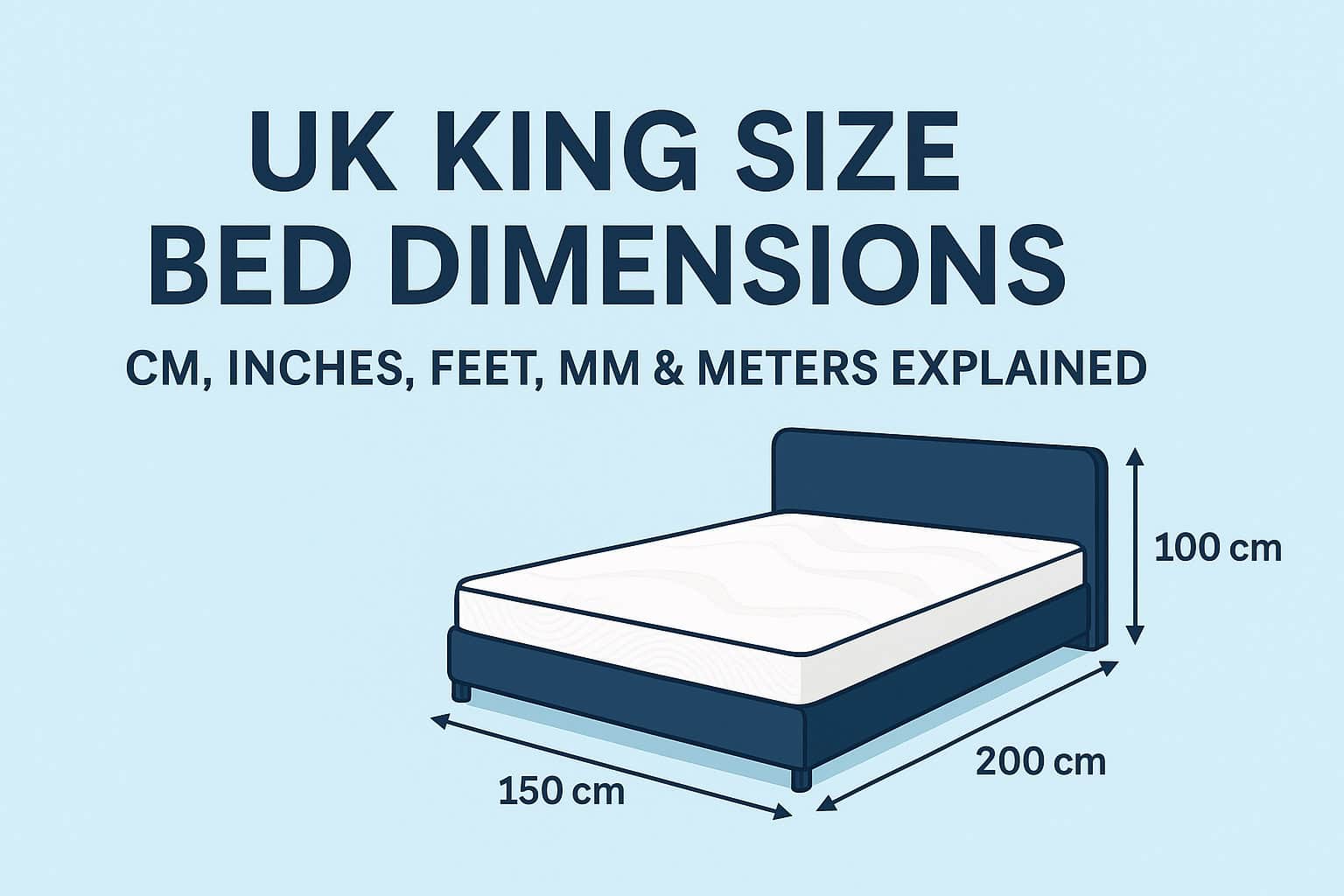
A standard UK king size mattress measures:
150 cm wide x 200 cm long
1.5 metres wide x 2.0 metres long
59.1 inches wide x 78.7 inches long
4.92 feet wide x 6.56 feet long
1500 mm wide x 2000 mm long
These measurements apply to the mattress only. Bed frames may be larger, depending on style, design, or headboard features. Some frames may add an additional 5–10 cm to each side.
UK Bed Size Comparison Chart
To understand how a king size bed compares with other popular UK bed sizes, here’s a full breakdown in multiple units:
Bed Size
Width (cm)
Length (cm)
Width (in)
Length (in)
Width (feet)
Length (feet)
Single
90
190
35.4
74.8
2.95
6.23
Double
135
190
53.1
74.8
4.43
6.23
King
150
200
59.1
78.7
4.92
6.56
Super King
180
200
70.9
78.7
5.91
6.56
This shows that a king bed is 15 cm wider than a double and 30 cm narrower than a super king. It’s also slightly longer than both single and double beds.
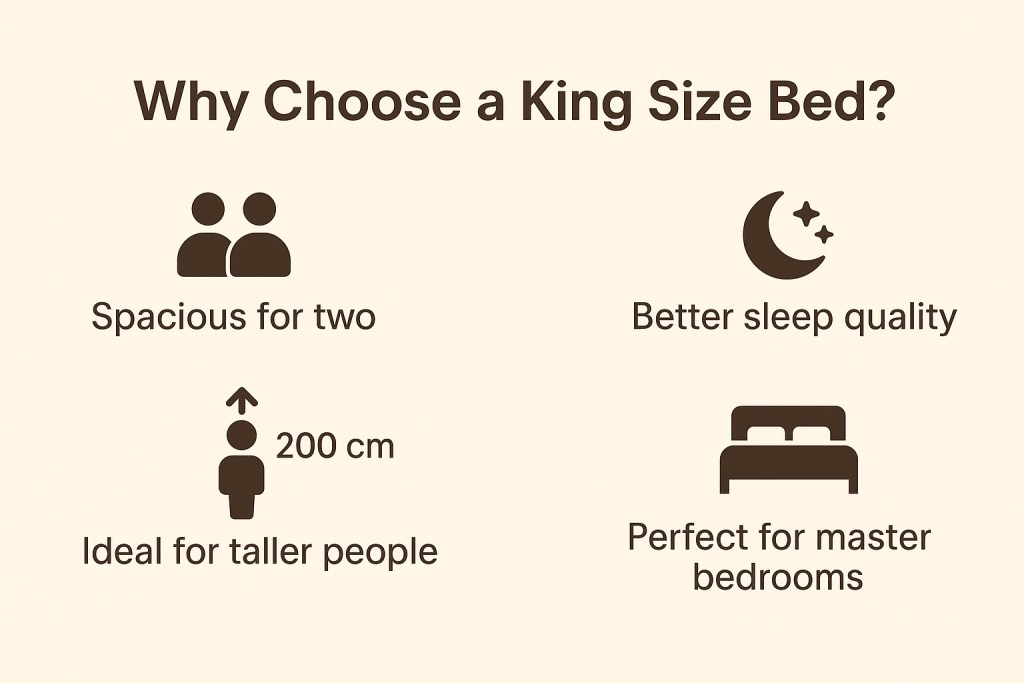
Why Choose a King Size Bed?
A UK king size bed strikes a sweet spot between comfort and space efficiency. Here are some key reasons people choose a king size:
Spacious for two: No more bumping elbows in the middle of the night.
Better sleep quality: More space means fewer disturbances from your partner.
Ideal for taller people: The 200 cm (6.56 ft) length gives ample legroom.
Perfect for master bedrooms: A king bed fits well in medium to large rooms without overwhelming the space.
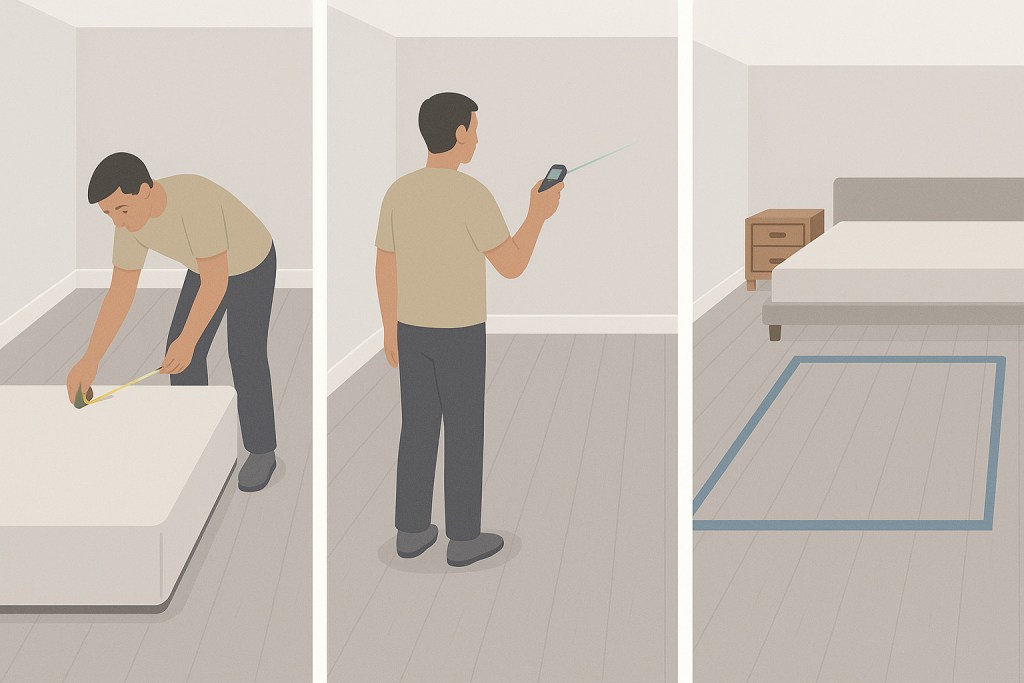
Tools You Need to Measure Your Space
Before buying a king bed, it’s crucial to assess your room size. Here’s what you’ll need:
Tape Measure (5 metres or longer) – Essential for length and width.
Laser Distance Measurer – For high accuracy in larger rooms.
Painter’s Tape or Chalk – To mark the outline of the bed on the floor.
Follow these steps to ensure your room can comfortably accommodate a king bed:
1. Measure the Mattress Area
Mattress dimensions:Â 150 cm x 200 cm
Add frame size: typical frame adds 5–10 cm on each side
Total footprint estimate:Â 160 cm x 210 cm
2. Measure Your Room Size
Ideal minimum room size:Â 3.2m x 3.2m
Allows for movement, bedside tables, and walking clearance
Larger rooms (4m x 4m or more) offer more comfort
3. Use Painter’s Tape or Chalk
Mark the exact footprint on your floor using tape
Include bed frame dimensions
Walk around it to test movement space
Visualising Bed Size vs. Room Size
Below is a simple guide to help you assess room fit:
Room Size (m)
Fit for King Bed?
Comments
3m x 3m
⌠Tight
Bed dominates room; minimal walk space
3.2m x 3.5m
✅ Good
Allows basic furniture + walk space
4m x 4m
â Ideal
Ample space for bed, wardrobes, seating
Tip: For tight spaces, consider a slim-frame or divan-style king bed with under-bed storage.
Tips Before Buying a King Size Bed
Measure stairways and hallways: Especially for king bed frames and headboards.
Modular frames or split bases: Easier to move into upper-floor bedrooms.
Storage options: Look for ottoman or drawer-based king beds for added functionality.
Slim-frame beds: Great for tight rooms while still fitting a full king mattress.
Trial period: Choose a mattress with a trial period if you’re unsure about comfort or fit.
Frequently Asked Questions
Is a UK King the Same as a US King?
No. A UK king is 150 x 200 cm, while a US king is 193 x 203 cm. So, the US king is wider but slightly shorter.
Can I Use European or American Bedding on a UK King?
European king bedding (160×200 cm) may fit but can feel tight. US king bedding will usually be too large.
Are King Mattresses Available in Split Versions?
Yes. Many retailers offer zip and link king mattresses, which are two singles joined together—ideal for tight stairwells.
Final Thoughts
The UK king size bed is a top-tier choice for couples, tall individuals, and anyone looking for luxurious sleep space. With its 150 x 200 cm dimensions, it provides ample width and length while still fitting into most modern bedrooms. Be sure to measure your room, doorways, and available clearance before buying, and don’t forget to factor in the bed frame size too.
A well-planned purchase ensures both comfort and style, giving you the sleep you deserve without crowding your space.
A good night’s sleep starts with choosing the right bed size. For many people in the UK, a double bed offers the perfect balance between space-saving and comfort. Whether you’re furnishing a guest room, outfitting a new home, or upgrading from a smaller size, understanding double bed size measurements is essential. This comprehensive guide will cover everything you need to know about double bed size measurements in inches, centimetres (cm), and feet, and how to choose the right bed for your space and sleeping needs.
What Are the Standard Double Bed Size Measurements in the UK?
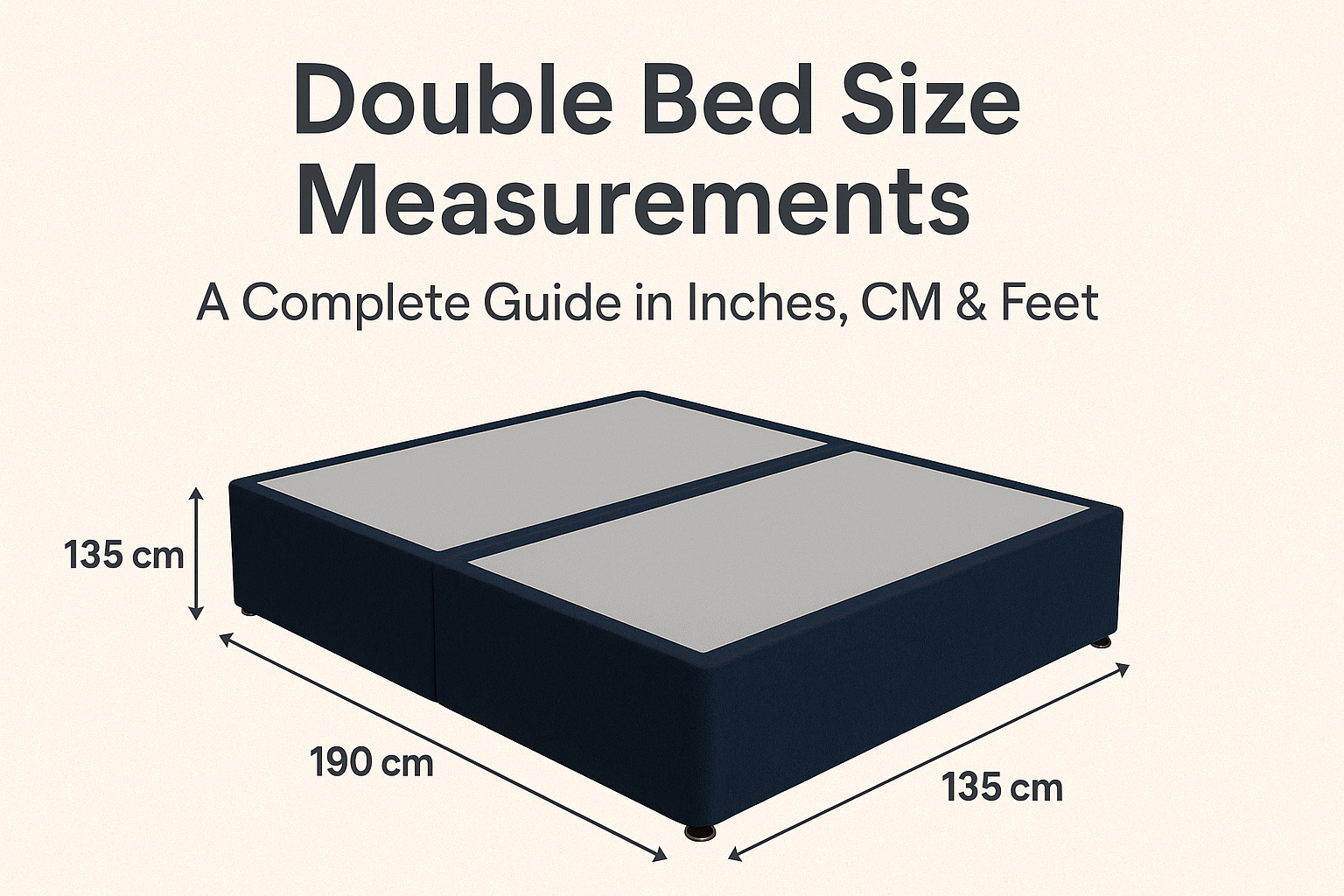
In the UK, the standard double bed size refers to the size of the mattress, not including the frame. The standard dimensions are:
135 cm x 190 cm
54 inches x 75 inches
4 feet 6 inches x 6 feet 3 inches
These dimensions apply to the mattress itself. However, the bed frame may be slightly larger, depending on its design and materials. Always measure the outer frame if you’re working with limited room space.
Double Bed Frame Dimensions
While the mattress size is standardized, bed frame sizes can vary. The outer dimensions of a double bed frame typically add 2 to 5 inches (5 to 12 cm) on each side to accommodate design features like padded edges, built-in storage, or headboards and footboards.
Example:
Mattress: 135 cm x 190 cm (4ft 6in x 6ft 3in)
Frame: Up to 145 cm x 200 cm (4ft 9in x 6ft 7in), depending on style
Tip: Always allow extra space for the frame if you are planning your room layout.
Room Size Requirements for a Double Bed
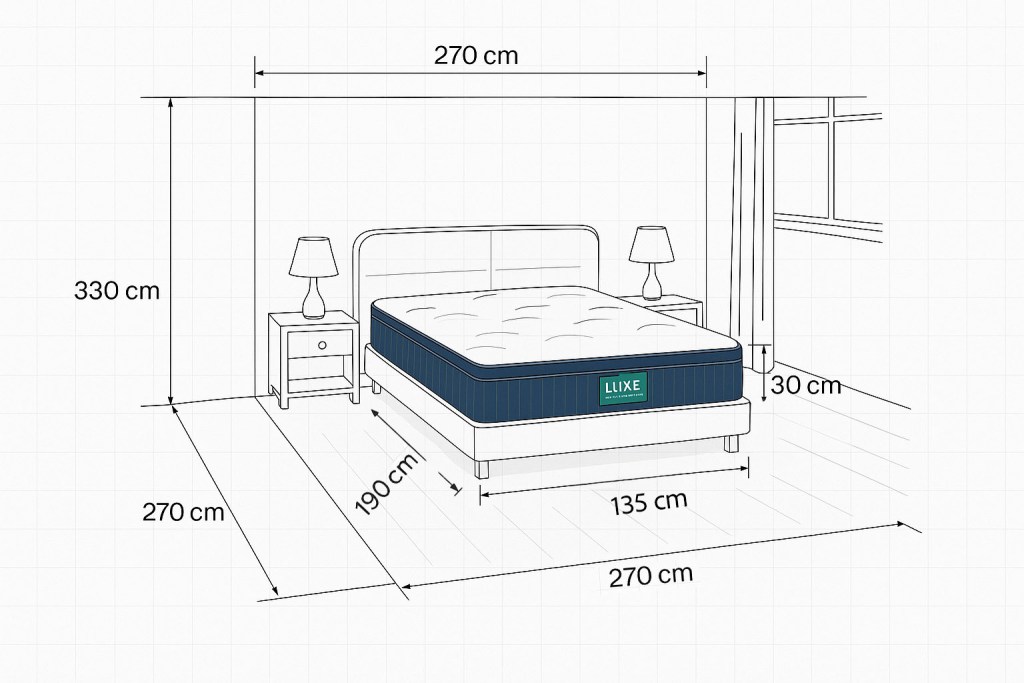
A standard double bed is suitable for most average-sized UK bedrooms. The recommended minimum room size for a double bed is:
2.4m x 3m (240 cm x 300 cm)
7.9ft x 9.8ft
This space allows for walking room around the bed and space for furniture like bedside tables or wardrobes.
If you’re tight on space, consider a storage bed or wall-mounted furniture to maximize functionality.
Double Bed Size Measurements in CM, Inches, and Feet (Quick Reference)
Unit
Width
Length
CM
135 cm
190 cm
Inches
54 inches
75 inches
Feet
4 ft 6 in
6 ft 3 in
This is the industry standard across most UK and European mattress manufacturers.
Who Should Choose a Double Bed?
A double bed is ideal for:
Single adults who want extra space
Teenagers or growing children
Couples with smaller bedrooms
Guest rooms where flexibility is needed
A double bed is roomier than a single (90 cm x 190 cm) or a small double (120 cm x 190 cm) but smaller than a king (150 cm x 200 cm) or super king (180 cm x 200 cm).
Small Double Bed (a.k.a. Queen or Three-Quarter Size):
120 cm x 190 cm (47 inches x 75 inches / 4ft x 6ft 3in)
Standard Double Bed:
135 cm x 190 cm (54 inches x 75 inches / 4ft 6in x 6ft 3in)
Key Difference: A double bed gives an additional 15 cm (6 inches) of width, which can make a big difference for two sleepers.
Mattress Depth and Considerations
Besides length and width, depth plays a role in comfort and fit with bed sheets and protectors.
Standard mattress depth: 20–30 cm (8–12 inches)
Extra-deep mattresses: up to 40 cm (16 inches)
Make sure your fitted sheets are designed to accommodate your chosen depth. For thicker mattresses, deep-pocket sheets are recommended.
Bedding and Accessories: What Fits a Double Bed?
When shopping for bedding, it’s important to match the size to your mattress:
Duvet size: 200 cm x 200 cm (79 inches x 79 inches)
Fitted sheet: 135 cm x 190 cm (with added depth for thick mattresses)
Flat sheet: 230 cm x 275 cm (90 inches x 108 inches)
Mattress protector: Match mattress dimensions and thickness
Always double-check the packaging, as UK, EU, and US sizes can differ slightly.
Tips for Choosing the Right Double Bed
Measure Your Room First Ensure there’s enough clearance for walking space, storage, and other furniture.
Consider the Bed Frame Size Don’t just measure the mattress space, account for decorative frames, footboards, or storage bases.
Think About Who Will Use It If two people will be using the bed regularly, consider whether a double provides enough width or if a king might be more comfortable.
Check Access Points Make sure the bed can fit through doorways and staircases when delivered!
Common FAQs about Double Bed Size Measurements
Q1. What are the exact double bed size measurements in inches?
54 inches wide by 75 inches long.
Q2. How many cm is a standard double bed in the UK?
135 cm wide by 190 cm long.
Q3. Can two adults sleep on a double bed comfortably?
Yes, although it may feel tight for larger individuals or those who move frequently in their sleep.
Q4. Will a double bed fit in a small bedroom?
Yes, but ensure the room is at least 2.4m x 3m to allow for movement and furniture.
Q5. What’s the difference between a double and a king bed?
A king bed is 15 cm wider and 10 cm longer (150 cm x 200 cm).
Q6. Is a double bed the same size in the US?
No. The US “Full” bed is similar but slightly shorter.
Q7. What size duvet should I buy for a double bed?
A 200 cm x 200 cm duvet offers full coverage.
Q8. Are all double beds 135 x 190 cm?
Most are, but always check the specifications as custom beds may vary.
Q9. What mattress depth works best for a double bed?
20–30 cm is standard; thicker mattresses need deep-pocket sheets.
Q10. Can a small double sheet fit a standard double bed?
No. It will be too tight. Always match your bedding to mattress size.
Conclusion
Choosing the right bed starts with understanding double bed size measurements in cm, inches, and feet. A double bed (135 cm x 190 cm) offers an excellent mix of comfort and space efficiency for solo sleepers, couples, and guest rooms. Be sure to consider your room dimensions, usage needs, and mattress depth when selecting both your bed and accessories. With the correct measurements in mind, your new double bed can transform your sleep and space effortlessly.
Why “Bigger King†Is the Buzzword in Modern Bedrooms
If you’ve ever found yourself clinging to the edge of your bed while your partner snores peacefully with limbs spread out, you’re not alone. For couples, bed real estate is a nightly battle. This discomfort is sparking a growing trend: investing in a “bigger king mattress.†But this isn’t just about extravagance. It’s about comfort, better sleep, and what many are calling “sleep independence.â€
In a time when people are rethinking their sleep environments, this trend goes beyond size. It touches on personal wellness, relationship dynamics, and even lifestyle. So what exactly is a bigger king mattress, and why is it earning such a loyal following?
What Is a Bigger King Mattress, Really?
The term “bigger king mattress†often refers to mattress sizes that go beyond the standard king, and often considered as Super king size mattress, Depending on where you live, this can mean different things:
In everyday slang, “bigger king†can mean any of these or even a custom-sized bed. What unites them is one thing: extra space.
Bigger King Mattress Uk
With Luxe Mattresses, customers can even customise dimensions to suit their specific room or body needs, length, width, firmness, and more. It’s this level of personalisation that is turning a bigger king mattress from a niche product into a mainstream must-have.
The Rise of the Bigger King: Where and Why It’s Trending
While the U.S. has long embraced oversized furniture and bedding, the UK is catching on fast. Driven by trends like co-sleeping with children or pets, hybrid home living (where beds become offices), and simply a desire for better rest, the bigger king is being welcomed with open arms.
Luxe Mattresses, a UK-based custom mattress manufacturer, has noted a surge in orders for larger sizes. The demand isn’t limited to luxury homes either. Even flat owners and small-space dwellers are rearranging rooms to accommodate bigger beds. Why? Because a better night’s sleep is worth the space.
What Room Size Do You Need for a Bigger King Mattress?
When planning to upgrade to a bigger king mattress, one of the most important considerations is whether your bedroom can comfortably accommodate it. While mattresses like the Super King or Alaskan King offer unmatched space, they do require proper planning.
As a general guide:
Super King (180 x 200 cm): Minimum room size should be around 3.5m x 3.5m to allow for walking space and furniture.
California King (183 x 213 cm): Ideal in rooms larger than 3.6m x 3.6m.
Alaskan King (274 x 274 cm): Works best in master suites or large open-plan rooms with at least 4.5m x 4.5mavailable.
Make sure to leave about 60–90 cm clearance on each side of the bed for ease of movement and access to nightstands. If your room is tight, consider wall-mounted or floating furniture to save space. Luxe Mattresses also provides guidance on custom-fitting larger beds into smaller UK rooms with smart layout strategies.
The Science of Space: How More Surface Area Supports Better Sleep
According to the Sleep Foundation, the average person changes position 12-20 times a night. When sharing a smaller bed, these movements often lead to accidental elbow jabs, blanket wars, and fragmented sleep.
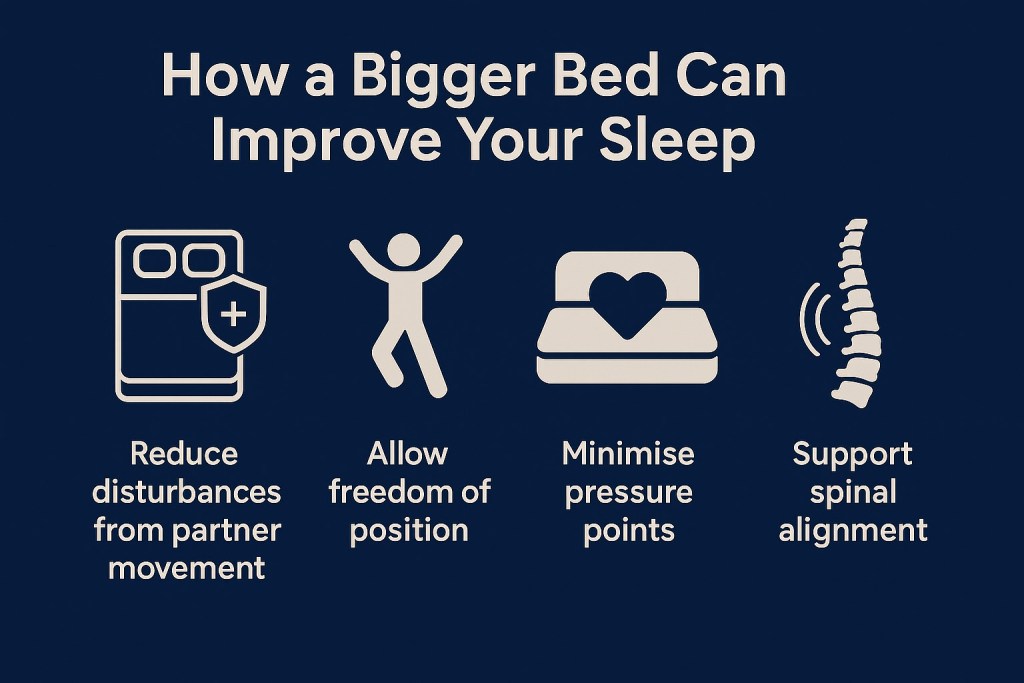
Here’s what a bigger surface area can do:
Reduce disturbances from partner movement
Allow freedom of position, from starfish to side-sleeper
Minimise pressure points, especially for people with chronic pain
Support spinal alignment across a wider range of sleeping postures
Add to this the psychological benefit of personal space, and the bigger king starts looking like a necessity rather than a splurge.
Motion Isolation: The Secret Weapon of a Bigger Mattress
Let’s face it, we’re all a bit sleep-fragile during the night. Especially pregnant women, light sleepers, or anyone suffering from anxiety or insomnia.
motion isolation in mattress
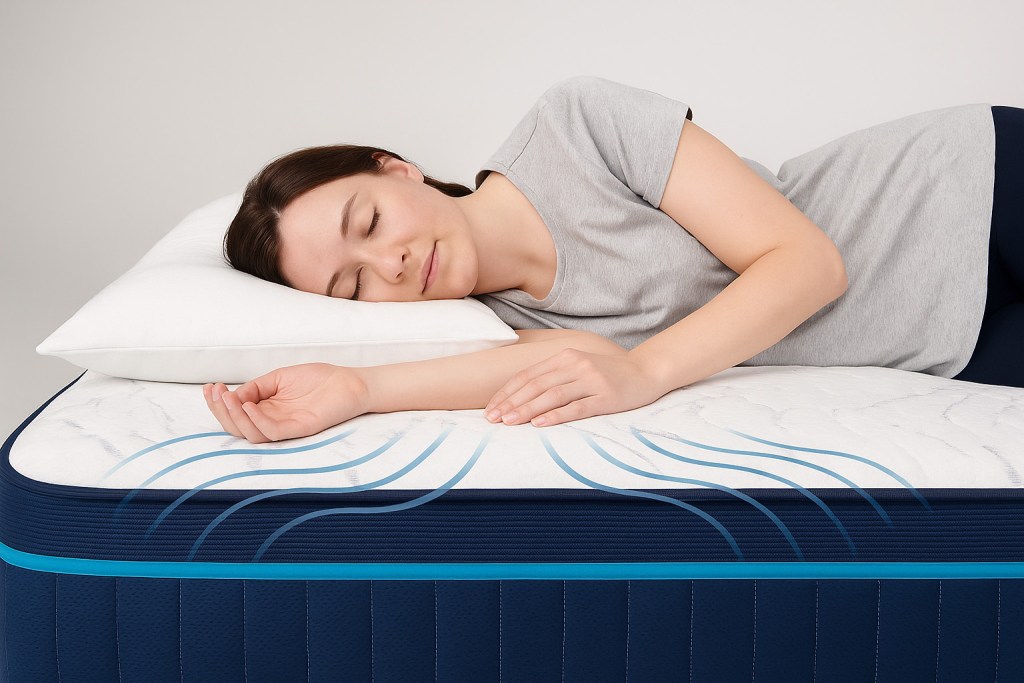
Motion isolation refers to how well a mattress absorbs movement so that it doesn’t ripple across the surface. A bigger mattress paired with quality materials (like those found in Luxe’s hybrid or memory foam models) drastically reduces motion transfer.
Your partner can toss and turn without waking you up.
Kids or pets jumping in won’t shock your sleep cycle.
You stay deeper in REM sleep, improving cognitive and physical recovery.
This feature is particularly useful if you’re a light sleeper or dealing with chronic fatigue or hormonal imbalances.
Luxury vs Necessity: Is the Bigger King Just a Fancy Upgrade?
Some may call a bigger king mattress a “nice to have.†But let’s compare it to investing in good shoes or ergonomic office chairs. You spend a third of your life in bed, comfort and support should be non-negotiable.
Couples in particular benefit from space. As relationship therapists point out, personal sleep comfort can actually improvea couple’s intimacy and communication. If one partner is uncomfortable, neither of you sleeps well. That has a knock-on effect on your mood, productivity, and even immune function.
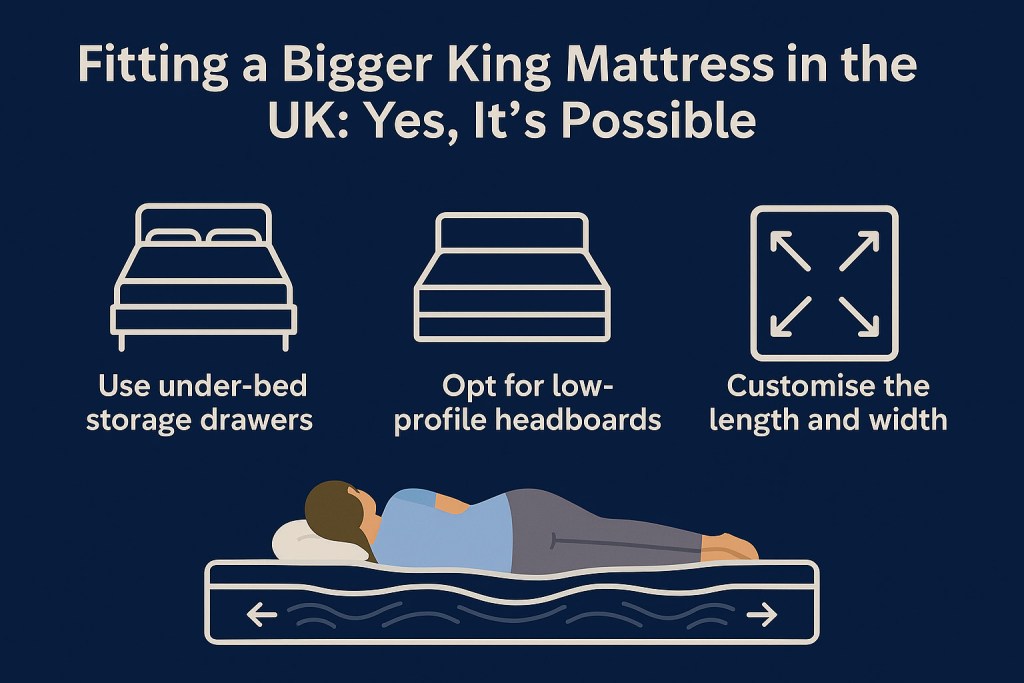
Fitting a Bigger King Mattress in the UK: Yes, It’s Possible
The common concern in the UK is space. British homes and bedrooms are typically smaller than their American counterparts. But thanks to customisation options from companies like Luxe, even modest rooms can be upgraded smartly.
Here’s how:
Use under-bed storage drawers to replace bulky wardrobes
Opt for low-profile headboards or floating nightstands
Choose a split or modular mattress for easier delivery and flexibility
Customise the length and width to fit your unique layout
Real-Life Story: “We Finally Stopped Fighting Over Spaceâ€
Amy and James, a couple from Leeds, upgraded from a double to a custom super king Luxe mattress last year.
“We were sceptical at first, our bedroom isn’t huge. But we called Luxe, explained our needs, and they helped us customise the dimensions to fit our space. The difference was immediate. No more kicking each other at night, no more sleep arguments.â€
Their Luxe mattress even came with dual firmness soft on Amy’s side, firmer on James’.
“It’s honestly the best thing we’ve bought for our relationship,†she added.
Who Should Consider Buying a Bigger King in the UK?
While not everyone has the square footage of a country estate, a bigger king mattress isn’t reserved for the ultra-wealthy or those with enormous bedrooms. It’s actually a smart, practical upgrade for a wide range of people. Couples who value personal space, restless sleepers, families with young children who occasionally share the bed, and even pet owners can all benefit.
If you or your partner struggle with disrupted sleep due to tossing, turning, or simply feeling cramped, this extra surface area could be a game changer. Even in smaller UK bedrooms, opting for a bespoke or modular version of a bigger king allows you to enjoy the added comfort without sacrificing layout or flow.
What to Look for in a Bigger King Mattress
Before you go all in, make sure you’re choosing the right features:
Material quality: Look for high-density memory foam or hybrid coils
Firmness options: Consider dual firmness zones for couples
Cooling layers: Bigger beds trap more heat; breathable fabrics and gel-infused foam help
Edge support: Prevents the mattress from sinking at the sides
Motion isolation: Essential if one or both of you moves a lot
And of course, check delivery logistics will it fit through your stairs or hallway? Luxe Mattresses offers home consultations and delivery guidance to help with this.
Final Thoughts: Is Sleep Independence the New Couple’s Goal?
We all love the idea of closeness, but modern couples are learning that closeness in a relationship doesn’t require physical crowding in bed.
A bigger king mattress is not just a product, it’s a personal investment in your health, relationship, and mental wellbeing. From better sleep posture and motion isolation to custom firmness and cooling comfort, it provides a true upgrade to how we rest, recover, and reconnect.
And if you’re still clinging to the edge of a double bed wondering why you’re always exhausted, maybe it’s time to stretch out – literally.
Need help choosing the right dimensions or firmness level? Visit LuxeMattresses.co.uk or take their custom mattress quiz to find your perfect fit.
Find Your Perfect Mattress Firmness
Discover the ideal mattress firmness for your sleep position, body type, and support needs — backed by sleep science.
Let’s be honest: few things say “comfort†quite like a king size mattress. Whether you’re stretching out solo or sharing with a partner (or a toddler who insists on sneaking in), that generous space can be a game changer for sleep quality. But choosing the right one? That’s a little more complicated, especially in the UK, where sizes, frames, and firmness preferences can vary widely.
This guide walks you through everything you need to know before buying a king size mattress in the UK, including how it differs from a European king, what firmness zones matter, and how to make sure it fits your bed frame and your life.
What Is a King Size Mattress in the UK?
In the UK, a standard king size mattress measures 150cm wide by 200cm long, that’s about 5 feet wide and 6 feet 6 inches long. It offers 15cm more width than a double mattress, which doesn’t sound like a lot until you realise how much that extra space helps you sleep without accidentally elbowing your partner in the ribs.
It’s a fantastic choice for:
Couples who like a bit of personal space
Taller individuals who need extra legroom
People who toss and turn or sleep in odd positions
Parents whose kids sometimes join them in the middle of the night
But here’s where it gets interesting, not all kings are created equal to understand how to choose king size mattress read our guide.
UK King vs European King vs Super King: What’s the Difference?
Mattress shopping can quickly get confusing when you realise that a “king†in one country isn’t always the same in another. Even within the UK, retailers might offer different “king†sizes, so let’s break it down clearly:
Mattress Type
Dimensions (cm)
Best For
UK King
150 x 200
Most UK bed frames and bedrooms
EU (Euro) King
160 x 200
IKEA beds or European-manufactured frames
UK Super King
180 x 200
Maximum space, larger bedrooms
Key tip: If you’re buying a mattress for an IKEA bed, chances are you need a European king, not a UK one. That extra 10cm in width makes a big difference in fit and comfort.
What Does “Bigger King†Really Mean?
When people talk about upgrading to a “bigger king,†they’re usually referring to either a European king (for more width) or a super king (for maximum spread). But keep in mind:
Bigger mattress = heavier – Latex and memory foam models can be particularly dense.
Bigger mattress = bigger frame needed – Not all king-size mattresses are interchangeable with your existing base.
Bigger mattress = more bedding required – Your old sheets might not fit, especially if you’re moving up from a double or standard king.
So, bigger can be better, but only if your space, budget, and lifestyle can accommodate it.
Firmness: What Works Best in a King Size?
This is where things get personal, literally. When you’re buying a king size mattress in uk, especially for two people, firmness becomes a shared decision. And we all know how tricky that can be.
Here’s what to consider:
1. Zoned Support
Look for mattresses with zoned firmness, where different areas of the mattress are tailored to support your body more effectively, for example, firmer around the hips and lower back, softer under the shoulders. This is especially helpful for couples with different body types.
2. Split Firmness (for Couples)
Some high-end models offer dual firmness options, one side firmer, one side softer. This is great if you love support and your partner prefers something plush. While not as common in the UK as in the US, some brands like TEMPUR and Emma are starting to offer them.
3. General Guide
Soft to Medium:Â Best for side sleepers and lighter individuals
Medium Firm:Â Ideal for combination sleepers and most couples
Firm to Extra Firm:Â Great for back sleepers, heavier individuals, or those with back pain
If you’re not sure what level suits you best, take advantage of free trial periods, most good UK mattress brands now offer 100-night trials or longer.
Understanding King Size Mattress Firmness Levels
When choosing a king size mattress, getting the size right is only half the equation — the firmness level plays an equally important role in ensuring comfort and support. With a larger sleep surface, firmness becomes especially noticeable, particularly for couples who may have different preferences.
Firm King Size Mattress
A firm king size mattress provides solid, even support with very little sink. It’s ideal for back sleepers, heavier individuals, or those who suffer from lower back pain and need a stable surface to maintain spinal alignment. It prevents the hips from sinking too far, which is crucial for proper posture overnight.
Medium Firm King Size Mattress
If you’re after a balanced feel, a medium firm king size mattress is the most popular choice in the UK. It offers a great middle ground, supportive enough to keep your spine aligned, yet cushioned enough for side sleepers or combination sleepers. It’s also the go-to firmness for most couples since it tends to suit a wide range of body types.
Firmness Level
Feel
Recommended For
Firm King Size Mattress
Very supportive, minimal sink
Back sleepers, heavier individuals, people with lower back pain
Medium Firm King Size Mattress
Balanced support and comfort
Most couples, side or combination sleepers
Extra Medium (Medium Soft) King Size Mattress
Softer surface with slight sink
Lightweight sleepers, people with joint pain
Soft King Size Mattress
Deep contouring, plush feel
Strict side sleepers, those with hip or shoulder sensitivity
Extra Soft King Size Mattress
Maximum sink, very plush
Luxury comfort seekers, not ideal for back pain sufferers
Extra Medium King Size Mattress
Slightly softer, the extra medium or medium-soft king size mattress gives a more plush feel without going fully soft. This type often appeals to lightweight sleepers, those with joint pain, or anyone who enjoys a gently cradling sleep surface without losing support completely.
Soft King Size Mattress
Then we have the soft king size mattress, which contours deeply around your body. It’s best suited for strict side sleepers or individuals with shoulder or hip sensitivity, where pressure relief is key. That said, soft mattresses can sometimes lack support for heavier sleepers or back sleepers.
enhanced spine alignment
Extra Soft king Size Mattress
Lastly, an extra soft king size mattress offers the deepest sink and plushest feel, think luxury hotel bed. While it’s incredibly cozy, it may not be ideal for everyone. Those with back issues or who need firmer support should approach extra soft models with caution, as they can lead to poor spinal alignment over time.
In a king size, all these firmness levels are amplified due to the mattress’s surface area. This makes firmness zoning and motion isolation especially important for couples. Many modern king size models come with zoned support systems or dual firmness options, helping partners enjoy the feel they prefer without compromise.
Bed Frame Compatibility: Measure Before You Buy
It’s surprisingly easy to forget about your bed frame when you’re focused on finding the perfect mattress. But getting this wrong means dealing with awkward overhangs, gaps, or worse, a mattress that simply doesn’t fit.
If you have a UK bed frame, make sure the mattress is exactly 150 x 200cm.
For IKEA or European frames, check if they need a 160 x 200cm mattress instead.
Ottoman or storage beds? Check for hinge clearance, thicker mattresses (especially hybrid ones) can interfere with opening.
Pro tip: If you’re upgrading from a smaller size (like a double), double-check that your bedroom can comfortably accommodate a king. You’ll want at least 60cm clearance on either side of the bed to walk around it, please check here our room measurement guide for king size mattress.
Which Material Is Best for a King Size Mattress?
The bigger the mattress, the more you’ll feel the materials inside it, especially when two people are sleeping on it. Unlike smaller sizes where firmness and surface feel might be more uniform, king size mattresses often highlight the strengths and weaknesses of each material.
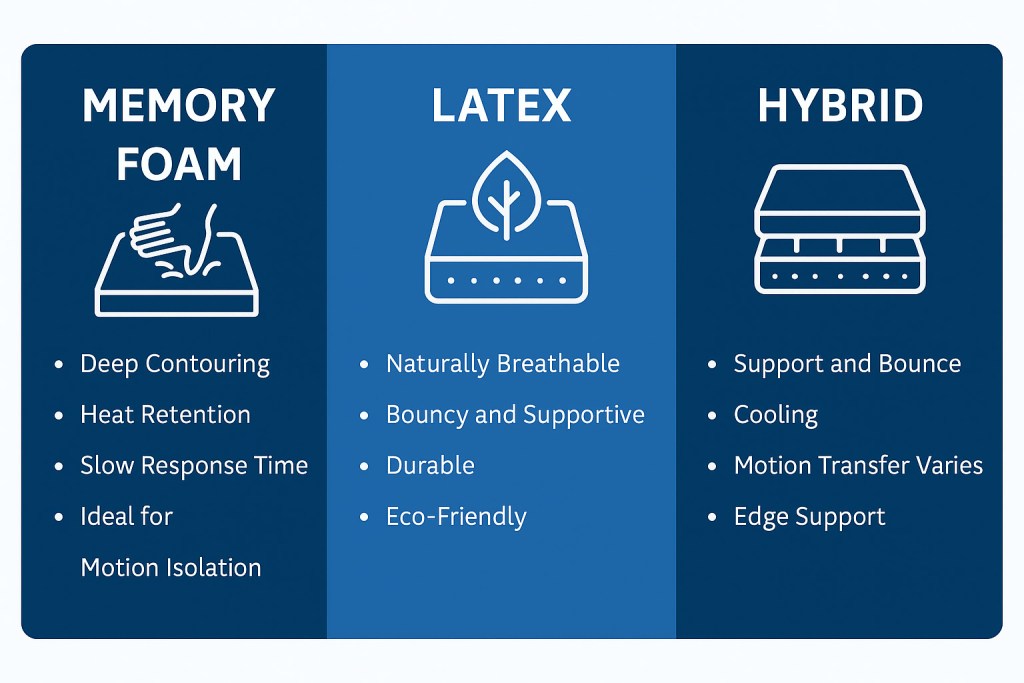
Material Type
Key Features
Best For
Memory Foam
– Deep contouring and pressure relief
– Excellent motion isolation
– Can retain heat (look for gel-infused or open-cell)
– Varies in edge support and bounce
– Couples sensitive to motion
– People with joint or pressure-point pain
– Those who enjoy a “sinking-in†feel
Latex
– Naturally breathable and cooling
– Springy and responsive surface
– Highly durable (10–20 years lifespan)
– Eco-friendly and biodegradable
– Eco-conscious buyers
– Hot sleepers
– People who shift positions frequently
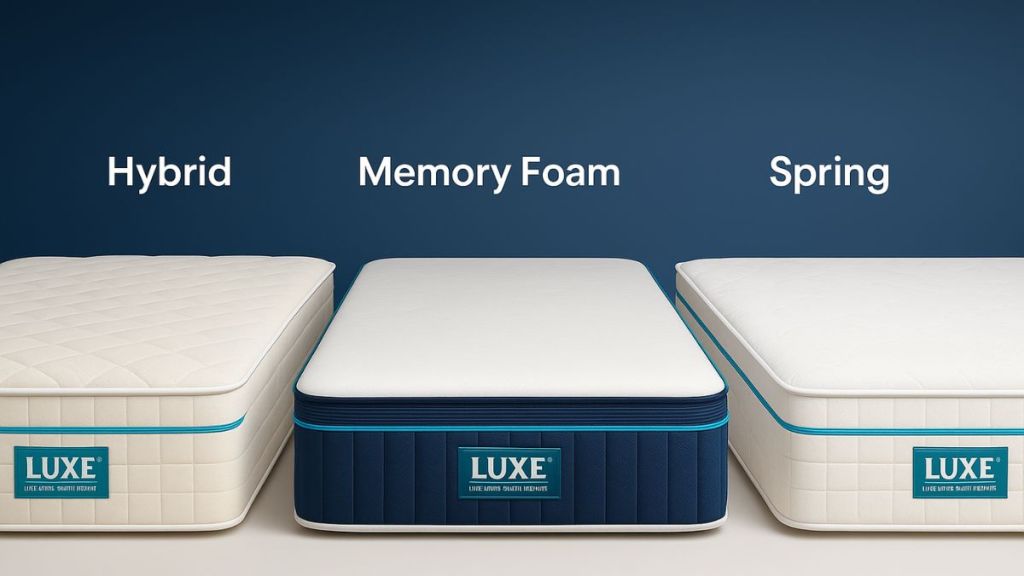
Hybrid (Foam + Springs)
– Combines support of coils with comfort of foam or latex
– Zoned support often included
– Strong edge support and airflow
– Some motion transfer depending on coil quality
– Couples with different sleeping preferences
– People wanting a “best of both worlds†feel
– Users needing strong edge support
Let’s take a closer look at the three most popular options, memory foam, latex, and hybrid, and what each one brings to the table (or bed, rather).
Memory Foam
Memory foam has earned a strong following for its deep contouring and pressure relief. It adapts to your body’s shape, cradling you like a moulded hug, which is great for people with joint pain or sensitive pressure points.
However, there are a few things to be mindful of, especially with king sizes:
Heat retention:Â Traditional memory foam tends to trap body heat. If you or your partner sleep hot, this could be uncomfortable, especially in a larger bed where airflow may be more limited.
Slow response time: Memory foam can feel “sticky†or slow to bounce back when you move, which may be noticeable if you toss and turn at night.
Edge support varies:Â Lower-quality memory foam mattresses can sag at the edges, making king size beds feel smaller than they actually are.
Ideal for:
Couples who value motion isolation , if your partner gets up in the night, you’re far less likely to feel it. It’s also great for people who prefer a “sinking-in†feeling and don’t mind the added warmth.
Bonus tip: If you love the feel of memory foam but sleep hot, look for a gel-infused or open-cell foam design to help with breathability.
Latex
Latex is often seen as the premium choice for sleepers who want comfort, support, and sustainability in one package. Whether it’s natural latex (tapped from rubber trees) or a blend, latex has a unique springy, responsive feel that doesn’t trap heat or slow you down when you move.
Here’s why it works well in a king size format:
Naturally breathable:Â Airflow is key in a larger mattress, especially for couples, and latex excels here.
Bouncy and supportive: You won’t feel “stuck†like you might with memory foam. Latex gives gentle pressure relief without compromising spinal alignment.
Durability: High-quality latex mattresses can last 10 to 20 years, even with two people using them every night.
Eco-friendliness:Â Natural latex is biodegradable and often produced with sustainable farming practices.
Ideal for:
Eco-conscious shoppers, hot sleepers, or anyone looking for a long-term investment in comfort and resilience. It’s also a great choice if you tend to change positions throughout the night and need a mattress that keeps up.
You can explore high-quality options like these UK latex mattresses, many of which come in king size formats with varying firmness levels.
Hybrid (Foam + Springs)
A hybrid mattress combines the comfort layers of foam or latex with a support base of pocket springs, offering a well-rounded sleep experience. This balance makes hybrids a top pick for king size beds, especially among couples with different sleep preferences.
Here’s what stands out in a hybrid:
Support and bounce: The springs provide a strong base that holds its shape over time. Many hybrids offer zoned support, with firmer springs under your hips and lower back.
Cooling:Â With built-in airflow from the coils and breathable foam or latex layers, hybrids are generally much cooler than traditional memory foam.
Motion transfer varies:Â High-quality hybrids isolate motion well, but cheaper ones might feel a bit bouncier, depending on the coil system.
Edge support:Â Most hybrids are reinforced around the edges, crucial in a king size mattress where every inch of space counts.
Ideal for:
People who want the best of both worlds, the contour of foam or latex with the bounce and support of springs. Also perfect for couples with different body types or sleeping styles.
Final Thoughts on Mattress Materials
Choosing the right material is just as important as choosing the right size. In a king mattress, you’ll notice how the material performs across different zones of the bed, how it supports two bodies instead of one, and how it regulates temperature throughout the night.
To summarise:
Go for memory foam if you want body-hugging comfort and peace from partner movement.
Choose latex for a breathable, responsive, and eco-friendly upgrade.
Pick a hybrid if you want a balanced feel with robust support and airflow.
Still unsure? Many UK mattress brands offer trial periods (usually 100 nights or more), so you can try your mattress at home before fully committing. if you want to read the more detailed guide about mattress materials, you can read here.
Top Tips Before You Buy
Try before you buy (if possible):Â Visit a showroom or order from a brand with a solid return policy.
Look at edge support: With larger beds, poor edge support means you’ll lose usable space.
Check the return policy:Â At least 60 to 100 nights, ideally with free returns.
Think long-term: A king size mattress is an investment. Look for at least a 5 to 10 year warranty.
Final Thoughts: Go Big, But Go Smart
A king size mattress can transform your sleep, but only if you choose the right one. Understand the dimensions you need (especially UK vs EU king), the firmness that fits your sleep style, and the bed frame compatibility before you hit buy.
And remember, a bigger mattress doesn’t just mean more space, it means better sleep, fewer sleep disruptions, and happier mornings. Whether you’re shopping for comfort, posture, or peace of mind, the right king size mattress is worth every inch.
Is a Queen Size Mattress Bigger Than a Double? Understanding the UK’s “Small Double†Confusion, When shopping for a mattress in the UK, the term “Queen Size†can be surprisingly confusing. Unlike in the US or Europe, where mattress sizes like “Queen†and “King†follow consistent measurements, the UK market uses terms more loosely. Most notably, many UK retailers refer to the Small Double mattress (120 x 190 cm) as a “Queen.†So the real question becomes:
Is a UK Queen Size (Small Double) mattress bigger than a Double?
No — a Small Double (Queen) is actually smaller than a standard Double.
Mattress Type
Dimensions (cm)
Width Comparison
Small Double (Queen)
120 x 190
–
Double
135 x 190
+15 cm wider
1. Understanding Mattress Size Terminology
Before diving into measurements, it’s important to note that mattress terminology differs by region:
In the UK, the term “Queen†is not officially standardised. A Small Double (120 x 190 cm) is often informally referred to as a “Queen.â€
In Europe, “Euro Queen†refers to a 160 x 200 cm mattress.
In the US, a standard Queen size is 60 x 80 inches (approximately 152 x 203 cm).
This variation in naming leads to confusion. When we ask “Is a queen bigger than a double?â€â€”we must first clarify which queen and which double.
2. Standard Mattress Sizes at a Glance
Let’s look at how the most common sizes compare:
Mattress Size
Dimensions (cm)
Best For
Single
90 x 190
Kids, teens, small guest rooms
Small Double (Queen)
120 x 190
Solo adults, small bedrooms
Double
135 x 190
Couples with limited space
UK King
150 x 200
Couples who want more room
Super King
180 x 200
Luxury spaces, co-sleeping
3. What Is a Small Double (Queen) Mattress?
A Small Double mattress measures 120 x 190 cm and is the size often referred to as “Queen†in the UK market. It’s wider than a single but not quite as roomy as a standard double.
Who is it for?
Solo adults wanting extra room to stretch
Teenagers transitioning from single beds
Small bedrooms where every cm counts
Advantages:
Compact yet spacious for one person
Fits in small to medium bedrooms
More affordable than double or king options
Drawbacks:
Can be tight for two people
Limited bedding availability compared to standard sizes
4. What Is a Double Mattress?
A Double mattress is 135 x 190 cm and is traditionally viewed as the first standard couple’s bed. It provides 15 cm more width than a Small Double.
Who is it for?
Budget-conscious couples
Solo sleepers wanting generous space
Guest rooms or modest master bedrooms
Advantages:
Affordable and widely available
Works in most UK bedrooms
More space for couples than small double
Drawbacks:
Can still feel cramped for two, especially for restless sleepers
5. Size Comparison: Small Double vs Double
Let’s break it down clearly:
Width
Small Double: 120 cm
Double: 135 cm
Difference: 15 cm more space in a Double
Length
Both are 190 cm long
Surface Area
Small Double: 22,800 cm²
Double: 25,650 cm²
Difference: 2,850 cm², or ~12.5% more surface area in a Double
This difference in space can make a noticeable difference in comfort, especially for two people sharing the bed.
6. How Much Room Do You Need?
To sleep comfortably and maintain good room flow, consider these spacing guidelines:
60–70 cm of clearance on each side of the bed
90 cm at the foot of the bed for easy movement
Room Size Tips:
Small Double (Queen): Room should be at least 2.3 metres wide
Double: Room should be 2.4–2.5 metres wide for optimal flow
7. Who Should Choose a Small Double?
Solo sleepers needing more than a single
Teenagers in their own room
Guest bedrooms with limited space
Budget buyers who want compact comfort
A small double works well for people who don’t share their bed or need a compact solution that doesn’t sacrifice comfort entirely.
8. Who Should Choose a Double?
Couples who are okay with less space
Guest rooms needing to fit two adults
Solo sleepers wanting extra space and comfort
Budget-conscious master bedrooms
For couples who don’t toss and turn much or are used to tighter spaces, the double can still work. But if personal space matters, it might not be ideal.
9. Bedding and Compatibility
Small Double:
May require more specific bedding (not as widely stocked)
Often found in student bedding ranges or at IKEA
Double:
Bedding is universally available across the UK
Usually cheaper and easier to find
Buying Tip: Always check the labelled size on packaging. “Queen†can mean 120 or 160 cm depending on the store.
10. Personal Story: Why I Moved from Small Double to Double
In my 20s, I moved into my first flat and bought a “Queen size†bed from an online retailer. I later found out it was actually a Small Double. At first, it was great for just me, but when my partner moved in, we found ourselves bumping elbows more than sleeping peacefully.
We upgraded to a Double, and it made a significant difference. That extra 15 cm gave us enough space to sleep without constantly waking each other. It fit the room just fine with some rearranging, and I could finally buy bedding from local shops without special orders.
11. Common Confusion: UK Queen vs Euro Queen
UK Queen = Small Double = 120 x 190 cm
Euro Queen = 160 x 200 cm (bigger than a UK King)
Many retailers use “Queen†for both, so always check dimensions before assuming size. The Euro Queen is 40 cm wider than a UK Small Double, so you don’t want to get the wrong frame or bedding.
12. Final Verdict
If you’re comparing a UK Queen (Small Double) to a Double, the Double is definitely larger, offering better space, more comfort for two, and easier bedding options.
Choose a Small Double if:
You sleep alone
Your room is tight on space
You’re upgrading from a single bed
Choose a Double if:
You’re sleeping as a couple
You have a medium-sized room
You want more room to stretch
Bonus Tips Before You Buy
Measure your room before choosing your mattress size
Don’t rely on labels, check actual measurements
Consider your future needs: Will a partner be joining you soon?
Conclusion
A mattress isn’t just about comfort, it’s about function, fit, and long-term satisfaction. While the Queen (Small Double)can suit many UK homes, a Double mattress offers more value and space for most sleepers. Choosing the right size from the start can dramatically improve your sleep quality and how well your bedroom works.
Fitting a queen mattress into a small master bedroom feels impossible for most homeowners—especially in tight 10’x10’ spaces where every inch counts . You’re not alone if you’ve sacrificed closet space, ditched nightstands, or debated downsizing your bed just to walk freely. Designers confirm this struggle stems from conflicting needs: wanting spacious comfort without sacrificing storage or style .
Your queen bed can work beautifully. Start with strategic queen mattress room layout tweaks—like centering it on the longest wall or testing corner alignment—to unlock hidden floor space . Combine this with vertical storage and low-profile frames, and you’ll gain breathing room and keep essentials like bedside tables .
Let’s discuss eight designer-proven solutions curated from top space-saving experts.
Strategic Bed Placement for Optimal Flow
Low-profile frames help, but placement determines true functionality in tight spaces.
Centred vs. Corner Alignment Pros/Cons
Centring your queen mattress room layout against the longest wall creates balance. This traditional approach leaves equal walking space on both sides. It works well for couples needing dual nightstand access. However, it consumes more floor space. Corner placement frees up central area for other furniture. This angled position maximises corner dead zones. But it may limit one partner’s bedside storage access. Measure your room before choosing.
Door/Window Clearance Standards
Maintain 30-inch pathways around your queen bed frame. This clearance prevents cramped movement. Doors must open fully without hitting the mattress edge. Position the bed at least 24 inches from windows. This avoids blocked light and ventilation issues. Avoid placing under air vents. Proper clearance ensures comfortable daily use.
Floating Layouts as Space-Saving Solutions
Floating bed arrangements mean centering the mattress away from all walls. This creates walkways on every side. It visually opens small master bedrooms. Combine with narrow platform beds for best results. This layout improves air circulation and cleaning access. Use area rugs to anchor the space. Floating designs prevent that boxed-in feeling.
Low-Profile Bed Frame Selection
Proper bed placement sets the foundation, but your frame choice determines usable space, before selecting the bed frame make sure to measure your room properly, here is our guide to measure your room.
Platform Beds vs. Box Springs
Platform beds sit lower than traditional setups. They provide solid support without box springs. This reduces total bed height by 8-12 inches. Lower frames create more air space above the bed. This makes small master bedrooms feel less crowded. Platform beds also offer built-in slat systems. These eliminate the need for extra foundations. Box springs add unnecessary height in tight rooms. They make under-bed storage harder to access.
12″ Clearance Storage Solutions
Aim for 12 inches of clearance beneath your frame. This height allows standard storage containers to slide underneath. Use low-profile plastic bins for seasonal clothes. Vacuum-sealed bags maximize space for bulky items. Measure your storage containers before choosing a frame. Ensure they fit the available floor space. Roll-out drawers offer easy access without bending. Avoid overcrowding to maintain ventilation. A bed skirt hides items while reducing dust accumulation. Regular cleaning maintains air quality.
Vertical Space Maximisation Tactics
Low frames save height, but walls unlock true storage potential in cramped master bedrooms.
Floor-to-Ceiling Shelving Systems
Install floor-to-ceiling shelving beside your queen bed frame. This uses vertical space that normally stays empty. Choose units under 12 inches deep to avoid blocking pathways. Adjustable shelves fit both books and storage baskets. Place rarely used items higher up. Keep daily essentials at arm level. These systems prevent floor clutter better than dressers. They maintain clear walking paths in tight layouts.
Wall-Mounted Nightstands
Wall-mounted nightstands replace bulky furniture. They provide bedside storage without eating floor space. Look for models with cord management for clean charging. Consider these space-saving options:
Floating shelves with under-shelf baskets
Swing-arm designs that pivot over the bed
Slim drawers with built-in USB ports
Magnetic ledges for glasses and remotes
Fold-down tables that disappear when not used
Install them 24-28 inches above the mattress top. This ensures easy accessibility while lying down. Measure before mounting to avoid ventilation issues near HVAC units.
Illusion-Boosting Visual Techniques
Vertical storage clears floors, but visual tricks make small bedrooms feel instantly larger.
Monochromatic Color Schemes
Using a monochromatic colour scheme creates seamless visual continuity. This bedroom styling tip eliminates harsh visual breaks. Choose light paint colours like soft greys or warm ivories. These hues reflect more natural light, helping rooms feel brighter and larger. Paint walls, trim, and ceilings the same colour. Extend this palette to bedding and curtains. The effect stretches perceived boundaries. Avoid contrasting accents that chop up space. This approach simplifies colour coordination and enhances a cohesive, spacious atmosphere.
Strategic Mirror Angles
Place mirrors opposite natural light sources. This doubles sunlight penetration for brighter rooms. Try mirror placement tricks like leaning tall mirrors against walls. Angle them slightly toward windows. Position at eye level for maximum impact. Avoid facing beds directly to prevent sleep disruption. Corner mirrors capture light from two directions. They create depth perception in narrow spaces. Pair with light paint colours for amplified brightness.
Multifunctional Furniture Integration
Visual tricks expand space optically, but dual-purpose furniture delivers actual square footage savings—critical for small master bedrooms.
Storage Ottomans vs. Benches
Storage ottomans work as footstools, seats, or makeshift coffee tables while hiding bedding or off-season clothes inside. Their lightweight design allows easy relocation to clear pathways . Unlike fixed benches, ottomans fit beneath desks or beds when unused . Footboard benches, like the Cape Cod’s upholstered design with drawers, offer permanent seating and concealed storage without extra furniture. These built-in units maximize floor space efficiency but lack mobility . Choose ottomans for flexibility; opt for integrated benches for streamlined aesthetics in layouts tighter than 10’x10’ .
Fold-Desk Nightstand Combos
Wall-mounted desks fold down from Murphy bed units, creating instant workspaces without dedicated rooms. Models like Resource Furniture’s Italian-crafted systems include integrated lighting and cable management, converting bedrooms to offices in seconds . For smaller footprints, loft beds elevate the mattress, freeing floor space for desks below. The WARMMUSE queen loft includes LED lighting and USB ports, ideal for work-from-home setups . Fold-down nightstands attach to bed frames or walls, featuring slide-out desks for laptops. These combos eliminate separate furniture purchases, crucial when floor area is under 100 sq ft .
Queen Beds with Built-In Drawers
Low-profile platform beds with integrated drawers, like IKEA’s MALM series, offer under-bed storage depths of 12–18 inches. These eliminate bulky dressers, fitting storage containers for seasonal items directly beneath the mattress .
Olive Luxe Divan Beds
For greater capacity, consider Murphy beds like the TIRSMIAUBEST, combining fold-down desks, closets, and drawers in one unit. This design consolidates storage, sleeping, and work zones—perfect for studios under 300 Square ft .
Decluttering & Zone Definition
Multifunctional furniture saves space, but intentional organization prevents recurring clutter in compact layouts.
5-Step KonMari Method for Bedrooms
Start by gathering every bedroom item onto your floor space. Keep only possessions sparking joy—discard the rest immediately. Sort clothes using the vertical folding technique. This minimalist approach fits more into drawers while maintaining clutter-free surfaces. Store categories like books or accessories in designated zones. Finish by thanking unused items before donating them. This creates lasting bedroom organization systems focused on function.
Rug Placement Rules
Use large area rugs (8’x10’ or 9’x12’) to unify small master bedrooms. Center the rug under the lower two-thirds of your queen bed frame, extending 18-24 inches beyond its sides. This proportion guideline creates walkable borders around the bed. Ensure all key furniture legs sit on the rug. This defines a cohesive design while anchoring the sleeping zone. For tight spaces, position a runner along one side of the bed. This adds texture without blocking walking paths. These space-saving queen bed ideas visually expand rooms through smart zone definition.
Lighting & Colour Psychology
Defined zones organise space, but strategic lighting and finishes amplify perceived dimensions in cramped quarters.
Layered Lighting Diagram
Implement a layered lighting system to conquer shadows in tight master bedrooms. Start with overhead lighting flushed ceiling fixtures save ceiling height better than hanging lights. Add task lighting like swing-arm sconces for reading in bed without nightstand space. Complete the setup with ambient lighting: LED strips under beds create soft glows. Use dimmer switches to adjust colour temperature from bright white (morning) to warm amber (evening). This flexibility maintains a cozy atmosphere while serving different needs as well as play crucial part in your sleep health.
Paint Finishes That Expand Space
Paint sheen levels dramatically impact spatial perception. Matte finishes hide wall flaws but absorb light. Choose satin or eggshell for better light reflection. These wall paint finishes bounce artificial and natural light around the room. Pair with light paint colours like pale blues or warm beiges for maximum effect. Maintain colour continuity on trim and ceilings. This eliminates visual breaks that shrink visual space. A monochromatic scheme with varying sheens adds depth without clutter.
Conclusion
Transforming a cramped master bedroom around a queen mattress demands smart compromises. Prioritizing strategic bed placement creates essential walkways, while low-profile frames reclaim precious vertical inches. Vertical storage systems and multifunctional furniture like loft beds with desks eliminate clutter without sacrificing function. Remember: visual expansion techniques—monochromatic palettes, layered lighting, and mirror placement tricks—work with your room’s architecture to dissolve boundaries.
These queen mattress room layout principles prove that bedroom styling tips like multifunctional furniture turn cramped spaces into sanctuaries. Consistent decluttering maintains hard-won space, and properly scaled area rugs anchor your sleep zone with intention.
The result? A bedroom that feels 30% larger without renovations. You’ll gain:
Unobstructed pathways for easy movement
Dedicated zones for sleeping, dressing, and working
Reduced visual noise for true relaxation
Storage that disappears into walls and under beds
Ready to optimize? Start with our #1 space-saving queen bed idea: vertical storage solutions at Luxe Mattresses. Explore space-smart platforms, loft designs, and modular systems tailored for UK bedrooms under 100 sq ft.
Finding the perfect king size mattress can transform your sleep experience, but first, you need to ensure it fits seamlessly into your space. Proper room measurement for your king size mattress is crucial, whether you’re upgrading your bedroom or moving into a new home. Measuring your room correctly is essential to avoid a lumpy, cramped situation. This ultimate guide will equip you with all the tips and tricks needed to measure your room accurately, ensuring your king size mattress becomes a cozy haven rather than a source of frustration. From understanding room dimensions to taking furniture into account, we’ll walk you through the process step-by-step. Say goodbye to guesswork and hello to restful nights, as we help you create a space that balances style and comfort effortlessly. Let’s dive in and set the stage for your best sleep yet!
Understanding King Size Mattresses: Dimensions and Types
Choosing a king size mattress can be a game-changer for your sleep quality. Before diving into measurements, it’s crucial to understand the standard dimensions of a king size mattress. A traditional king size mattress measures 76 inches wide by 80 inches long. This generous size offers ample space for couples, allowing each person to spread out comfortably without disturbing the other. However, within the realm of king size mattresses, there are variations to consider, such as the California king, which measures 72 inches wide by 84 inches long. This option is slightly narrower but longer, making it ideal for taller individuals.
Beyond dimensions, king size mattresses come in various types, each with unique characteristics. Memory foam mattresses are popular for their ability to contour to the body, providing excellent support and pressure relief. Innerspring mattresses, on the other hand, offer a more traditional feel with robust support from a network of coils. Hybrid mattresses combine the best of both worlds, featuring a mix of innerspring coils and memory foam layers for a balanced sleep experience. Latex mattresses are lauded for their durability and natural resistance to allergens, making them a great choice for those with sensitivities.
When selecting a king size mattress, it’s important to consider personal preferences and specific sleep needs. Factors such as firmness level, temperature regulation, and motion isolation can significantly influence your decision. Understanding these different types and dimensions sets the foundation for ensuring that your new mattress will not only fit your space but also enhance your quality of sleep. With this knowledge in hand, you’re ready to move on to the critical task of measuring your room accurately.
Importance of Proper Room Measurement
Measuring your room correctly is paramount to achieving a harmonious bedroom layout. A king size mattress is a significant investment, and ensuring it fits comfortably within your space can prevent a host of issues down the line. Proper room measurement allows you to avoid the frustration of a cramped room where movement is restricted, and it helps maintain an aesthetically pleasing and functional bedroom environment. The goal is to create a space where your mattress enhances your lifestyle rather than disrupts it.
One of the primary reasons for accurate room measurement is to ensure you have adequate clearance around the bed. Sufficient space around the mattress is essential for easy access and movement. Ideally, you should have at least two to three feet of space on each side of the bed and at the foot of the bed. This clearance is crucial for not only making the bed but also for moving around the room without feeling confined. Additionally, proper measurement allows you to consider other furniture pieces and their placement, ensuring a well-balanced and cohesive room design.
Furthermore, accurate room measurement helps you make informed decisions about additional bedroom elements, such as nightstands, dressers, and seating areas. It allows you to plan for these pieces without overcrowding the space. By taking the time to measure your room meticulously, you can create a sanctuary that promotes relaxation and restful sleep. As we move forward, we’ll delve into the tools you need for accurate measurements and the step-by-step process to follow, ensuring that your king size mattress fits perfectly within your room.
Tools You Need for Accurate Measurements
Before you begin measuring your room, it’s essential to gather the right tools to ensure accuracy. The tools you need are straightforward, but having them on hand will make the process smoother and more precise. The primary tool you’ll need is a good quality tape measure. A 25-foot retractable tape measure is usually sufficient for measuring most rooms. Make sure it has both imperial and metric units for versatility. Additionally, a laser measure can be a helpful tool for measuring longer distances and ensuring straight lines, especially in larger spaces.
Another useful tool is a notepad and pen for recording measurements. While it may seem old-fashioned, writing down your measurements as you go can help prevent errors and confusion later. You can also use a smartphone or tablet app designed for room measurement, which can store and organize your data digitally. These apps often come with features that allow you to visualize your room layout and plan furniture placement, making the process more interactive and engaging.
A carpenter’s level is another tool that can be beneficial, particularly if you’re measuring for furniture placement and ensuring everything is aligned correctly. It helps in making sure that surfaces are flat and level, which is crucial for setting up a stable and comfortable bed. Additionally, having a friend or family member to assist you can be invaluable. They can help hold the tape measure, record measurements, and provide a second set of eyes to double-check your work. With these tools in hand, you’re ready to proceed with the step-by-step guide to measuring your room.
Step-by-Step Guide to Measuring Your Room
Measuring your room accurately involves a systematic approach to ensure all dimensions are captured correctly. Start by measuring the length of the room. Place one end of the tape measure against one wall and extend it to the opposite wall, keeping the tape measure straight and taut. Record this measurement on your notepad. Repeat this process for the width of the room, measuring from one side wall to the opposite side wall. These two measurements will give you the basic dimensions of your room.
Next, measure the height of the room. This is particularly important if you have a low ceiling or plan to add a canopy bed frame or other tall furniture pieces. Place the end of the tape measure on the floor and extend it up to the ceiling, ensuring it is perpendicular to the floor. Record this measurement as well. If your room has alcoves or recessed areas, measure these separately by measuring the width, depth, and height of each section. These additional measurements will help you account for all the usable space in the room.
After capturing the basic dimensions, it’s time to measure the doors and windows. Measure the width and height of each doorway, as well as the clearance from the floor to the bottom of the door frame. This information is crucial for ensuring that your king size mattress can be delivered and set up in the room without any issues. For windows, measure the width and height, as well as the distance from the floor to the bottom of the window and from the top of the window to the ceiling. These measurements will help you plan for window treatments and ensure they do not interfere with the placement of your bed or other furniture.
Considering Furniture Placement and Layout
Once you have accurate measurements of your room, it’s time to consider the placement and layout of your furniture. Start by sketching a rough floor plan of your room, including the dimensions you recorded. This doesn’t need to be to scale but should give you a visual representation of the space. Mark the locations of doors, windows, and any other architectural features, such as closets or built-in shelves. This will help you see how much space you have to work with and where potential obstacles might be.
Next, think about the placement of your king size mattress. Ideally, the bed should be the focal point of the room, positioned in a way that maximizes comfort and functionality. Consider placing the bed against the longest wall to create a balanced look and leave ample space for walking around. Ensure that there is enough clearance on all sides of the bed for nightstands, allowing easy access and convenience. If you have a large room, you might also consider positioning the bed in the centre with a seating area or storage bench at the foot of the bed for added functionality.
In addition to the bed, consider the placement of other essential furniture pieces, such as dressers, wardrobes, and seating areas. Ensure that these pieces do not obstruct pathways or create a cluttered look. Use your measurements to plan for adequate clearance around each piece, allowing for easy movement and access. If you have a small room, consider using multifunctional furniture, such as a storage bed or a dresser that doubles as a nightstand, to maximize space. By thoughtfully planning your furniture layout, you can create a cohesive and functional bedroom that complements your king size mattress.
Assessing Doorways and Hallways for Mattress Delivery
One of the critical aspects of measuring your room for a king size mattress is ensuring that the mattress can be delivered without any hitches. This involves assessing the doorways, hallways, and staircases that the mattress will need to navigate to reach your bedroom. Start by measuring the width and height of all doorways the mattress will pass through, including the front door, bedroom door, and any other doors along the delivery path. Measure from the floor to the top of the door frame and from one side of the door frame to the other to ensure there is sufficient clearance.
In addition to doorways, measure the width and height of any hallways and staircases. Pay attention to any turns or corners in the hallways, as these can pose a challenge for manoeuvring a large mattress. Measure the narrowest point in the hallway and the distance from the floor to the ceiling. For staircases, measure the width of the stairs, the height of any landings, and the clearance from the stairs to the ceiling. If there are any tight corners or low ceilings, consider how the mattress will need to be angled to navigate these obstacles.
It’s also important to consider any fixtures or decorations that might obstruct the delivery path. Items such as light fixtures, handrails, and wall art can all pose potential obstacles. Measure the distance from these items to the floor and to the nearest wall to ensure there is enough space to manoeuvre the mattress around them. By thoroughly assessing the delivery path and taking these measurements into account, you can avoid any surprises on delivery day and ensure a smooth and hassle-free process.
Calculating Space for Bedding and Accessories
In addition to measuring for your king size mattress and furniture, it’s important to consider the space needed for bedding and accessories. Start by thinking about the bedding essentials, such as pillows, blankets, and comforters. These items add bulk to the bed and can impact the overall look and feel of the room. Measure the height of the mattress with all the bedding in place to ensure it doesn’t interfere with other furniture or window treatments. This is particularly important if you have a canopy bed or a bed with a tall headboard.
Next, consider the space needed for additional accessories, such as nightstands, lamps, and decorative items. Nightstands should be placed on either side of the bed with enough clearance to open drawers or doors easily. Measure the height, width, and depth of the nightstands to ensure they fit comfortably beside the bed without obstructing pathways. If you plan to add lamps, measure the height of the lamp base and the width of the lampshade to ensure they do not create visual clutter or interfere with other elements in the room.
Finally, think about any additional storage solutions you might need, such as under-bed storage bins or a chest at the foot of the bed. Measure the height and width of these storage pieces to ensure they fit neatly within the available space. If you plan to add seating, such as a bench or a chair, measure the dimensions of these pieces and consider their placement carefully to avoid overcrowding the room. By calculating the space needed for bedding and accessories, you can create a well-organised and aesthetically pleasing bedroom that complements your king size mattress.
Common Mistakes to Avoid When Measuring
Accurate measurement is crucial for ensuring a perfect fit for your king size mattress, but there are common mistakes that can lead to issues down the line. One of the most common mistakes is not accounting for the full thickness of the mattress and bedding. When measuring the height of the room, be sure to include the height of the mattress, box spring, and any additional bedding. This ensures that the bed does not interfere with any low ceilings, light fixtures, or other furniture.
Another common mistake is failing to measure all the entry points, including doors, hallways, and staircases. It’s easy to assume that if the mattress fits in the bedroom, it will fit through the doors and hallways. However, tight corners, narrow doorways, and low ceilings can all pose significant challenges during delivery. Be sure to measure the entire delivery path and account for any potential obstacles to avoid any surprises on delivery day.
Additionally, many people overlook the importance of measuring furniture and accessories. It’s essential to measure all the furniture pieces that will be placed in the room, including nightstands, dressers, and seating areas. Ensure there is adequate clearance around each piece to allow for easy movement and access. By avoiding these common mistakes and taking a thorough and meticulous approach to measurement, you can ensure that your king size mattress fits perfectly within your room and enhances your sleep experience.
Tips for Choosing the Right King Size Mattress
Choosing the right king size mattress involves considering various factors beyond just size. One of the most important factors is the level of firmness. Mattresses come in different firmness levels, ranging from soft to extra firm. Your preferred firmness level depends on your sleep position and personal comfort. Side sleepers typically prefer softer mattresses that cushion the shoulders and hips, while back and stomach sleepers often benefit from firmer mattresses that provide more support for the spine.
Temperature regulation is another crucial factor to consider when choosing a mattress. Some mattresses are designed with cooling technologies, such as gel-infused memory foam or breathable covers, to help regulate body temperature and prevent overheating during the night. If you tend to sleep hot, look for a mattress with cooling features to ensure a comfortable sleep environment. On the other hand, if you prefer a warmer sleep environment, consider a mattress with better heat retention.
Motion isolation is an important consideration for couples sharing a bed. A mattress with good motion isolation minimises the transfer of movement, allowing one person to move without disturbing the other. Memory foam and latex mattresses are known for their excellent motion isolation properties. Additionally, consider the mattress’s edge support, which is important for maximising the usable sleep surface and providing stability when sitting on the edge of the bed. By considering these factors and taking the time to test different mattresses, you can find the perfect king size mattress that suits your sleep needs and enhances your overall sleep quality.
Conclusion: Ensuring a Perfect Fit for Your King Size Mattress
Ensuring a perfect fit for your king size mattress involves careful planning and accurate measurement. By understanding the dimensions and types of king size mattresses, you can make an informed decision that meets your needs. Proper room measurement is essential to avoid a cramped and uncomfortable space. Using the right tools and following a systematic approach to measuring your room, furniture placement, and delivery path can help you avoid common mistakes and ensure a seamless setup.
Considering the space needed for bedding and accessories, as well as choosing the right mattress based on firmness, temperature regulation, and motion isolation, can enhance your sleep experience. By taking these steps, you can create a well-organized and aesthetically pleasing bedroom that balances style and comfort effortlessly. Say goodbye to guesswork and hello to restful nights, as you transform your room into a cozy haven with the perfect king size mattress fit.
Creating the ideal sleep sanctuary involves careful sizing, particularly when choosing a double-size mattress that fits well in your room. This guide will help you accurately measure your space, ensuring that your mattress integrates smoothly with your room’s layout. Proper measuring is crucial for comfort and style, allowing you to avoid the hassle of mismatched dimensions and enjoy peaceful nights in your customised retreat.
Understanding Double Size Mattresses
When selecting a mattress, understanding sizes is crucial. A double size mattress, or full mattress, measures 54 inches by 75 inches and is ideal for single sleepers or couples who prefer a cozy fit. It’s popular for guest rooms and smaller spaces due to its comfort and versatility. Unlike a twin mattress, it allows more movement without occupying as much room as a queen or king size. The mattress should integrate well with the room’s layout, making accurate measurements and thoughtful planning essential for a comfortable sleep environment.
Importance of Accurate Room Measurements
Accurate room measurements are the cornerstone of a well-designed bedroom. Without precise measurements, you risk purchasing a mattress that either overwhelms the space or leaves it feeling incomplete. A double size mattress, while versatile, still requires careful consideration of the room’s dimensions to ensure it fits seamlessly. Measuring your room accurately helps you avoid common pitfalls such as obstructed pathways, cramped furniture arrangements, and compromised accessibility.
Accurate room measurements are essential for achieving a balanced and functional layout. A double size mattress should improve your room’s comfort and aesthetics while ensuring sufficient space for other furniture like nightstands and dressers. Proper measurements also aid in optimal mattress placement, considering natural light, outlet access, and movement ease. Ultimately, taking the time to measure your room pays off by creating a cohesive and efficient bedroom environment.
Tools You’ll Need for Measuring
Before you start measuring your room, it’s essential to have the right tools on hand. Proper measurement tools ensure accuracy and make the process more straightforward. The most basic tool you’ll need is a tape measure. A retractable metal tape measure is ideal because it provides the most precise measurements and can extend to cover the entire length of the room. Make sure your tape measure is long enough to measure the largest dimensions of your space in one go.
To effectively measure your room for a new double size mattress, consider using a laser distance measurer for quick and accurate measurements, especially in hard-to-reach areas. It’s advisable to double-check with a traditional tape measure for accuracy. Additionally, having a notebook and pencil, a level, and masking tape can facilitate the measuring process and help you clearly mark dimensions on the floor. With the right tools, you can confidently plan your mattress placement.
Step-by-Step Guide to Measuring Your Room
Measuring your room accurately involves a systematic approach. Start by clearing the room of any obstructions. This includes moving furniture and other items that might get in the way of your measuring tape. Once the room is clear, you can begin taking measurements from wall to wall. Measure the length and width of the room at several points to ensure consistency. Record these measurements in your notebook for reference.
To effectively place a double size mattress in a room, start by measuring the room’s height, as this aids in understanding the overall space and planning for additional furniture. Pay attention to architectural features like alcoves or nooks and measure them separately. Additionally, consider other factors such as windows, doors, and built-in closets by measuring their distance from the floor and walls. This detailed approach ensures optimal mattress placement while maintaining room functionality.
Considering Mattress Placement and Accessibility
Once you have accurate measurements of your room, the next step is to consider the placement of your double size mattress. The goal is to find a spot that maximises comfort and accessibility while complementing the room’s layout. Start by identifying the primary wall where you’d like to place the head of the bed. This wall should be free from windows and large obstructions to provide a solid backdrop for your mattress.
When arranging your bedroom, prioritize the flow of movement and accessibility. Place the mattress to allow easy access to furniture and walkways, ensuring sufficient space for nightstands and reach to outlets. Also, consider natural light exposure by positioning the mattress to benefit from daylight without direct early morning light. Additionally, keep heating and cooling vents in mind for year-round comfort. Thoughtful mattress placement promotes a functional and aesthetically pleasing bedroom.
Evaluating Room Layout and Design
Evaluating your room’s layout and design is a critical step in ensuring that your double size mattress fits perfectly. Start by sketching a floor plan of your room. This doesn’t have to be a professional drawing; a simple sketch with accurate measurements will suffice. Mark the positions of doors, windows, closets, and other fixed elements. This visual aid will help you see how different furniture pieces, including your mattress, will fit into the space.
When placing your mattress, consider the style and theme of your bedroom to enhance its design. A central placement works well for minimalist designs, highlighting simplicity, while traditional rooms benefit from arrangements that create a cozy atmosphere. Additionally, plan for other furniture by measuring and marking their positions to visualize the layout, ensuring a harmonious and spacious sleeping environment that meets aesthetic and practical needs.
Common Mistakes to Avoid When Measuring
While measuring your room for a double size mattress may seem straightforward, it’s easy to make mistakes that can lead to an ill-fitting mattress or an awkward room layout. One common mistake is not measuring the room at multiple points. Rooms are rarely perfectly square, and walls can have slight variations. By measuring at several points, you can account for these discrepancies and ensure more accurate dimensions.
When planning a room, it’s crucial to consider the space occupied by furniture and accessories like nightstands and dressers to prevent a cramped environment. Always measure the dimensions of your furniture and include them in your planning. Additionally, consider the height of the mattress and bed frame, as they can take up more vertical space than expected. By being mindful of these aspects, you can successfully fit a double-size mattress into your room.
Tips for Choosing the Right Mattress Frame
Choosing the right mattress frame is just as important as selecting the mattress itself. The frame provides support and stability, and it can significantly impact the overall look and feel of your bedroom. When selecting a frame for your double size mattress, consider the style and material that best complements your room’s decor. Options range from sleek metal frames to classic wooden designs, each offering a unique aesthetic.
When selecting a mattress frame, functionality is key. Consider frames with built-in storage options like drawers or shelves to maximize space. The height of the frame is also important; higher frames can create a feeling of spaciousness and offer under-bed storage, while lower frames provide a cozier atmosphere. Additionally, ensure that the frame is easy to assemble and made of durable materials for long-lasting support. Choosing the right mattress frame can enhance both the functionality and aesthetics of your bedroom.
Conclusion: Ensuring a Perfect Fit for Your Double Size Mattress
Ensuring a perfect fit for your double size mattress requires careful planning and precise measurements of your room’s dimensions. It is crucial to avoid common measuring mistakes and thoughtfully evaluate your room’s layout to create a balanced and aesthetically pleasing environment. Selecting the right mattress frame and high-quality bedding enhances comfort and style, contributing to a cohesive bedroom design. The ultimate aim is to create a personalized sleep sanctuary that meets practical needs and promotes restful sleep, transforming your space into a tranquil retreat.