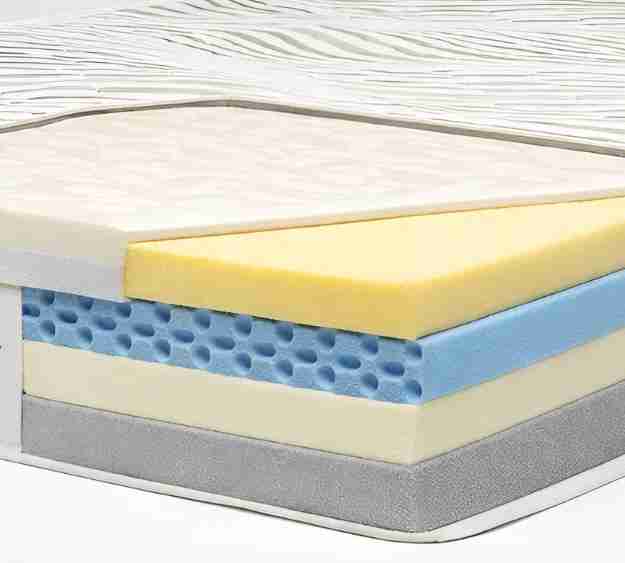
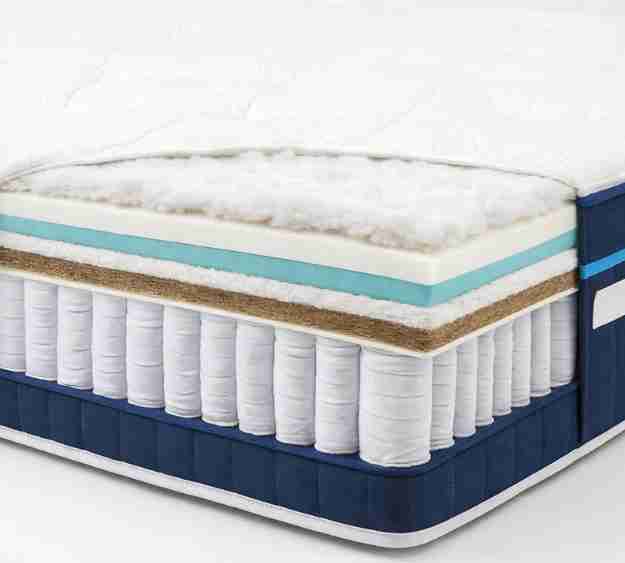
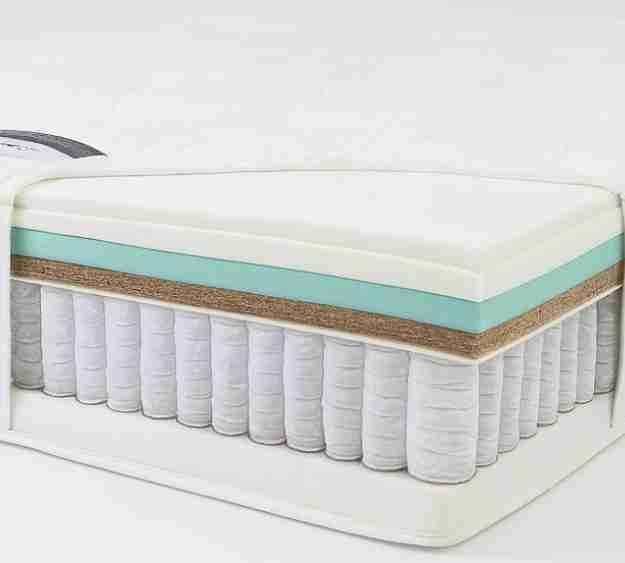
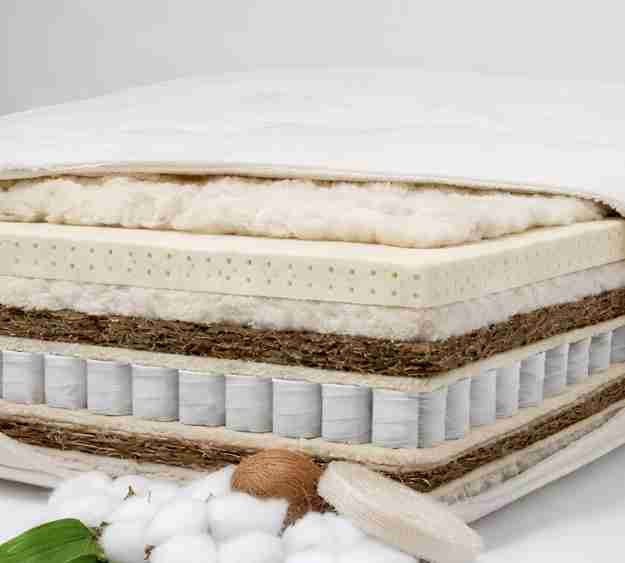
If you’ve ever woken up with stiffness or struggled through the night tossing because of back pain, you know how much it affects your daily life. Your mattress plays a huge role in supporting your spine, aligning your body, and helping you recover while you sleep. Choosing the best mattress for back pain can feel overwhelming, especially with so many options out there.
In this guide, we’ll break down how the right mattress can reduce back pain, what to look for when buying a mattress for back pain, and the top choices people love.
Why Back Pain and Mattresses Are Connected?
Your spine has a natural curve that needs proper support when lying down. A poor-quality or old mattress can put pressure on certain areas, causing or worsening back pain. Over time, sleeping on the wrong surface may lead to misalignment, stiffness, and discomfort.
The best mattress for back pain is one that:
Keeps your spine aligned
Distributes your weight evenly
Reduces pressure points
Provides the right balance of firmness and comfort
If you’re already experiencing back pain, your mattress could either be part of the problem or part of the solution.
Signs Your Mattress Is Causing Back Pain
Not sure if your mattress is behind your back pain? Watch out for these signs:
You wake up with stiffness that eases during the day
You feel more comfortable on a hotel bed or someone else’s mattress
There are visible sags or lumps in your bed
You toss and turn frequently to get comfortable
You notice worsening back pain after sleeping
If any of these sound familiar, it’s probably time to start looking for the best mattress for back pain that suits your needs.
Types of Mattresses for Back Pain Relief
When searching for the best mattress for back pain, it’s important to know what each type offers:
Lightweight sleepers: Softer mattresses work better
Heavy sleepers: Firmer options prevent sinking and help with back pain
4. Durability
Sagging is one of the biggest culprits of back pain. Always check the warranty and durability before buying.
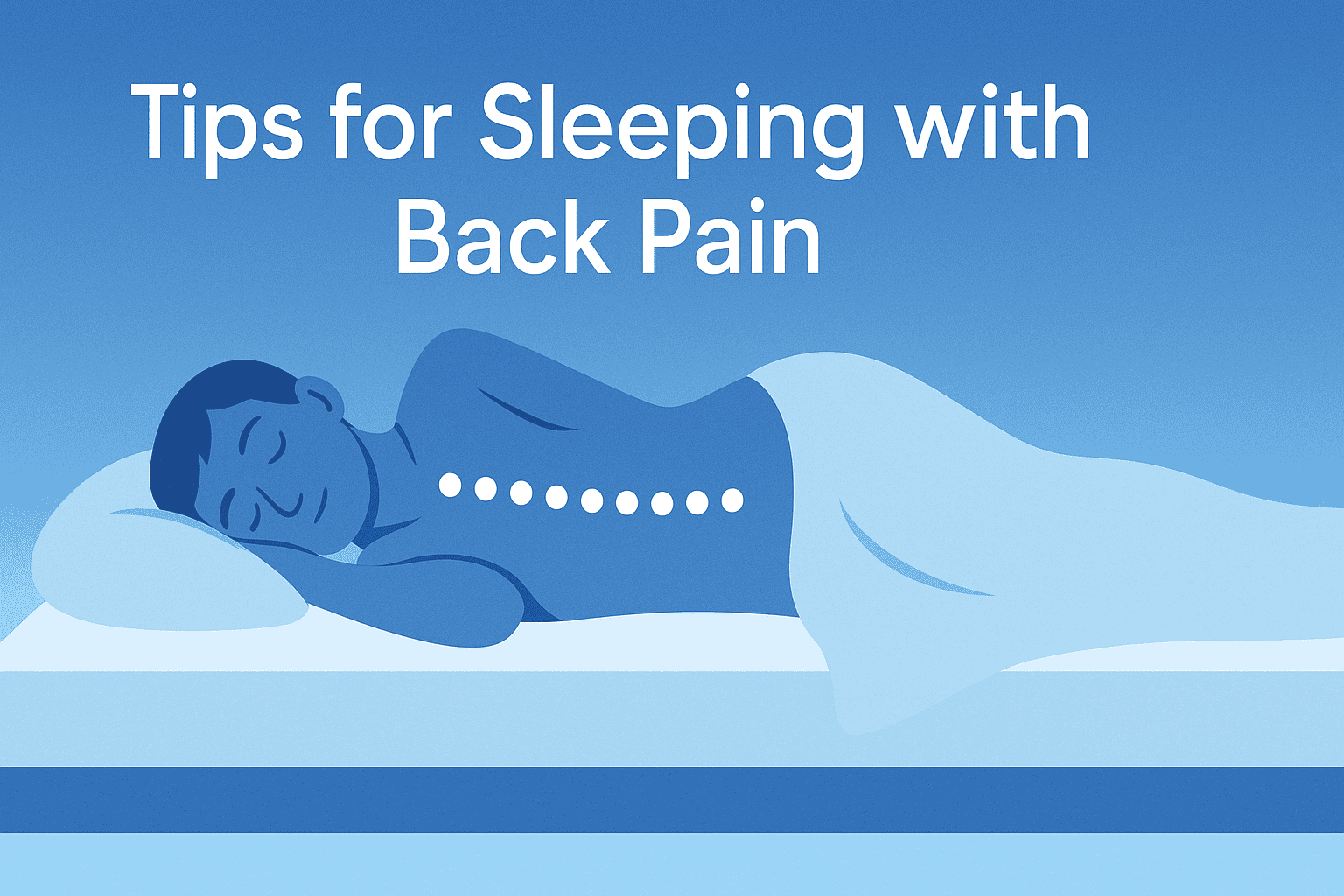
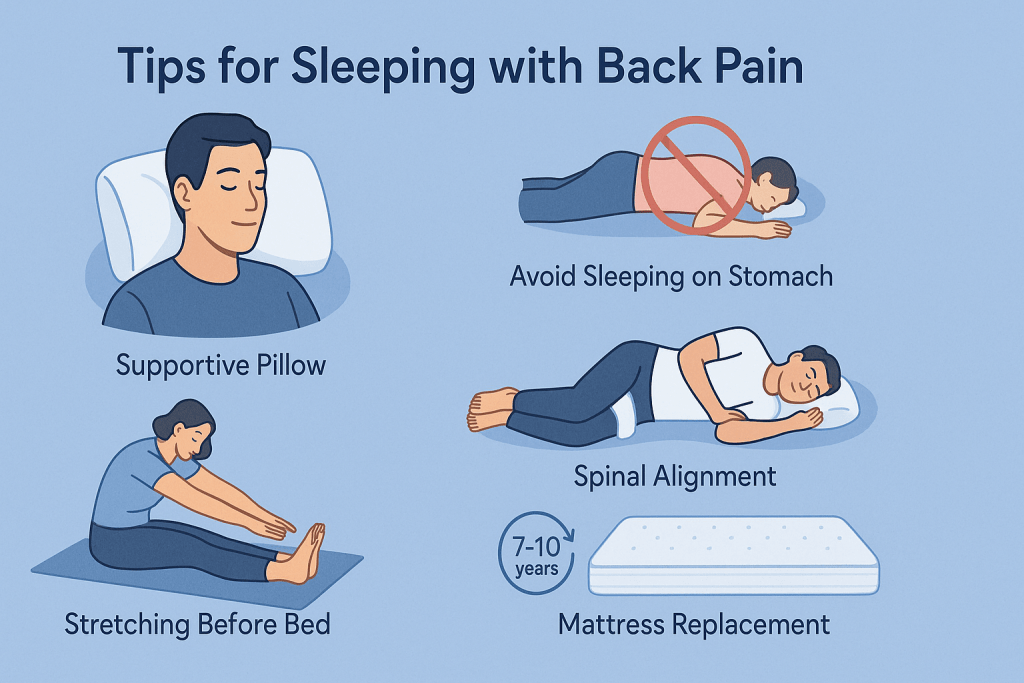
Tips for Sleeping with Back Pain
Even the best mattress for back pain won’t help if you don’t practice good sleep habits. Try these tips:
Use a supportive pillow for neck alignment
Avoid sleeping on your stomach if you already have back pain
Stretch lightly before bed to relax muscles
Keep your spine straight with a small pillow under your knees (for back sleepers) or between your knees (for side sleepers)
Replace your mattress every 7–10 years
FAQs
Q1: What firmness is best for back pain?
A medium-firm mattress is usually considered the best mattress for back pain because it balances support and comfort.
Q2: Can a mattress cause back pain?
Yes. An old or unsupportive mattress can trigger or worsen back pain.
Q3: How long before I notice improvement in back pain after buying a new mattress?
It can take a few weeks for your body to adjust, but many notice back pain relief within days.
Q4: Should I choose memory foam or hybrid for back pain?
Both are great choices. Memory foam is better for contouring, while hybrids combine support and bounce making them strong options for the best mattress for back pain.
Q5: How often should I replace my mattress if I have back pain?
Every 7–10 years, or sooner if sagging or worsening back pain occurs.
Conclusion
Living with back pain can feel exhausting, but the right mattress can make a world of difference. Instead of waking up sore and stiff, you could start your mornings refreshed and pain-free. The best mattress for back pain is the one that aligns your spine, supports your weight, and fits your sleeping style.
Remember:
Choose medium-firm support
Match your mattress to your sleeping position
Don’t overlook durability and quality
By investing in the best mattress for back pain, you’re not just buying a bed, you’re investing in your health, comfort, and overall well-being.You can visit our website to explore the best back pain mattress options designed to give you maximum comfort and support.
When it comes to choosing the perfect bed, a memory foam mattress is often one of the most trusted options for comfort and support. Known for its ability to adapt to body shape and relieve pressure points, memory foam has transformed the way people sleep. Unlike traditional spring mattresses, it provides a personalized sleep experience that helps reduce tossing, turning, and discomfort during the night. For those struggling with back pain or restless nights, memory foam is often the ultimate solution.
What Makes a Memory Foam Mattress Different?
A memory foam mattress is not like other mattresses. It uses a unique material that responds to body heat and pressure, allowing it to mold perfectly around your body. This means it gives support exactly where you need it most, whether that’s your shoulders, hips, or lower back. Unlike spring beds that can feel bouncy or uneven, memory foam distributes your weight evenly across the surface. This difference makes it ideal for people who want both comfort and stability while they sleep.
Pressure Relief for a Pain-Free Sleep
One of the greatest benefits of a memory foam mattress is pressure relief. When you lie down, your body puts weight on certain points, especially the shoulders, hips, and spine. A regular mattress might not provide equal support, which can lead to discomfort or pain. Memory foam solves this problem by absorbing the pressure and spreading it across the surface, reducing strain on your joints and muscles, helping you wake up refreshed instead of sore.
Perfect Support for Spinal Alignment
Good posture is important not only when you are standing but also while you sleep. A memory foam mattress helps keep the spine aligned in its natural position. For side sleepers, it supports the shoulders and hips without sinking too much. For back sleepers, it provides enough firmness to prevent the lower back from arching unnaturally. Maintaining proper alignment throughout the night reduces the risk of back pain and long‑term posture issues Essentia Organic Mattress.
Motion Isolation for Undisturbed Rest
If you share your bed with a partner, a memory foam mattress can be a real game‑changer. Traditional mattresses often transfer movement across the surface, so if your partner tosses and turns, you feel it too. Memory foam absorbs these motions instead of spreading them, meaning you can sleep peacefully even if the other person is moving. Couples especially value this feature because it allows both partners to enjoy restful, uninterrupted sleep
Ideal for All Sleeping Positions
A memory foam mattress is suitable for every type of sleeper. Side sleepers benefit from pressure relief on their shoulders and hips. Back sleepers enjoy firm support that keeps the spine aligned. Even stomach sleepers find comfort because the foam adjusts to their body while preventing too much sinking. This versatility makes memory foam a great option for families or anyone unsure about which type of mattress fits their sleep style best American MattressNational Council on Aging.
Temperature Control and Cooling Options
One concern many people have about memory foam is heat retention. In the past, these mattresses were known for trapping heat, which made them uncomfortable in warmer weather. However, modern designs now include cooling technologies like gel‑infused foam, open‑cell structures, and breathable covers. These upgrades ensure that a memory foam mattress stays cool and comfortable all night long, making it suitable even for people who tend to sleep hot.
Durability and Long-Lasting Comfort
Investing in a mattress is a long‑term decision, and memory foam mattresses are known for their durability. Unlike spring mattresses that may sag or lose shape over time, high‑quality memory foam maintains its structure for years. It returns to its original form after use, ensuring consistent comfort and support. With proper care, a good memory foam mattress can last 8 to 10 years, making it a worthwhile investment for better sleep American MattressWikipedia.
Hypoallergenic and Health Benefits
For people with allergies, a memory foam mattress is a healthier option. The dense structure of the foam prevents dust mites, mold, and other allergens from settling inside American Mattress. In addition, the mattress’s ability to relieve pressure and improve circulation reduces nighttime discomfort, helping you sleep more deeply and wake up feeling energized.
Affordable Options for Every Budget
Many people assume that memory foam mattresses are always expensive, but that’s not true anymore. With so many brands now offering different levels of quality and features, you can find a memory foam mattress that fits your budget. From basic models to luxury versions with cooling layers and advanced support, there is something available for everyone.
Why Choose a Memory Foam Mattress Over Others?
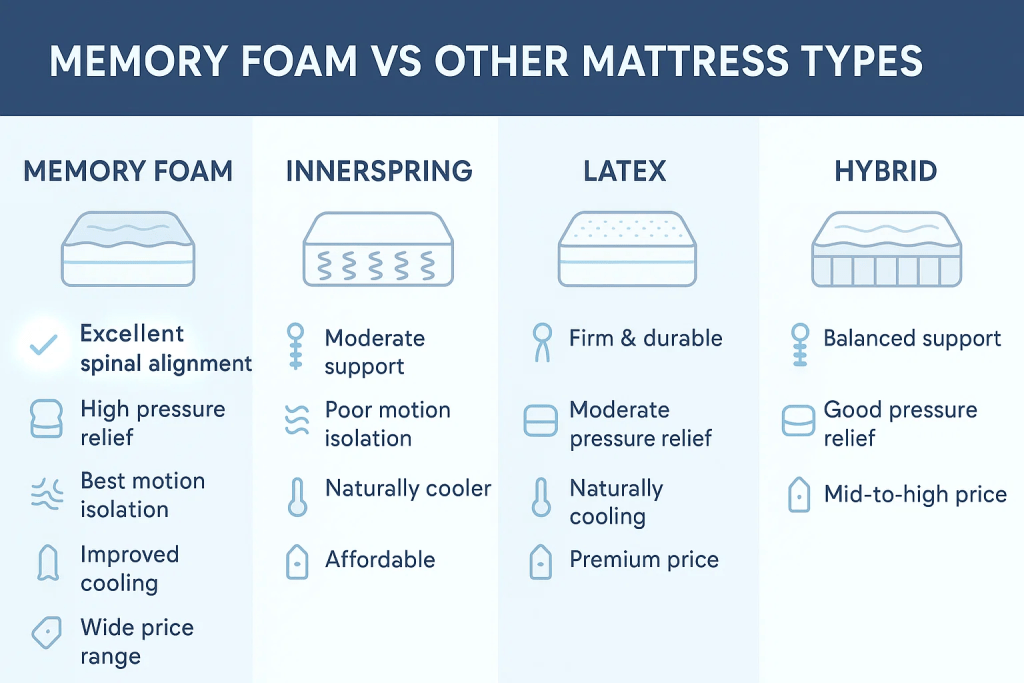
When comparing different types of mattresses, the advantages of memory foam stand out clearly. Innerspring mattresses may provide bounce, but they lack targeted support. Latex mattresses are durable, but they can feel too firm for some people. Hybrid mattresses combine multiple materials, but they are often more expensive. A memory foam mattress provides the perfect balance of comfort, support, and value, making it an ideal choice for better sleep GQThe Guardian.
Mattress Type Comparison: Memory Foam vs Alternatives
Mattress Type
Support & Alignment
Pressure Relief
Motion Isolation
Temperature Control
Price Range
Memory Foam
Excellent spinal alignment, contours to body
High – relieves shoulders, hips, spine
Excellent – absorbs movement fully
Improved with gel/open-cell tech
Wide range (£200 – £1,500+)
Innerspring
Moderate – depends on coil design
Low – uneven support on pressure points
Poor – transfers motion easily
Good airflow, naturally cooler
Affordable (£150 – £1,000)
Latex
Strong, responsive support
Moderate – firmer feel, less contouring
Moderate – some bounce remains
Excellent – naturally cooling
Premium (£800 – £2,000+)
Hybrid (Coils + Foam)
Balanced support and comfort
High – combines foam contouring with coil lift
Good – better than springs, not as good as foam
Moderate to good, depends on design
Mid to high (£500 – £2,000+)
Caring for Your Memory Foam Mattress
To make the most out of your investment, it’s important to take proper care of your memory foam mattress. Always use a breathable mattress protector to keep it clean and safe from spills. Rotate the mattress occasionally to ensure even wear. Avoid placing it directly on the floor, as it needs proper airflow to remain fresh and hygienic. With these simple steps, your mattress can remain supportive and comfortable for many years.
Conclusion
Choosing the right mattress can completely transform your sleep, and a memory foam mattress is one of the best options available today. From relieving pressure and supporting spinal alignment to reducing motion transfer and improving sleep quality, it offers benefits that other mattresses can’t match. Modern versions are cooler, more durable, and available in every price range, making them suitable for all kinds of sleepers. If you are looking for comfort, support, and long-lasting value, memory foam is the perfect choice for better sleep.
FAQ’s
1. Are memory foam mattresses good for back pain?
Yes, memory foam mattresses are highly recommended for back pain as they provide proper spinal support and pressure relief.
2. Do memory foam mattresses get too hot at night?
Older versions did, but modern memory foam mattresses use cooling gels and breathable covers to regulate temperature.
3. How long does a memory foam mattress last?
On average, a good-quality memory foam mattress lasts between 8 to 10 years with proper care.
4. Can memory foam mattresses help with allergies?
Yes, memory foam is naturally resistant to dust mites and allergens, making it a healthier choice for sensitive sleepers.
5. Is a memory foam mattress suitable for all sleep positions?
Absolutely. It adapts to side, back, and stomach sleepers by offering personalized support and comfort.
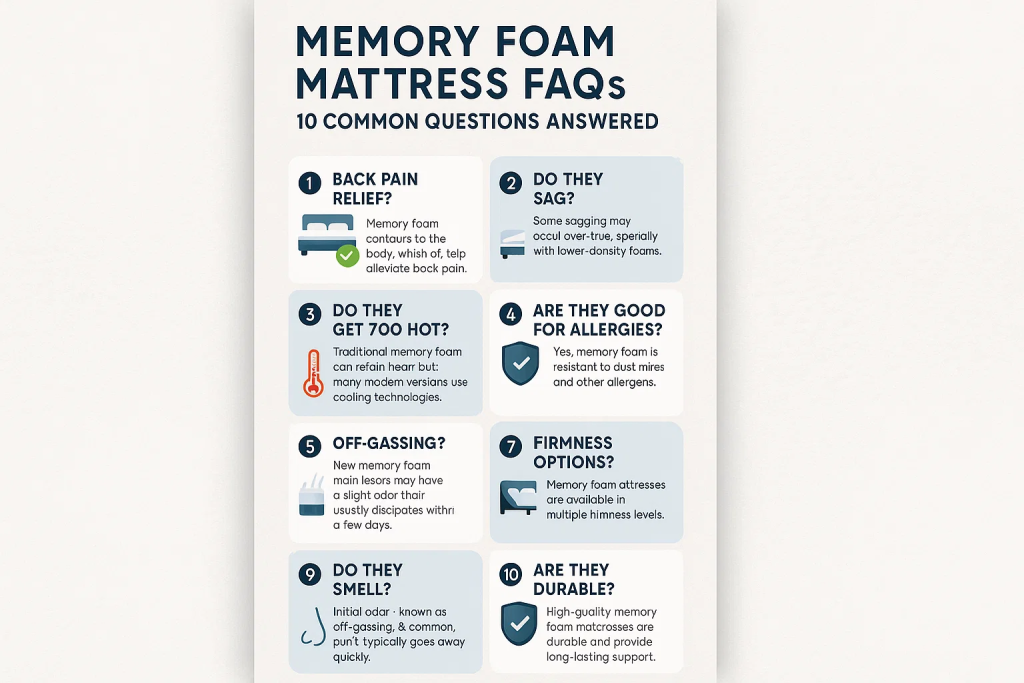
Memory foam mattresses have become one of the most popular choices for people seeking comfort and support during sleep. Known for their ability to contour the body, relieve pressure, and reduce tossing and turning, these mattresses are often recommended for better rest. But with so many options available, buyers are often left with several questions. This guide covers the ten most common queries about memory foam mattresses, helping you make an informed decision.
1. What is a memory foam mattress?
A memory foam mattress is made from viscoelastic material that reacts to body heat and pressure. It molds around the body to provide personalized support and comfort. Unlike traditional spring mattresses, memory foam minimizes motion transfer, making it a great choice for couples.
2. Is a memory foam mattress good for back pain?
Yes, memory foam is often recommended for people with back pain. Its ability to align the spine and relieve pressure points can reduce discomfort. However, the firmness level should match your sleeping style for the best results.
A high-quality memory foam mattress usually lasts between 7 and 10 years. Proper care, such as rotating the mattress and using a protector, can extend its lifespan.
5. Are memory foam mattresses safe?
Yes, most modern memory foam mattresses are made with CertiPUR-US® certified foam, ensuring they are free from harmful chemicals like formaldehyde or heavy metals. Always check for certifications before purchasing.
6. Do memory foam mattresses sag over time?
Like any mattress, memory foam can sag if it’s of poor quality or not properly maintained. Choosing a dense foam mattress and rotating it regularly can help prevent this issue.
7. Can memory foam mattresses help with allergies?
Yes, memory foam is resistant to dust mites and allergens, making it a good option for people with allergies. Pairing it with a hypoallergenic mattress cover provides even better protection.
8. Is a memory foam mattress suitable for all sleepers?
Memory foam works well for most sleeping positions, but side sleepers usually benefit the most due to pressure relief on the shoulders and hips. Back and stomach sleepers should opt for medium to firm options for better support.
9. Can you use a memory foam mattress on any bed frame?
Memory foam mattresses require a solid or slatted base for proper support. Using a weak or uneven frame can reduce mattress lifespan and comfort. Adjustable bases also pair well with memory foam.
10. Are memory foam mattresses expensive?
Prices vary depending on thickness, density, and brand. While they can be more costly than spring mattresses, their durability and comfort often make them a worthwhile investment.
Question
Quick Answer
What to Look For
Pro Tip
What is a memory foam mattress?
Viscoelastic foam that contours to body heat and pressure; great motion isolation.
Quality foams, supportive base layer, breathable cover.
Choose reputable brands with clear specs and warranty.
Is it good for back pain?
Yes, when firmness matches your body and sleep position.
Medium‑firm feel, zoned support, good lumbar alignment.
Trial periods help verify relief within 2–4 weeks.
Do they get too hot?
Modern models add cooling gels, open‑cell foams, or airflow channels.
Prioritize foam quality over “gimmick†layers.
Conclusion
Memory foam mattresses have revolutionized the way people sleep by offering comfort, pressure relief, and better spinal alignment. They are especially beneficial for those dealing with back pain or sleep disturbances. By understanding the most common questions, you can choose a mattress that matches your needs and ensures quality rest for years to come.
Q1. How often should I replace a memory foam mattress?
On average, every 8 to 10 years, depending on wear and comfort.
Q2. Is a thicker memory foam mattress always better?
Not always. The ideal thickness depends on body weight and sleeping style.
Q3. Do memory foam mattresses need flipping?
No, most are one-sided. Rotating them every few months is recommended instead.
Q4. Can memory foam mattresses be compressed for storage?
Yes, they can be compressed and vacuum-sealed, but repeated compression may damage the foam.
Q5. Is off-gassing harmful in memory foam mattresses?
Off-gassing is usually temporary and harmless. Choosing a certified mattress minimizes any risks.
Did you know you’ll spend nearly ⅓ of your life on a mattress? Yet for centuries, “comfort†meant straw mats, lumpy springs, or sweaty foam.
If you’ve ever tossed all night from back pain, overheating, or partner disturbance, you’re not alone. Outdated designs fail 85% of sleepers with pressure points and poor support.
Today’s mattress technology innovations solve these ancient woes. Memory foam from NASA cradles your spine. Smart beds adjust firmness as you sleep. Cooling gels banishing night sweats.
Let’s discover how science transformed sleep from survival to revival.
The Historical Journey of Mattress Materials
While modern sleepers benefit from cutting-edge innovations, today’s mattress technology innovations stem from millennia of material experimentation. Early civilizations laid the groundwork transforming rudimentary piles of grass into engineered support systems. This journey reveals humanity’s relentless pursuit of comfort through resourcefulness.
From Straw to Springs: Early Foundations
The earliest known mattress dates back 77,000 years a compacted layer of insect-repellent grass and leaves discovered in South Africa . By 3,600 BCE, Persians innovated with goatskin waterbeds for temperature regulation, while Egyptians elevated sleep on wooden frames to avoid pests, stuffing beds with palm boughs or wool . Romans later added luxury, using feather-filled cloth bags atop rope-strung frames—the origin of the phrase “sleep tight†.
The Middle Ages saw straw- or wool-stuffed sacks, though durability suffered. Renaissance craftsmanship introduced horsehair and cotton fillings wrapped in silk or velvet for elites . A pivotal shift came in 1871 when Heinrich Westphal patented the first innerspring mattress, using metal coils to replace lumpy natural materials. This design dominated for a century, offering standardized support .
NASA’s Legacy: Memory Foam Breakthrough
In the 1960s, NASA scientists developed viscoelastic foam to cushion pilots during test flights. The material absorbed shock and conformed to body shapes under pressure though it was initially too dense for comfort . NASA released the formula publicly in the 1980s, sparking interest from Swedish entrepreneurs. After refining its texture and breathability, they launched the first commercial memory foam mattress under the brand TEMPUR® in 1991 .
Early models faced criticism for trapping heat and off-gassing odors. Manufacturers responded with open-cell structures and gel infusions, improving airflow. By the 2000s, memory foam became synonymous with pressure relief, especially for back-pain sufferers. Its adaptability also enabled “bed-in-a-box†shipping, revolutionizing retail access .
Hybrid Mattresses: Where Comfort Meets Innovation
While early mattresses relied on single-material designs like straw or springs, modern sleep demands smarter solutions. Hybrids bridge this gap by merging innerspring durability with memory foam contouring creating a sleep surface that adapts to the body while lasting longer. This innovation addresses chronic pain and overheating, two flaws older designs could not solve.
Anatomy of Hybrid Designs: Coils, Foam & Latex
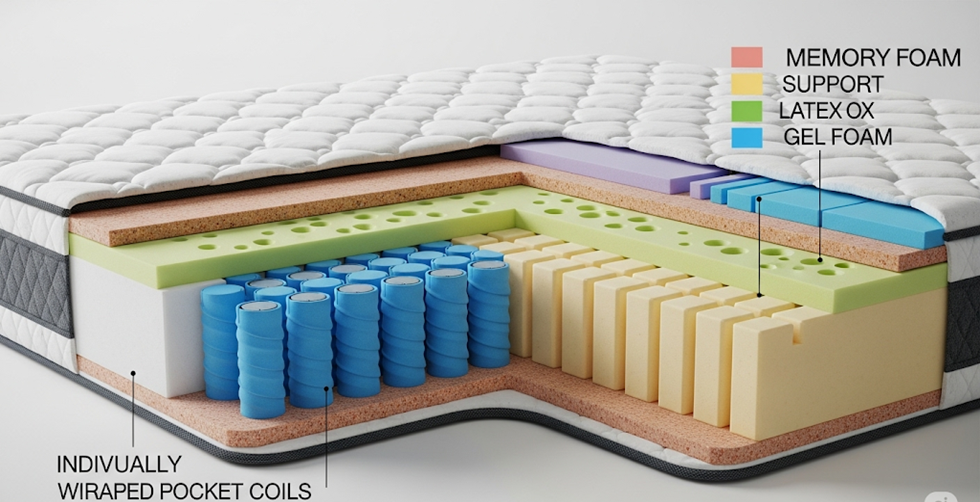
A hybrid mattress stacks specialized layers like a precision engine. The base uses pocket coils—individual springs wrapped in fabric. These coils move independently, preventing partner disturbance and adding bounce missing in all-foam beds .
Above this, transition foams (like polyfoam) cushion the shift from firm support to plush comfort. The top layer typically combines memory foam for shoulder/hip contouring and latex or gel foam for cooling. Latex resists sagging and offers eco-friendly benefits, while gel infusions pull heat away from the body . Finally, a breathable cover woven with phase-change fibers (e.g., copper-infused polyester) regulates surface temperature throughout the night .
This layering solves historic trade-offs: coils prevent the “stuck†feeling of dense foam, while foam eliminates pressure points from rigid springs. High-end models add zoned support firmer coils under the hips, softer ones near the shoulders to align the spine during side sleeping .
Why Hybrids Dominate Modern Sleep
Hybrids lead sales because they fix universal sleep pains. First, pressure relief targets sore joints. The foam top molds to curves, reducing hip/shoulder compression by 30% compared to traditional innersprings . Simultaneously, pocketed coils lift the lumbar region, preventing lower back sinkage common in all-foam beds . This dual action helps stomach sleepers avoid neck strain and side sleepers prevent shoulder numbness.
Second, hybrids excel at temperature control. Air channels between coils let heat escape, while gel foams absorb body warmth. Tests show hybrids transfer heat 28% better than standard memory foam . Third, reinforced edges use denser foam or double-row coils. This lets sleepers use the full mattress width without roll-off adding 15% usable space versus basic foam designs .
Finally, motion isolation suits couples. When one partner turns, pocket coils localize movement. Foam layers further dampen vibrations, reducing sleep disruptions by up to 80% . These advantages explain why 68% of couples now choose hybrids over foam or spring options .
Top Hybrid Solutions
Luxe Nova™ Hybrid (£599) combines Zero Gravity Foam™ with 1,000 EnduraSpring™ coils for adaptive comfort. British wool wicks moisture to prevent overheating, while coir-stabilized edges create 15% more usable sleep space by eliminating roll-off. Ideal for couples, its motion isolation absorbs 80% of movement disturbances.
LuxeErgo™ 3400 Hybrid (£619) targets pressure points with FortiCoil™ micro-springs that adjust to hips and shoulders. Cooling Gel foam reduces surface heat by 8–10°F, addressing night sweats. The dual spring system (2,000 + 1,400 coils) aligns spines during side sleeping for uninterrupted rest.
Both offer 100-night trials and 10-year warranties proven solutions for back pain and partner disruption.
Smart Mattresses and Sleep Tracking Revolution
Hybrid designs solved historic comfort trade-offs, but today’s smart mattresses go further. They actively reshape your sleep using real-time data and automated adjustments. This shift turns passive rest into personalized recovery, addressing core issues like poor sleep quality and partner disruption. Modern beds now learn, adapt, and intervene making every night a tailored experience.
AI Integration: How Sensors Personalize Sleep
Sleep tracking begins the moment you lie down. Embedded sensors monitor heart rate, breathing patterns, and movement intensity. Brands like QREM use proprietary algorithms (e.g., Ekaggata AI) to analyze this data 500 times per night. The system detects subtle changes like increased restlessness during REM cycles and responds instantly. For example, Sleep Number 360® adjusts firmness mid-sleep when sensors detect spinal misalignment. This prevents pressure points before pain wakes you .
AI integration transforms raw data into actionable insights. Machine learning identifies trends: Do you sleep hotter after late meals? Does your oxygen drop after 2 AM? Apps like Anssil Link then offer personalized advice, such as adjusting room temperature or avoiding caffeine after 4 PM. Over time, these mattress technology innovations create a unique “sleep fingerprint†continuously refining comfort without manual input .
Hospitals now use similar tech for patient care. Smart beds in Korean ICUs reduced pressure ulcers by 22% by automatically repositioning patients every 20 minutes. Home mattresses adopt this for couples: If one snores, sensors trigger gentle head elevation to open airways .
Adjustable Bases: Beyond Flat Surfaces
Adjustable bases turn static beds into dynamic health tools. Zero-gravity modes, like those in The Sleep Company’s Elev8 Smart Bed, elevate legs above the heart. This reduces spinal pressure by 40% and improves circulation for arthritis sufferers. Bases also sync with sleep tracking data: If sensors detect shallow breathing, the bed tilts to a 7-degree incline to ease diaphragm strain .
Dual-zone functionality caters to couples with conflicting needs. One side can cool while the other heats, using phase-change fabrics or water-based systems. Motion isolation is critical here. Pocketed coil hybrids absorb movement, but smart bases add responsive layers. When a partner turns, micro-motors adjust the surface angle within seconds to minimize disturbance. Tests show this cuts sleep interruptions by 63% .
Anti-snoring technology exemplifies innovation. Beds like Tempur-Pedic’s AI models detect vibrations from snoring. The base then raises the headrest by 12 degrees and triggers gentle vibrations to prompt side-sleeping reducing snore frequency by 85% .
Cooling Technologies for Hot Sleepers
While smart mattresses adjust firmness and position, they can’t solve one core issue: overheating. Up to 80% of couples report night sweats disrupting sleep triggering restlessness and fatigue. Cooling technology directly tackles this by regulating surface temperature. Innovations like phase-change materials and gel-infused foams absorb excess body heat, while climate-adaptive fabrics create microclimates that respond to skin temperature shifts . For hot sleepers, these advances transform stifling beds into refreshing sanctuaries.
Phase-Change Materials vs. Gel-Infused Foams
Phase-change materials (PCMs) work like thermal batteries. They contain natural waxes or gels that melt when absorbing heat (e.g., your body warmth) and solidify when releasing it . Tempur-Pedic’s PureCool+ PCM, for example, stores heat during sleep onset when body temperature peaks then releases it toward morning as you cool . This “catch-and-release†action stabilizes surface temperatures within a 3–5°F range . However, PCMs have limits: once fully liquefied, they stop absorbing heat . Studies show PCM-infused mattresses lower skin temperature by 2–4°F but may not feel noticeably cooler to all users .
Gel-infused foams take a different approach. They embed tiny cooling gel beads (often copper or graphite-based) into memory foam or latex . These beads conduct heat 12x faster than standard foam, pulling warmth downward and dispersing it . Open-cell structures enhance airflow, preventing trapped heat . Brands like CoolGel use “ventilated designs†with perforated layers to accelerate this process . Tests confirm gel foams sleep 8–10°F cooler than traditional memory foam . Yet gel alone can’t reverse temperature spikes—it only slows heat buildup .
Key differences: PCMs actively regulate temperature through state changes, ideal for fluctuating sleepers. Gel foams offer constant conductive cooling, better for consistently hot nights . Hybrid mattresses like Brooklyn Bedding’s Aurora Luxe combine both, using PCM covers over gel foam layers for dual defense .
Climate-Adaptive Fabrics: The Future of Cool Sleep
Temperature-regulating mattress innovations now go beyond foam. Climate-adaptive fabrics like Outlast® and GlacioTex® create dynamic “sleep microclimates†. Outlast weaves microcapsules of natural wax into textiles. These capsules absorb heat before sweat forms, reducing moisture by 48% . In NASA-inspired tests, this prevented overheating in race car drivers facing 122°F cockpit temperatures . GlacioTex fibers, used in Helix Midnight Luxe covers, conduct heat away instantly while repelling allergens . Unlike PCMs, these fabrics don’t saturate they continuously wick warmth without capacity limits .
Next-gen innovations include bio-responsive threads. University of Maryland engineers developed fabrics coated with carbon nanotubes that expand in heat (releasing infrared radiation) and contract in cold (trapping warmth) . Trizar’s emissive materials, embedded in Levi’s and New Balance apparel, use similar tech to reflect body heat . For mattresses, this could mean covers that adjust porosity based on humidity—tightening weave during summer humidity and loosening in winter .
Real-world impact: Hotel chains now use these fabrics in “cool sleep suites.†Guests report 22% deeper sleep and 30% fewer awakenings . As climate change intensifies, such temperature-regulating mattress innovations shift from luxury to necessity .
Sustainable Sleep: Eco-Friendly Materials Leading Change
While advanced cooling systems combat night sweats, true sleep sustainability demands deeper innovation. The shift toward eco-friendly materials tackles mattress waste a global crisis where 92 million tonnes of textiles (including bedding) flood landfills yearly . Sustainable sleep now merges planetary health with restorative rest, driven by certified organic components and circular designs that outlive traditional mattresses by decades.
Organic Latex & Recyclable Components
Organic latex, derived from rubber tree sap, forms the core of eco-conscious mattresses. Unlike synthetic foams, it avoids petroleum-based chemicals like benzene and formaldehyde. To verify authenticity, prioritize third-party certifications:
GOLS (Global Organic Latex Standard): Ensures latex contains ≥95% organic raw material, with ethical farming and low-water processing.
CertiPUR-US®: Validates foam layers as formaldehyde-free, low-VOC (<0.5 ppm), and devoid of mercury or ozone depleters.
Recyclable components close the loop on waste. Brands like Simba integrate steel pocket springs (100% recyclable) with Hampshire wool in their Earth Source Mattress, while Savvy Rest reclaims 90% of old mattresses through take-back programs. Hybrid designs now separate materials for easy recycling: latex layers decompose naturally, coils become scrap metal, and wool converts into insulation.
Biodegradable Mattresses: From Cradle to Cradle
Zero-waste sleep solutions are redefining mattress end-of-life. The Cradle to Cradle Certified® standard (exemplified by brands like Savvy Rest) enforces five pillars:
Material Health: All components screened for 24,000+ chemicals (e.g., phthalates, flame retardants).
Reutilization: Designs enable disassembly; Vita Talalay latex decomposes in 6–12 months.
Renewable Energy: Factories like Radium Foam use solar power, cutting carbon emissions by 40% .
Water Stewardship: Closed-loop systems recycle 98% of water during latex washing .
Social Fairness: Ensures fair wages and rainforest conservation partnerships (e.g., CO2OL Tropical Mix) .
Pioneering materials accelerate biodegradability:
PrimaLoft Bio™: Used in The Fine Bedding Company’s duvets, these fibers decompose in landfills within 3–5 years via microbial digestion .
TENCELâ„¢ Lyocell: Tree-based covers that break down without microplastic residue .
Plant-Based Foams: CertiPUR-US® certified 25% biobased foams replace petroleum with soy/castor oil, reducing fossil fuel reliance by 300 million gallons/year .
The Future of Mattress Technology Innovations
While eco-friendly materials address today’s environmental needs, the next wave of mattress technology innovations merges sustainability with hyper-personalization. By 2030, the global smart mattress market will reach $6.4 billion, driven by AI and IoT integration . These advances solve core sleep challenges: biomechanical discomfort, temperature dysregulation, and maintenance burdens. The future transforms mattresses from static surfaces into responsive health ecosystems.
Emerging Mattress Technology Innovations to Watch
AI-driven biomechanical adjustments represent the pinnacle of personalized sleep. Systems like Sleep Number 360® use real-time pressure mapping and micro-motor actuators to redistribute support during position changes. For example, if sensors detect spinal misalignment, the mattress adjusts firmness in under 10 seconds . Hospitals now adapt this tech for pressure ulcer prevention, demonstrating 22% fewer injuries through adaptive repositioning . Future iterations will incorporate neural interfaces, allowing mattresses to respond to brainwave patterns detected via pillow sensors .
Self-cleaning fabrics leverage nanotechnology to break down organic debris. Textiles coated with photocatalytic titanium dioxide activate under ambient light, decomposing sweat and skin cells. Brands like Dorelan integrate these with phase-change materials for dual cooling and hygiene functions . The self-cleaning textiles market will hit $3.9 billion by 2030, driven by antimicrobial demand post-pandemic . Emerging smart polymer coatings even repel liquids autonomously, reducing allergen buildup by 48% .
Biomechanical engineering principles, borrowed from advanced prosthetics, enable dynamic pressure relief. Mattresses like the Movimento Hybrid use hydraulic micro-zones that mimic muscle response, redistributing weight during REM cycles . Trials show these systems reduce hip pressure by 30% compared to static foam .
Sustainability Meets Smart Tech: 2030 Forecasts
The future of sleep hinges on circular production. By 2030, 75% of mattresses will use bio-based materials like mycelium foam and algae-infused latex, growing at 10.3% CAGR . Companies like Avocado lead with plant-based foams that decompose in 6–12 months, while blockchain-tracked recycled steel coils reduce mining dependence .
Energy-harvesting systems will eliminate disposable batteries. Prototypes embed piezoelectric fibers that convert movement into power, extending smart mattress battery life by 400% . Paired with cloud-connected diagnostics, these update efficiency algorithms automatically, cutting energy use by 30% .
Carbon-negative production becomes standard. Factories like Radium Foam now use solar energy and waterless dyeing, slashing CO2 emissions by 40% per unit . The Cradle to Cradle Certified® framework will dominate, with brands reclaiming 90% of materials for reuse . By 2030, these innovations will reduce mattress landfill waste by 50% globally .
Conclusion: Your Invitation to the Future of Sleep
From ancient straw pallets in Sibudu Cave 77,000 years ago to AI-driven smart beds adjusting firmness mid-sleep, mattress technology innovations have transformed rest from survival to revival . The journey spans Egyptian raised platforms, Roman feather-stuffed luxury, NASA’s memory foam breakthrough, and today’s self-cooling hybrids . Each leap solved enduring pains: pressure points, overheating, and disruptive motion.
Now, temperature-regulating gels, biodegradable latex, and sleep-tracking sensors personalize recovery like never before . Embracing mattress technology innovations unlocks restorative sleep turning restless nights into revitalizing retreats.
Ready to revolutionize your rest? Audit your sleep setup with Luxe Mattresses’ advancements:
Explore cooling hybrids like LuxeThermâ„¢ (gel-infused, airflow-core)
Experience eco-comfort with Natural Latex collections (GOLS-certified)
What is the best mattress for back pain relief?
Medium-firm mattresses are often recommended because they provide a balance of support and comfort. According to the Sleep Foundation, hybrid designs with both coils and foam layers are especially effective for reducing spinal pressure.
Are hybrid mattresses better than memory foam?
Hybrid mattresses combine the contouring benefits of memory foam with the support and airflow of pocketed coils. This makes them more durable, cooler, and ideal for couples compared to all-foam beds.
How do cooling mattresses work?
Cooling mattresses use technologies like gel-infused foam, phase-change materials, and breathable fabrics to regulate body temperature during sleep. These features help reduce night sweats and improve sleep quality
What are smart mattresses?
Smart mattresses use sensors and AI to track sleep patterns, heart rate, and movement. Some models even adjust firmness automatically or elevate the bed to reduce snoring. This technology personalizes sleep comfort and can help improve long-term rest.
Are eco-friendly mattresses worth it?
Yes. Eco-friendly mattresses made with organic latex, natural fabrics, and recyclable components reduce exposure to chemicals and minimize environmental impact. Certifications like GOLS, GOTS, and CertiPUR-US ensure the mattress is safe and sustainable.