
100-Night Risk-Free Trial
Free Nationwide Delivery
10 Years Warranty
Call us at: 020 4572 5122
0% APR Finance Available
Why Modern Life Is Making Us Bad at Sleep
April 21, 2026

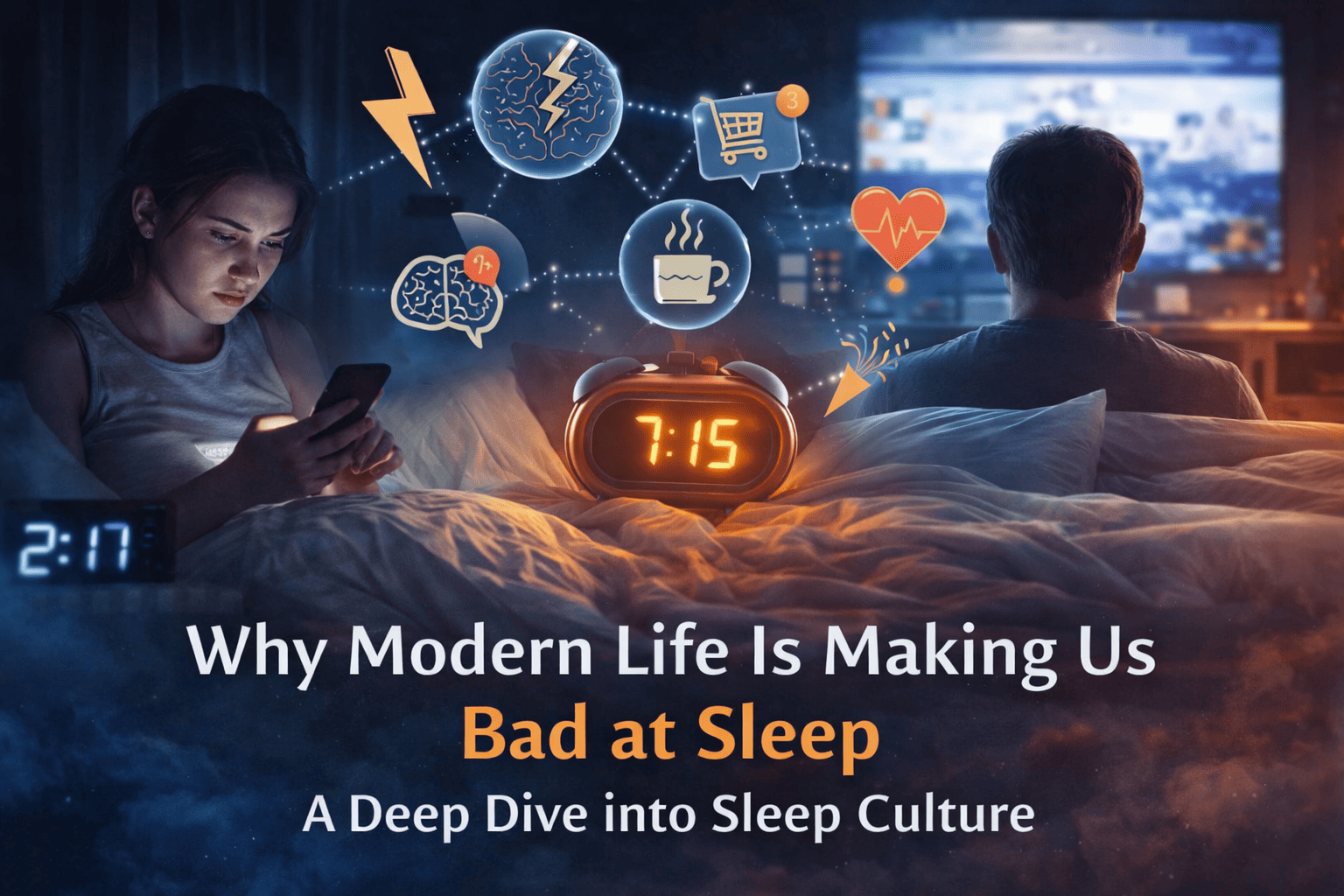
Why Modern Life Is Making Us Bad at Sleep: A Deep Dive into Sleep Culture

The sleep crisis no one is talking about

Modern life is taking a toll on our sleep. In the UK, many people report poor sleep quality.  For example, a Mental Health Foundation survey found “almost one in three adults” in the UK has worse sleep quality due to financial worries.

This reflects a broader crisis. Despite knowing more about sleep and having smart tech, we’re sleeping worse than ever.  One recent report notes that 30% of British adults have poorer sleep, and many more are anxious or sleep-deprived.

In this article, we’ll look at historical sleep patterns, the pressure to sacrifice rest for productivity, the effects of screens and tech, and how stress and our noisy, light-polluted environments disrupt slumber.  Finally, we’ll share expert-recommended remedies to reclaim healthy sleep despite our 24/7 world.

A Historical Look at How We Used to Sleep

Long before electric light and 24-hour cities, human sleep was far more natural and even biphasic.  Historian Roger Kirch found that until the 1800s, many people actually split the night into two sleeps: a “first sleep” and a “second sleep,” with a period of wakefulness in between.

People woke with the sun and slept when it set.  When indoor lighting was limited, the day was ruled by sunlight.  Anthropologists note that traditional societies today – without electric light – often sleep in a single consolidated block at earlier times, aligning closely with natural light. 
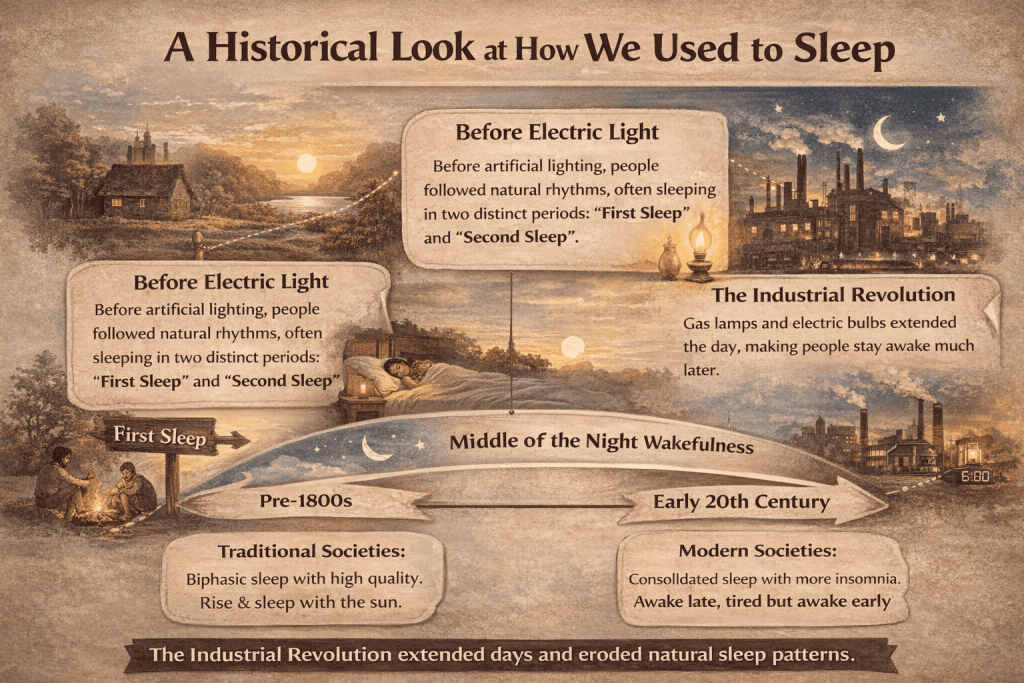
history of sleeping routines

For instance, Amish and hunter-gatherer groups, who rise with dawn, report far lower insomnia rates (around 1–2.5%) than people in modern societies (where as many as 10-30% suffer chronic insomnia).

The Industrial Revolution changed all that.  Gas lamps and then electric bulbs let people stay awake much later, even while still waking with the sun. As Ekirch explains, the spread of artificial light in the 18th–19th centuries “radically transformed” sleep patterns.

By the early 20th century, the segmented two-sleep pattern faded and most people tried to sleep in one long block.  Electric light (and later screens) pushed bedtimes later without pushing wake-up time’s later, eroding total sleep.  The fixed 9-to-5 (or 24-hour shift work) schedules common today also force many to sleep at unnatural times.  In short, compared to our ancestors who rose and slept with the sun, modern life lets us ignore natural rhythms.  We have more hours awake than ever, but often at the expense of quality rest.

The Culture of Sleep Sacrifice:  I’ll sleep when I’m dead

In today’s culture, sleeping enough is often seen as a weakness.  Hustle culture glorifies all-nighters and equates busyness with success.  Phrases like “sleep is for the weak” or boasting about “4AM wake-up routines” are common in entrepreneurial circles. 

Social media and business gurus celebrate the founder who sleeps only five hours a night.  But these norms take a toll.  Recent UK research highlights the scale: over a quarter (27%) of UK small business owners admit they survive on just five hours of sleep per night.  Even worse, nearly 80% of British SMEs said they frequently lose sleep due to work stress.

Long work hours and irregular schedules make sleep problems worse.  A new study by UCL found that people working 55+ hours per week – or who work nights or weekends have significantly shorter and poorer-quality sleep than those on normal schedules.  These busy workers suffer often have short bouts of sleep which last for less than seven hours.  But it gets even worse, it turns out that poor sleep in the UK leads to an estimated £40 billion in lost productivity every year. 

In short, the “work hard, sleep later” mentality is now recognized as self-defeating.  When people brag about cutting out sleep for extra work or study, it’s no badge of honor, it’s a path to burnout and health problems.

The result is that many feel trapped in a cycle of fatigue.  We undervalue sleep in society: staying up late for the office or an email is often praised, while sleeping 7–8 hours is seen as lazy.  This cultural mindset increases stress and makes insomnia more likely.  In other words, the modern work-and-success culture actively discourages one of our most vital biological needs, and in doing so degrades our sleep quality and mental health.

Tech, Screens, and Blue Light Epidemic

One of the most studied disruptors of sleep is modern screen use.  Smartphones, tablets, TVs and laptops emit blue light – a short-wavelength light that profoundly affects our brain’s sleep chemistry.  Blue light from screens suppresses melatonin, the hormone that signals to our body it’s time for sleep. 

In practical terms, scrolling through social media or watching videos late into the evening can trick your brain into thinking it is still daytime.  This delays the onset of sleepiness and shifts your circadian rhythm later.  Even the NHS agrees that we should avoid screens at least an hour before bed, since devices “all throw out blue light that stops sleep”.
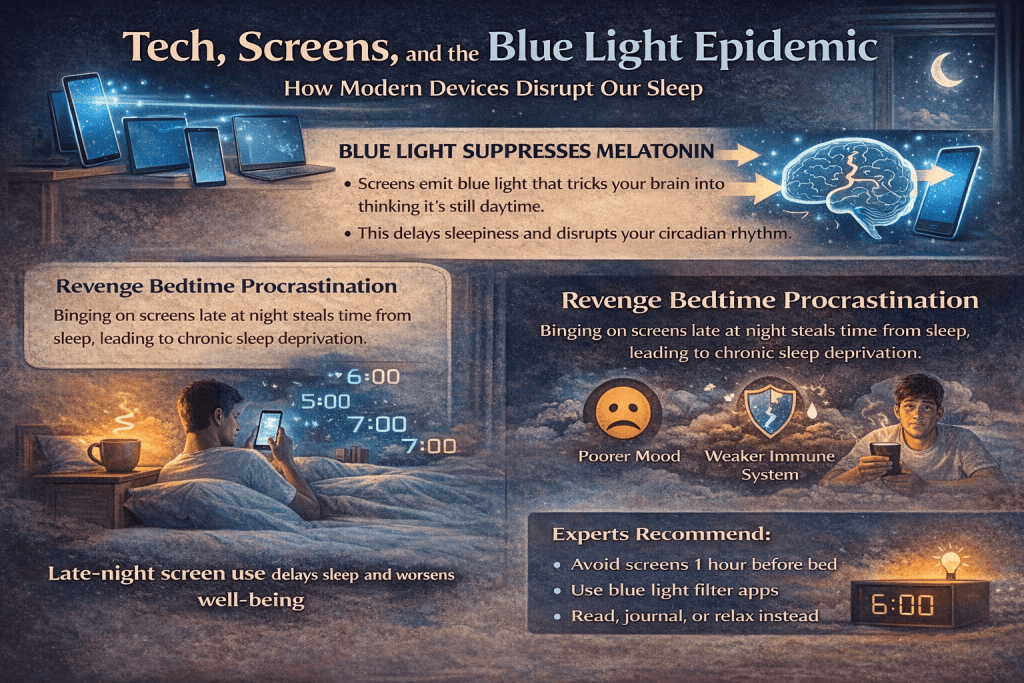
how blue light of phones, tablets, laptop can effect the sleep

This screen effect also feeds “revenge bedtime procrastination”.  That’s the phenomenon where busy adults delay sleep to reclaim personal time.  After a long workday, it’s tempting to binge TV or social media even if you have to wake early. 

Studies show that people with stressful jobs often trade sleep for late-night leisure.  But this comes with its own adverse effects. Those extra hours spent awake can lead to chronic sleep deprivation, which in turn worsens mood and health.  A UK survey during COVID-19 lockdowns reported a surge in both screen time and insomnia, coining the term “coronasomnia.”  Experts note that the combination of more device use and blurred schedules causes “circadian rhythm disruption”. In sum, our obsession with screens in bed is a modern curse on sleep.  The blue light effect delays drowsiness, and the habit of late-night scrolling leads to self-imposed sleep loss (often with a cup of tea or coffee involved too!).  These behaviours undermine our natural sleep drive

Anxiety, Burnout, and Mental Load

Chronic stress and anxiety are sleep’s enemy. When we’re anxious or depressed, our brains stay in a state of “hyperarousal,” making it hard to relax at bedtime.  Physically, stress hormones like cortisol and adrenaline are elevated, which directly fights the rise of melatonin needed to fall asleep.

Psychologically, worries and to-do lists keep our minds racing when we should be winding down.  As SleepStation notes, “stress, anxiety and depression can all make it more difficult to sleep; on the flip side, poor sleep can also make these symptoms worse.”.  In other words, insomnia and anxiety often amplify each other in a vicious cycle.
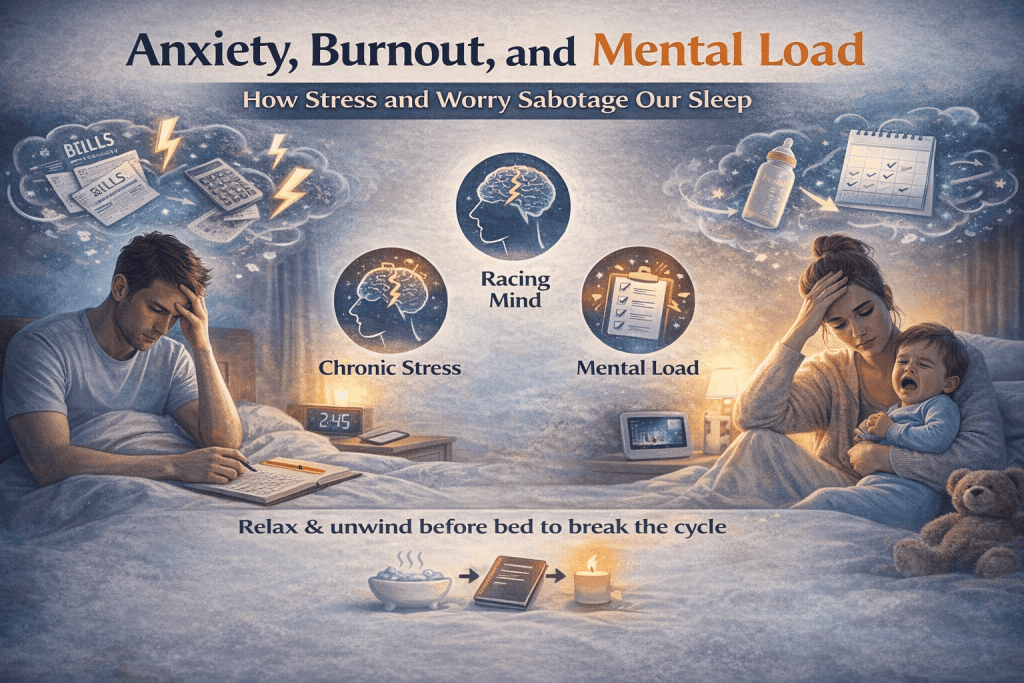
how anxiety effects sleep and how to help it

Parents and caregivers are especially hard-hit.  New parents get far less sleep, of course, but even beyond infancy, the constant mental load weighs on sleep.  The Mental Health Foundation reports that parents, especially mothers of young children, experience major drops in both the quality and quantity of sleep, contributing to stress and fatigue. 

And it’s not just childcare: juggling any significant responsibility (caring for relatives, demanding jobs, etc.) leaves less bandwidth to unwind at night.  UK surveys confirm this: nearly one-third of Britons said financial worries alone gave them worse sleep, and about a quarter cited money stress as a sleep disruptor.

Psychologists advise that addressing the underlying stress is key.  Sleep experts often recommend relaxation techniques (warm baths, meditation, gentle stretching) and cognitive strategies (journaling worries, planning the next day well before bed). 

The NHS Sleep Guide agrees that we should “relax at least 1 hour before bed” and set a regular bedtime to signal the brain to wind down.  Importantly, if you’re lying awake with anxiety, it’s better to get up for a while than to toss and turn.  By breaking the cycle of rumination (e.g. writing a to-do list so it’s out of your head), we can gradually let the mind settle.

In summary, the modern mental load – from economic worries to work pressure to social media stress – actively sabotages sleep.  Experts emphasize treating anxiety and sleep together: improving one often helps the other. 

UK authorities recommend talking therapies like CBT for insomnia, which address anxious thoughts around sleep. The upshot: managing stress and mental load is as important as mattresses for good sleep.

Environmental Disruptions: Noise, light and temperature

Even if we turn off the phone and the thoughts calm down, our bedroom environment can still be at war with sleep.  Urban UK settings pose many challenges: noise, light pollution, and the wrong temperature can all prevent deep sleep. 

Londoners and city-dwellers are often battered by late-night traffic, sirens, or even neighbors.  According to the NHS, “silence is golden” for sleep – ear plugs or white noise machines can help mask disruptive sounds.

Light is another culprit.  Streetlights or early dawn can prematurely arouse us.  Good curtains or blinds are a must.  The NHS advises making sure “your bedroom is dark and quiet”, using heavy curtains or blackout blinds to cut unwanted light.  Small lights from electronic devices such as alarm clocks and chargers should also be eliminated.
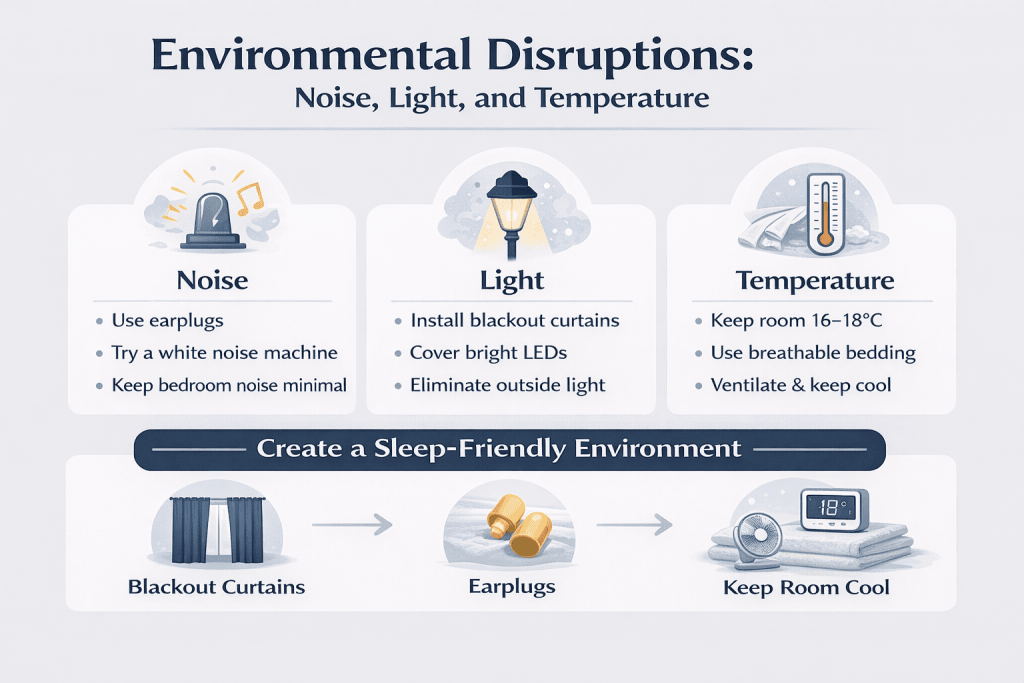
how environment can effect sleep

Temperature matters too.  UK guidance notes that a cool, well-ventilated room is ideal: around 16–18°C is often recommended.  Bedrooms that are too warm make falling asleep difficult.  Use breathable bedding and open a window if needed.  Natural fibers like cotton sheets and wool duvet are more breathable compared to synthetic polyester.

These simple remedies will work immediately if your bedroom is overly lighted, noisy, or heated. Adding blackout curtains and earplugs can make a big difference in how well you sleep. Abed that is excessively rough or too soft can keep you from sleeping or wake you up often.

Think about getting a permeable mattress that lets air flow through it. This will help you adjust the temperature better. Many sleep experts now say that moving to a natural or hybrid mattress will help you sleep better and cooler. In short, carve out a true sleep haven: darkness, silence, and a cool, comfy bed.

Rise of Sleep Performance Culture

In recent years, we’ve had different advancements in sleep technology but perhaps one of the most impressive is the gentle art of quantifying sleep.  From fitness trackers to smartphone apps, we have endless data about our slumber, but this has sparked performance anxiety.  People now obsess over their nightly “scores”, time spent sleeping deeply, sleep efficiency, and REM percentage. 

Paradoxically, this monitoring can make insomnia worse.  The Guardian reports that the UK sleep-tracker market is booming at £270 million per year and many users develop “orthosomnia” an unhealthy fixation on getting perfect sleep readings.

Behavioral sleep therapists see this firsthand.  One UK therapist noted that good sleepers rarely think about sleep at all they just drift off.  In contrast, clients struggling with sleep often pressure themselves to hit a magic number on their tracker. 

Seeing fewer deep-sleep minutes or brief awakenings on a graph can provoke panic, even though such readings are normal for most people.  Researchers coined “orthosomnia” to describe how chasing perfect metrics can fuel anxiety and longer time in bed.

In short, the modern obsession with monitoring has backfired. Rather than trusting our bodies, we second-guess every blink of wakefulness or percent of REM. Experts warn that no device can capture the full reality of natural sleep.

Perfect sleep doesn’t really exist.  This culture of “sleep optimization” means even bedtime is treated like a performance metric to improve, which ironically increases stress around sleep itself.  True experts advise that you should let go of the numbers.  The healthiest approach is to focus on habits and how refreshed you feel after sleeping, not on the nightly report your watch gives.

What Experts Say

Sleep experts and doctors agree on one thing. Make sleep a top priority and follow hygienic methods that are backed by research. The NHS and sleep foundations agree on the basics.  Adults typically need about 7–9 hours per night.  If you’re constantly tired, you’re probably not getting enough of those.  Experts say to go to bed and rise at the same times every day, even on weekends, to stabilise your circadian clock.  They also recommend winding down 30–60 minutes before bed either through reading, gentle stretches, or a warm bath and reserving the bed strictly for sleep, not scrolling or work.

Reclaiming Healthy Sleep

The good news is: we can flip the script on our sleep struggle.  By taking deliberate steps to protect rest, the damage of modern life can be mitigated.  Here are actionable strategies:

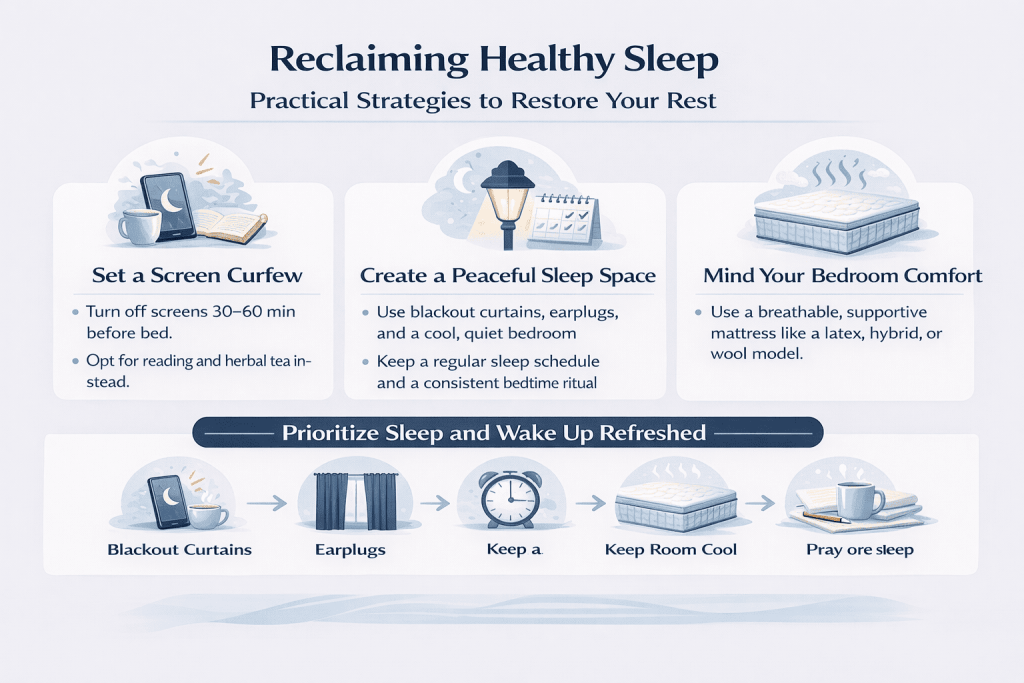
i. Set a screen curfew.

Turn off all devices at least 30–60 minutes before bed. Replace them with calming activities (reading, light stretching, herbal tea). This counters the blue light suppression of melatonin.

ii. Create a peaceful sleep space.

Make your bedroom as dark and quiet as possible. Use blackout curtains to block streetlights, and ear plugs if needed. Keep the room cool (around 16–18°C) and well-ventilated.

iii. Stick to a routine.

Go to bed and wake up at the same times daily. Build a short pre-sleep ritual such as washing your face, changing into pajamas and dimming the lights so your body learns the signal for sleep.
how to start health sleeping routine

iv. Mind your bedroom comfort.

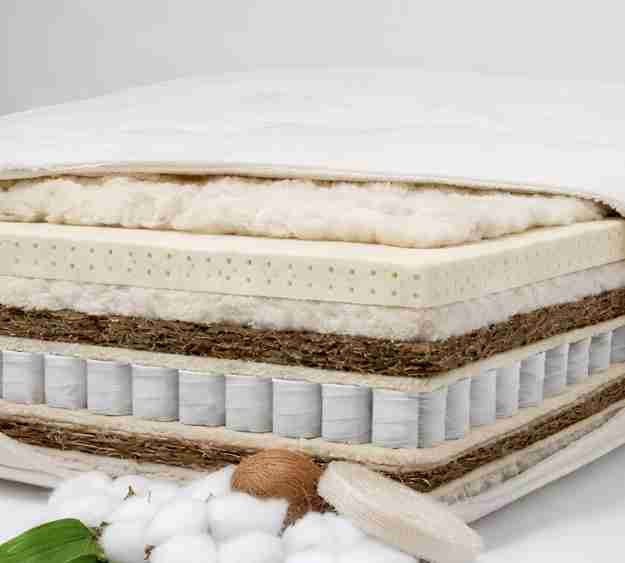
Invest in a good mattress that suits your sleep style. Luxe Mattresses recommends breathable designs: for example, latex or hybrid models that combine coils and foam can keep you cooler and more supported.  Our Natural Mattresses (latex/wool hybrids) are engineered for airflow and are naturally hypoallergenic. 

v. Manage stress mindfully.

Try some relaxation techniques before bed, such as deep breathing, meditation, or journaling. Schedule any worrying thoughts or tasks for earlier, so you don’t carry them to bed.

Reduce stimulants and overscheduling. Don’t drink caffeine or energy drinks late in the day. And learn to say no to non-essential late-night tasks. Remember: missing an hour of Netflix isn’t ruining your life, but missing sleep can.

By taking these steps, you align with what sleep science, actually recommends rather than the usual 24/7 grind culture. You’ll also earn back the right to sleep without guilt, which in turn boosts daytime productivity and health.

Every hour of quality sleep is an investment in your well-being.  Your body and mind will thank you for reclaiming it.

Conclusion

As we’ve seen, our ancestors slept naturally with the sun, whereas today we fight our biology with devices and deadlines. The pressures of productivity and technology can disrupt circadian rhythms and fuel insomnia, but they are by no means insurmountable. 

By recognizing these influences and adopting science-based strategies, we reclaim rest.  It’s not weak to prioritize sleep, it’s necessary. So turn off that phone, draw the curtains, and give yourself permission to rest.  Your body operates better when you listen to it.  In the words of sleep experts, sleep is not a luxury; it’s the foundation of everything you do.

FAQs

Why can’t I sleep at night even when I’m tired?

Stress or anxiety can keep your mind racing and raise stress hormones like cortisol, which block sleep signals. Evening screen use also delays melatonin release. Creating a calming pre-bed routine and limiting screens often restores natural sleepiness.

How does stress or anxiety affect sleep?

Stress keeps your brain in “alert” mode and raises adrenaline, making it hard to switch off. Worrying thoughts can also wake you during the night. Techniques like journaling or simple breathing exercises can help break this cycle.

What is “revenge bedtime procrastination”?

It’s staying up late to reclaim free time after a busy day, even if it means losing sleep. Although it feels empowering, it reduces overall rest and disrupts your body clock. Setting a firm “lights-out” time helps avoid this trap.

What is “orthosomnia” and why is it a problem?

Orthosomnia is an unhealthy obsession with perfect sleep metrics from trackers. Worrying over nightly scores often increases anxiety and makes sleep worse. Experts recommend focusing on how you feel in the morning rather than the numbers.

How can I improve my sleep hygiene in modern life?

Good sleep hygiene means habits that support sleep. Key steps include: going to bed and waking at the same time every day; having a calming pre-sleep routine; keeping the bedroom dark, quiet and cool; and avoiding caffeine, alcohol or heavy meals close to bedtime. Crucially, reduce screen use in the hour before bed, since devices emit blue light that tricks your brain into staying alert.

How many hours of sleep do adults really need?

Most adults need about 7–9 hours per night, but everyone’s ideal is slightly different. If you feel refreshed and alert during the day, you’re likely getting enough. Consistent bed and wake times help your body find its sweet spot.

Does blue light from devices really make it harder to sleep?

Yes. Blue light suppresses melatonin, the hormone that triggers sleepiness. When we use phones, tablets or laptops in the evening, that light fools our brain into thinking it’s still daytime.
From Anxiety to Insomnia: How Emotional Health Impacts Sleep Quality
April 14, 2026

From Anxiety to Insomnia: How Emotional Health Impacts Sleep Quality

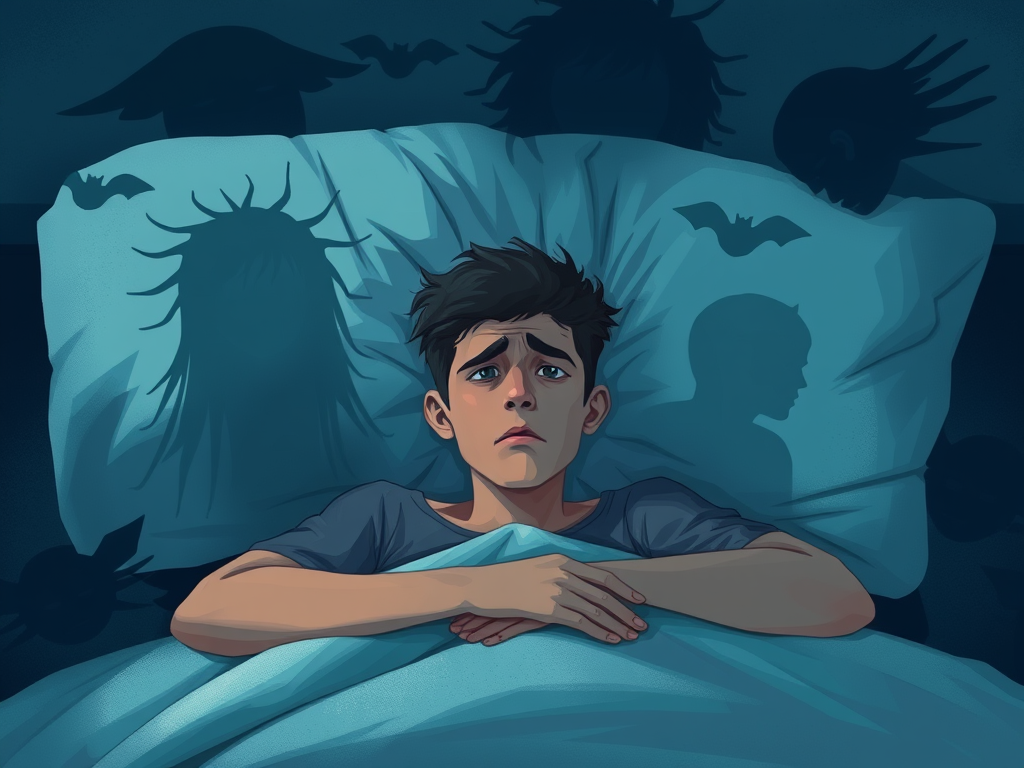
Sleep is not just physical, it is deeply linked to your emotional health. When stress, anxiety, or overthinking take over, your mind stays active, making it harder to fall and stay asleep. Many cases of poor sleep quality come from emotional imbalance rather than bad sleep habits.

From racing thoughts to disrupted sleep cycles, your mental well-being directly affects how well you rest. Understanding this connection is the first step to improving sleep quality and achieving deeper, more restorative sleep.

The Emotional Side of Sleepless nights

It’s hard to separate sleep and feelings. After a bad night’s sleep, most of us know that we can be cranky or nervous the next day. This is often caused by stress, sadness, or anxiety. We now know that not getting enough sleep can make you feel lousy and that being mentally sick can make it hard to sleep. A lot of mental health problems can make it hard to sleep.

This article talks about some of them. When people are terrified, angry, or unhappy, they typically can’t stop thinking. This is because not getting enough sleep might hurt your brain. We’ll also speak about typical triggers, some mental skills that can help you, and bedroom ideas that can help you break the cycle and get the sleep you need.

Understanding Anxiety’s Role in Sleep Disruption

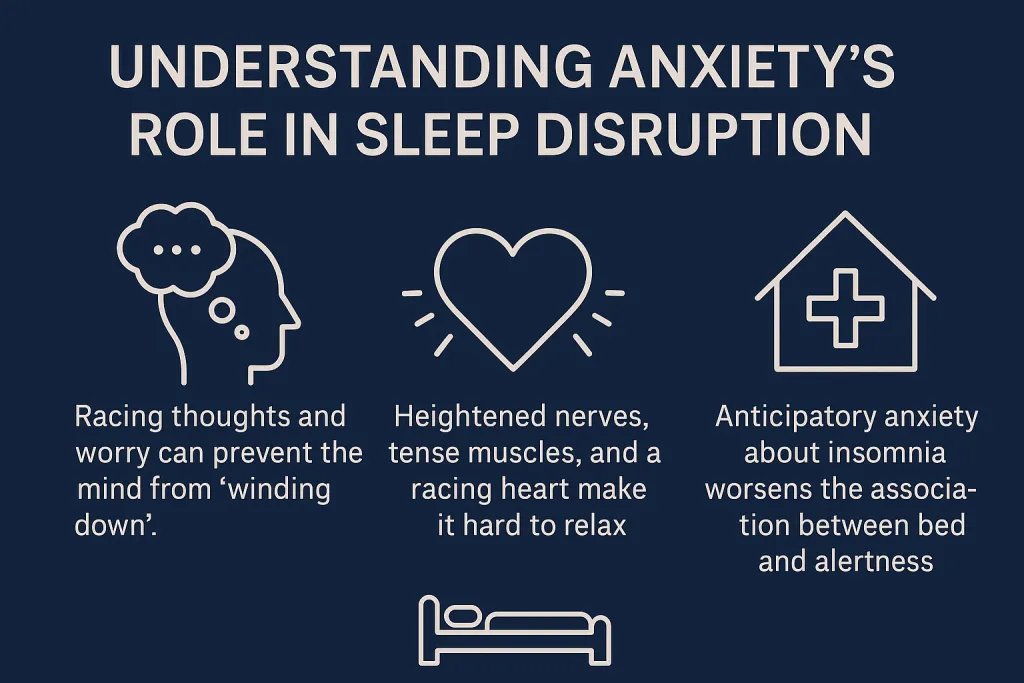
Stress makes the body want to fight or run away all the time, even when it’s time to sleep. Your nerve system gets incredibly busy when you’re terrified or worried. This makes it hard to relax and go to sleep. Sleeping experts note that people with this disease think a lot, have tense muscles, and their hearts beat quickly. A lot of thoughts, tense muscles, and a racing heart are all signs of this illness.

what are sign of anxiety and its role in sleep disruption

When you’re anxious, your body releases stress hormones like adrenaline, which make your heart beat faster and your body heat rise. Stress, a racing heart, and tight muscles can all make it hard to fall asleep or stay asleep. People who are troubled tend to worry about their troubles all the time. Whether you’re thinking about a talk you had or making a list of things you need to do tomorrow, these kinds of thoughts can come in a lot before bed and stop your brain from “winding down.”

Many people experience anticipatory anxiety about sleep itself. For example, “What if I lie in bed all night and still feel tired tomorrow?” is a common fear that people have before going to sleep. In a strange way, this fear of not sleeping can keep them up even longer. As time goes on, the bedroom continues to make you think of tension instead of sleep, which makes insomnia even worse.

In short, anxiety keeps your body and mind over-alert at night. This over-alertness is considered a central contributor to insomnia. The more anxious you feel, the harder it becomes to fall or stay asleep. Without intervention, this pattern can quickly spiral into a chronic problem.

The Vicious Cycle: Poor Sleep Fuels Poor Emotional Health

Both sleep and mood can influence each other. Just as anxiety and stress makes it hard to sleep, poor sleep can also make your mental health worse. Sleep deprived brains handle stress poorly. People tend to get bothered easily by little things, feel more annoyed and sad, and find it hard to regulate their emotions. In fact, the NHS warns that “longer stretches of bad sleep can…have a negative impact on our mental health or wellbeing”.

Biologically, not getting enough sleep makes cortisol rise and makes it harder for the brain to process positive feelings. This makes you feel dull or concerned. Not getting enough sleep can reduce your mood, make anxiety or depression worse, and even raise your chance of having new mental health conditions over the course of weeks or months. Because of this, not getting enough sleep makes stress and anxiety worse, which makes it much harder to get to sleep.

how poor sleep effects emotional health

Research confirms this loop. One study found that chronic insomnia not only often follows anxiety and depression, it can actually predispose otherwise healthy people to develop anxiety disorders later. Likewise, sleeping better has been shown to improve mental health outcomes. For example, therapy that targets insomnia (CBT-I) not only improves sleep but also reduces symptoms of depression and anxiety. In other words, better emotional health and better sleep go hand-in-hand, ignoring one can undermine the other.

Common Emotional Triggers of Insomnia

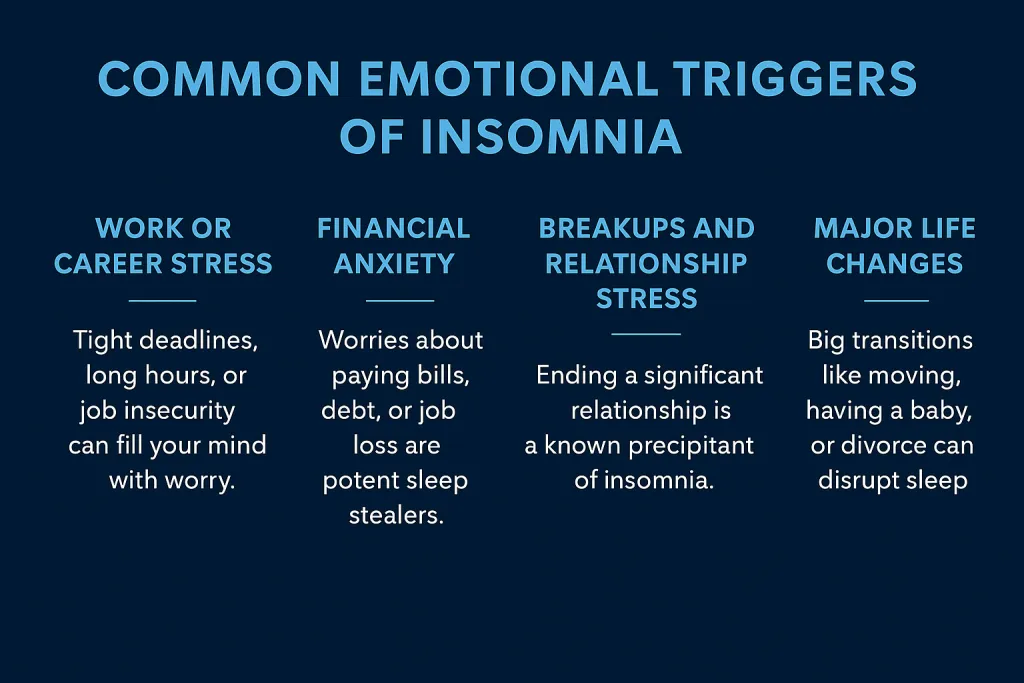
Many everyday stressors and life events can trigger sleeplessness. Here are some of the most common emotional triggers, along with brief examples of how they manifest:

i. Work or Career Stress: Tight deadlines, long hours, or job insecurity can fill your mind with worry.

ii. Financial Anxiety: Worries about paying bills, debt, or job loss are potent sleep stealers. In a recent survey, 77% of U.S. adults admitted they lose sleep over money worries at least some of the time. But seriously though, I totally get them. Making budgets or worrying about debt can easily put sleep at the back corner of one’s mind.

common emotional triggers of insomnia

iii. Grief and Loss: Losing a loved one can be quite upsetting and it often disrupts sleep. Health sources note that “trouble sleeping is common with grief.” Anxiety or sadness over the loss of a loved one can cause frequent awakenings or early morning wake-ups.

iv. Breakups and Relationship Stress: Ending a significant relationship is a known precipitant of insomnia. Behavioral scientist Wendy Troxel notes that losing a partner either through a bad breakup or death makes people feel vulnerable and triggers sleeplessness.

Major Life Changes: Big transitions like moving to a new city, starting (or losing) a job, having a baby, or going through divorce can also be stressful enough to disturb sleep. The emotional upheaval and broken routines during these times often spill into the bedroom.

Recognizing these triggers is the first step. The body’s natural response to worry often is to make sleep difficult. Identifying your trigger can help you tackle the insomnia associated with it.

How Depression Differs from Anxiety in Sleep Impact

While anxiety typically causes difficulty falling or staying asleep, depression can affect sleep in a different way. About 75% of people with depression report insomnia symptoms, but surprisingly many depressed patients also experience hypersomnia (sleeping too much). Studies show that roughly 40% of young adults with depression have hypersomnia. In practice:

  • Depression and Sleep Patterns: People with depression often have poor sleep quality, even if they spend more time in bed. They may fall asleep but wake up too early, or sleep only lightly and feel unrefreshed. Some simply sleep all the time and still feel exhausted. Depression can cause both non-restorative sleep and excessive sleepiness.
  • Anxiety and Sleep Patterns: On the other hand, anxiety usually makes you sleep in a way that makes you restless and hyper-alert. Anxious people tend to lie in bed worrying, startle awake easily, and spend little time in deep sleep. Nights are often fragmented with frequent awakenings.

These differences also show up in sleep architecture. Anxiety keeps the mind wired and awake, while sadness can leave someone dragging all day or waking painfully early. Both disrupt the restorative functions of sleep, but through somewhat different mechanisms.

Coping Mechanisms That Make It Worse

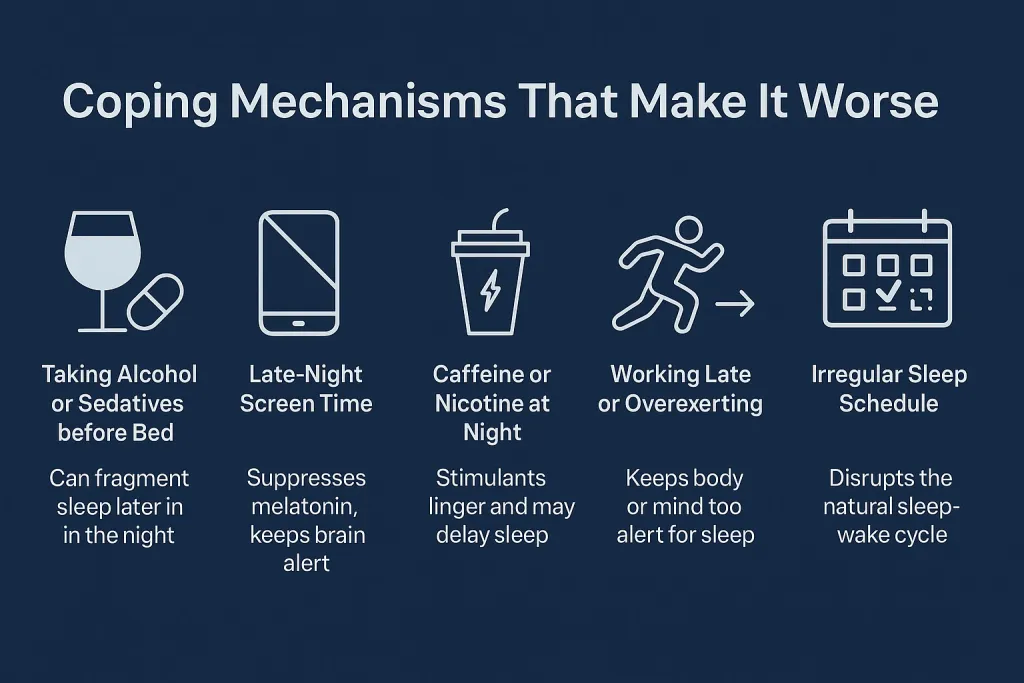
When sleep is elusive, it’s tempting to reach for quick fixes. But many common coping strategies backfire, further disrupting sleep and fueling anxiety. These include:

i. Taking Alcohol or Sedatives before Bed: While a nightcap could make you feel drowsy initially, alcohol fragmented sleep later in the night and lowers REM sleep. This can make you feel fatigued and stressed the next day.

ii. Late-Night Screen Time: Scrolling on your phone or watching TV right before bed throws off your internal clock. Melatonin, the hormone that makes you sleepy, is shut off by blue light from screens, keeping your brain alert. NHS experts advise avoiding electronic devices at least an hour before bedtime. Instead, unwind by reading or listening to calm music.

which factors contribute to worsen emotional health

iii. Caffeine or Nicotine at Night: Stimulants like coffee, tea, energy drinks, or nicotine from cigarettes can linger in your system and make it hard to fall asleep. The NHS notes that things like nicotine, coffee, and other stimulants might make it hard to sleep. Even sweets or some medicines taken in the evening can also be harmful.

Iv. Working Late or Overexerting: Doing work in bed or thinking about things that need to be done can make you feel stressed. Similarly, if you perform a lot of strenuous activity close to bedtime. When it’s time for bed, it’s hard to fall asleep if your mind or body is still awake.

V. Irregular Sleep Schedule: Staying up late on the weekends or changing your bedtime a lot can mess up your body’s natural sleep-wake cycle. A chaotic plan makes it hard for the brain to figure out a time of rest.

These strategies can feel like instant relief or productivity boosts, but they ultimately worsen sleep and anxiety. For example, stimulants are a common cause of sleep problems and should be avoided before bed. Likewise, SleepFoundation experts recommend good sleep hygiene: steady bedtimes, pre-bedtime wind-down routines, and a phone-free bedroom.

Emotional Sleep Disorders You Might Not Know About

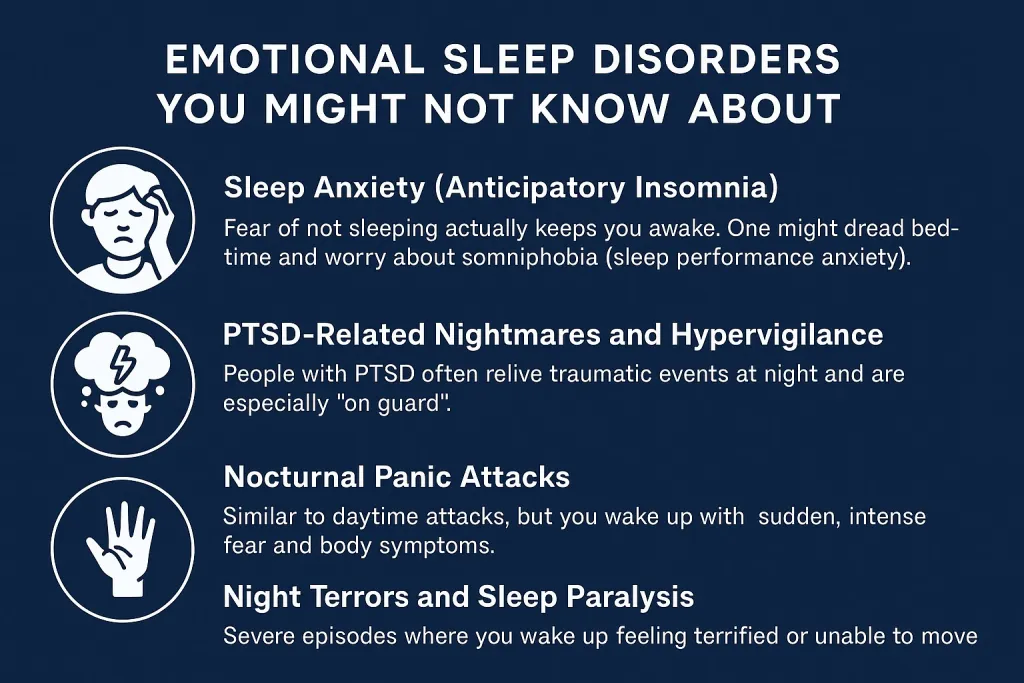
Beyond general insomnia, there are specific sleep disturbances linked to emotional health, which include:

i. Sleep Anxiety (Anticipatory Insomnia): This is when fear of not sleeping actually keeps you awake. A person might dread bedtime, worry about falling asleep, or even develop somniphobia (fear of sleep). Sleep experts call this “sleep performance anxiety.”

ii. PTSD-Related Nightmares and Hypervigilance: People with post-traumatic stress disorder often dream about awful events that happened to them and are particularly vigilant at night. A study found that more than 90% of combat soldiers with PTSD say they have trouble sleeping. People can have bad dreams and wake up many times. They can’t sleep because their bodies are always “on guard.”

what is emotional sleep disorder

iii. Nocturnal Panic Attacks: People with panic disorder don’t want to have panic attacks in the middle of the night, but some do. It’s the same at night: they wake up scared, their heart racing, and they can’t breathe. The Cleveland Clinic says that as many as seven out of ten people with panic disorder also have panic attacks at night. They might be scared, think they’re going to die, and worry that bad things are going to happen, but it wasn’t an emergency; it was just a panic attack.

iv. Night Terrors and Sleep Paralysis: In severe cases, one might experience night terrors, or sleep paralysis. Although more common in children, these disorders can occur in adults under extreme stress or trauma. They are more complex disorders, but are essentially manifestations of the same mind-body fear responses at night.

In all of these disorders, the sufferer wakes up feeling terrified or agitated. For example, having a panic attack at night means feeling very scared quickly, sweating, having a fast heartbeat, and being out of breath. The person is fully awake and afraid, which is not typical. It is vital to note that these indications are not “normal” but are instead induced by worry or stress. People who are hurting should get help because there are effective treatments available, like medication or therapy from a professional. 

Psychological Solutions for Restoring Sleep

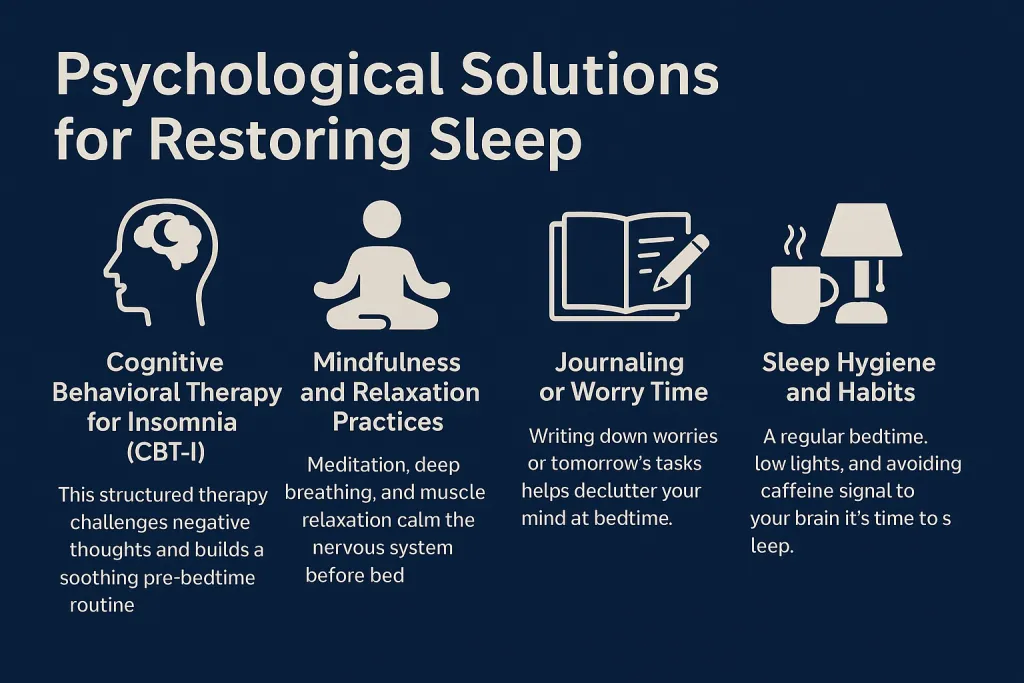
The good news is if your emotions are keeping you up, you can sleep better with the right techniques. Several evidence-based psychological approaches target the anxious thoughts and behaviors keeping you awake, such as:

i. Cognitive Behavioral Therapy for Insomnia (CBT-I): This structured, short-term therapy has been shown to help people who can’t sleep by changing the way they think about and act when they sleep. As part of CBT-I, patients typically learn to examine negative beliefs and build a soothing practice before bed. Big studies have shown that CBT-I not only helps people sleep better, but it also makes them feel less anxious and sad.

ii. Mindfulness and Relaxation Practices: Mindfulness training, like meditation, teaches the brain to stay in the now instead of worrying about the future. Harvard researchers showed that older adults who had difficulties sleeping and exercised mindfulness were much less likely to be weary, depressed, or unable to sleep. You can elicit this “relaxation response” by focusing on your breath or doing some gentle yoga before bed. Progressive muscular relaxation and deep breathing are two easy ways to calm down your heart rate and clear your mind.

what are psychological solutions for restoring sleep

iii. Journaling or Worry Time: Giving anxious thoughts a specific outlet can prevent them from hijacking bedtime. The NHS suggests writing down tomorrow’s tasks before bed as a way to “put your mind at rest”. Writing in a worry book or a thankfulness notebook can also help you relax. The most important thing is to do something peaceful and alone, and then stop when you’re done with your book.

iv. Sleep Hygiene and Habits: Your brain knows it’s time to sleep when you have a regular bedtime routine, like drinking herbal tea and turning off the lights. Don’t eat a lot, drink a lot of coffee, or work out hard straight before bed. Getting outside in natural light and working out regularly can help you fall asleep sooner. These little modifications make it easier for the brain to link bedtime with relaxation instead of worry over time.

If your worry or trauma is really bad, you usually require support from a specialist. Psychologists and sleep experts can make therapies work for you. Getting more sleep can assist your mental health just as much as or more than dealing with stress. For a lot of people, breaking the practice of worrying at night might make them feel better throughout the day.

The Role of Environment in Supporting Emotional Rest

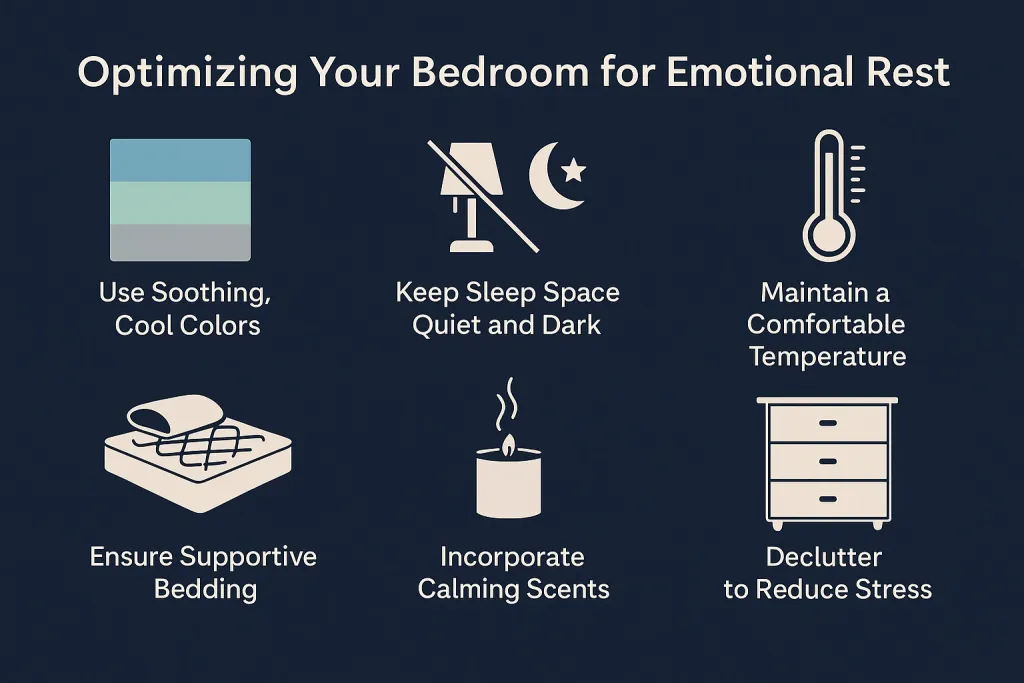
Your bedroom environment can either make your mental tension worse or better at night. The colors, warmth, and mood of the room can all affect your brain and instruct it to relax. Walls painted in gentle blues, greens, or even light gray tend to make individuals feel pleasant and relaxed. People who sleep in blue or green rooms are the most relaxed and get the greatest sleep, according to surveys. You might want to avoid bright reds or yellows, as they tend to make you feel more energized.

Silence is “golden” for sleep. To filter out unpleasant sounds, use earplugs or a white-noise machine. Blinds or eye masks that block off light can assist. Put your phones on silent or in another room. Most individuals sleep best in settings that are a little cold, between 65°F and 68°F (18°C and 22°C). The NHS suggests to keep the bedroom cool and “well ventilated” because being too hot or stuffy might make you feel restless.

how to optimise bedroom environment for better emotional sleep environment

Experts suggest that bedding should be the most comfortable and supportive. You need a mattress that fits your body and supports your spine, as well as a pillow that maintains your neck straight. For example, Luxe Mattresses’ contouring memory foam or hybrid mattresses are high-end and have characteristics that relieve pressure. These mattresses can aid with pain and help the body sleep. Sheets that let air flow and blankets that are soft and cozy might also help you feel safer.

Some smells might help you feel better. For instance, studies have shown that the scent of lavender might help you relax and feel less stressed. You can relax by putting a lavender bouquet next to your pillow or spraying your pillow with lavender. People have employed mellow scents like chamomile and jasmine for a long time to help them sleep. Make sure the smell isn’t too overpowering and doesn’t take over.

A clean bedroom with little mess is finally a place where you can relax and not worry about anything. Keep work things, bills, and notes out of sight. If you can, set up a little “sanctuary” area. A favorite image or plant can help you feel better, but don’t put too much in it, such games or junk.

When your bedroom is safe, tranquil, and comfortable, it helps you forget about the issues you had during the day. The Sleep Foundation suggested that making your bedroom more sleep-friendly and getting into “habits that help you sleep” can help you get more sleep. A good mattress, like the pressure-relieving ones from Luxe Mattresses, and a well-planned room layout will help you relax both physically and mentally.

Conclusion: Emotional Peace = Sleep Peace

In summary, sleep and emotional health are intimately linked. Anxiety, stress, depression and trauma all create physiological and mental arousal that can sabotage sleep. Left unchecked, this leads to a vicious loop: poor sleep raises stress hormones and impairs mood, which in turn makes sleep even harder. By contrast, interventions that target the emotional side of insomnia – therapy, relaxation practices, journaling, environment tweaks – can restore the cycle of sleep and healing.

The key message is hopeful: improving one side often helps the other. Tackling anxiety and stress (through CBT, mindfulness, or counseling) will improve sleep, and improving sleep hygiene will lift your mood and resilience. If sleep struggles persist, consider seeking professional advice – a sleep coach, therapist or doctor can guide you to the right resources. You might also explore LuxeMattresses’ sleep wellness guides and products designed to support both physical comfort and emotional rest.

Remember, the path to a peaceful night often begins with a calm mind. By addressing the emotional roots of sleeplessness, you can find your way back to deep, refreshing sleep – and wake up to brighter days ahead.

FAQs

Can anxiety alone cause insomnia?

Yes. Anxiety and chronic worry can directly interfere with sleep. When the mind is racing or tense, the body stays alert and can’t easily transition to sleep. This “hyperarousal” state is a known trigger for insomnia. Over time, anxiety about not sleeping can further entrench the problem. Fortunately, treating the anxiety often brings significant sleep improvement.

Will improving my sleep help my anxiety or depression?

Absolutely. Studies show that improving sleep through therapy, or good sleeping habits can reduce symptoms of anxiety and depression. For many people, simply getting more rest makes daily stressors feel more manageable, and it can even improve cognitive function and mood. Think of sleep as part of your mental health toolbox: better rest is both a result of feeling better and a cause of feeling better.

How do I create a better sleep environment?

Focus on comfort and calm. Keep the room dark, quiet, and slightly cool. Decorate in soothing colors like blue or green. Remove electronic distractions such as phones and computers from the bedroom. Invest in a supportive mattress and pillows that relieve pressure and keep your spine aligned. You can also introduce relaxing scents like lavender and chamomile while starting some bedtime routines such as reading, stretching, and having a warm bath to help you feel better. Each positive environmental cue sends a signal to your body that it’s time to sleep.

If you implement these strategies and still struggle, it may help to consult a sleep specialist or mental health professional. There are effective treatments available; you don’t have to battle chronic insomnia or anxiety alone. By addressing both your mind and your sleep setting, you can break free from the cycle of anxiety?induced sleeplessness.

the psychology of perfect mattress
April 13, 2026

The Psychology of the Perfect Mattress: How Comfort is Perceived, Not Just Engineered

Mattress comfort isn’t just about foam, springs, or firmness it’s about how it feels to you. True comfort is a personal experience shaped by your emotions, expectations, and preferences. In fact, simply believing a mattress is high-end can make it feel more relaxing, showing how powerful the mind is in shaping comfort.

At the same time, sensory details like fabric, scent, and temperature play a big role in how well you sleep. Your brain processes these signals to create a sense of calm, while familiar textures can help you unwind faster. That’s why brands like Luxe Mattresses blend smart design with psychology to create sleep experiences that feel just right.

What Is Mattress Comfort? A Multi-Sensory Experience

“Comfort” is not a single sensation but a combination of touches, pressures, temperatures and even sounds. When you lie on a mattress, millions of skin receptors send signals to your brain about softness, support and warmth. These messages travel from the spine to the thalamus in the brain and then to the somatosensory cortex.

This portion of the brain generates a “map” of how the whole body feels. This means that your shoulders, hips, and feet all communicate signals. For instance, you might feel a soft cushion under your shoulders, a heavier push around your hips, and a certain warmth or coldness on your skin.

Most essential, everyone feels comfortable in a different way. Someone else could think something is “too soft and unsupportive,” yet to them it feels “plush and relaxing.” An extremely soft mattress could get rid of pressure points, but if it makes your back sag, your brain might think that’s pain or strain. An extremely firm mattress, on the other hand, gives you a lot of support, but it can feel unpleasant if you push too hard against it.

What Is Mattress Comfort? A Multi-Sensory Experience

The NHS claims that the finest mattress “molds to the shape of your body but keeps your spine in alignment.” It should also “distribute your weight evenly” so that your hips and shoulders don’t experience too much pressure. In this way, tactile feedback, from the sense of sinking or pushing back combines with pressure sensation to form the overall feeling of comfort.

Temperature is another sensory factor. Sleep experts note that cooler bedding and well-ventilated materials can help you sleep more easily. A mattress that traps heat may make one feel restless or sweaty, even if its softness is ideal. Conversely, breathable layers (like natural latex or cooling-gel foams) can make the bed feel more pleasant. In short, mattress comfort is a multi-sensory experience: your skin, nerves and even your sense of smell (for example, fresh sheets or hypoallergenic fabrics all feed into your brain’s comfort calculation.

The Role of Expectations and Branding

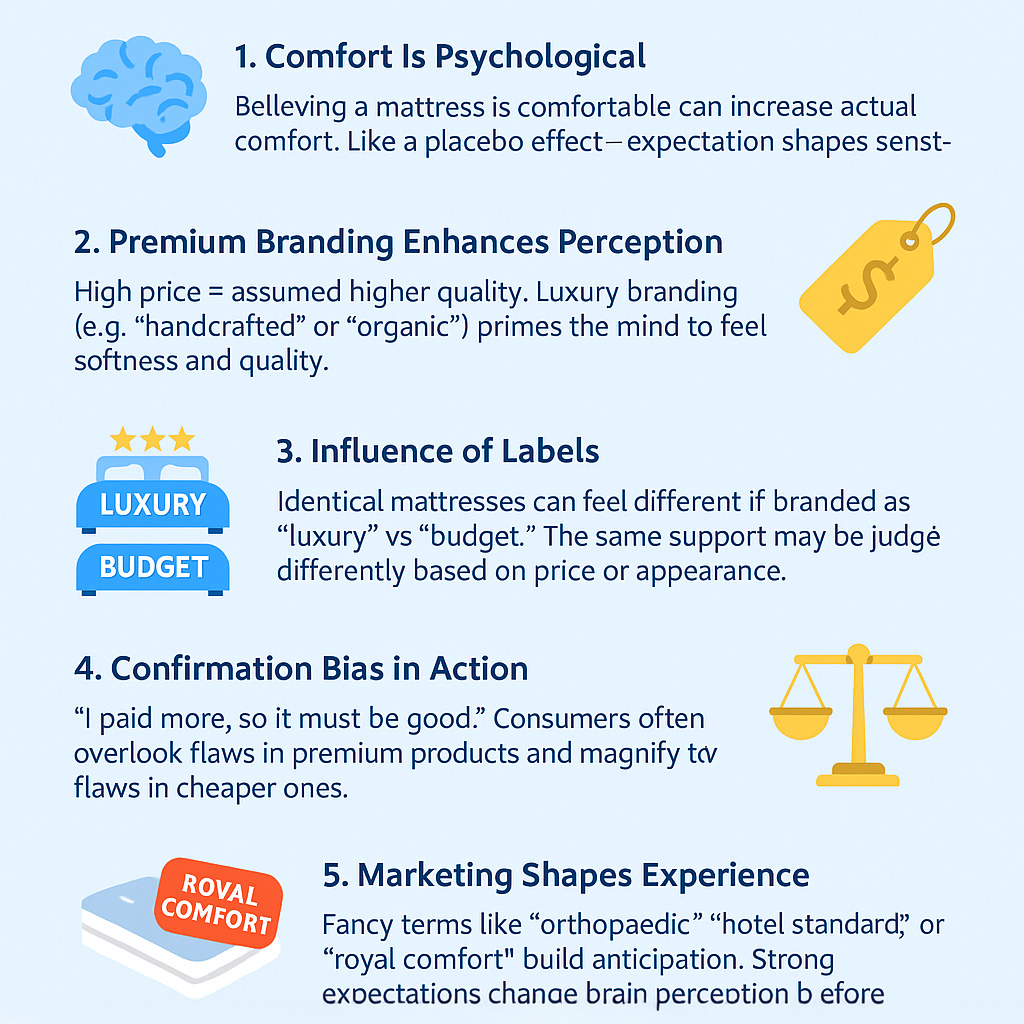
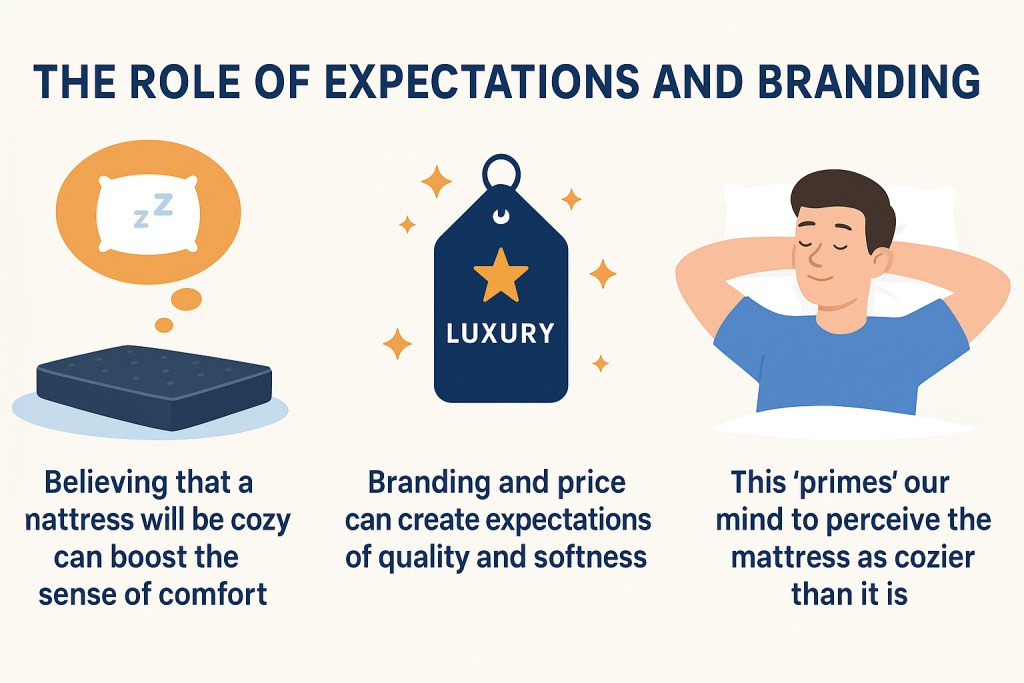
What we expect from a mattress strongly influences how we perceive it. In consumer psychology terms, comfort can be self-reinforcing: believing a bed will be cozy can actually boost the sense of comfort. This is a bit like a placebo effect.

People often pay more for a luxury bed believing it will help them sleep better, and that belief can shape their real experience. Research on product perception shows that “expected comfort”, the comfort a consumer anticipates, can alter the eventual sensation of comfort.

Mattress makers and retailers certainly play on this. A premium brand name or high price tag can create an expectation of quality and softness. For example, some luxury mattresses use tall, hand-tied springs and lavish natural materials (like horsehair) that are inherently comfortable, but they also market heavily on heritage and exclusivity.

The Role of Expectations and Branding

Confirmation bias plays a part, too: once you’ve chosen a mattress as a “luxury” option, you tend the cradling foam, the fine upholstery and downplay minor flaws. Conversely, if you doubt a mattress will suit you, you may hyper-focus on its least comfy features. As one study on product comfort noted, perceived comfort and product satisfaction often hinge on our preconceived data and expectations.

In practical terms, this means that two identical beds could feel different to people who think one is a “premium model” and the other a budget version. Marketing and branding thus “prime” our minds: a higher price or fancy name can make a mattress seem softer or more luxurious before we even lie down.

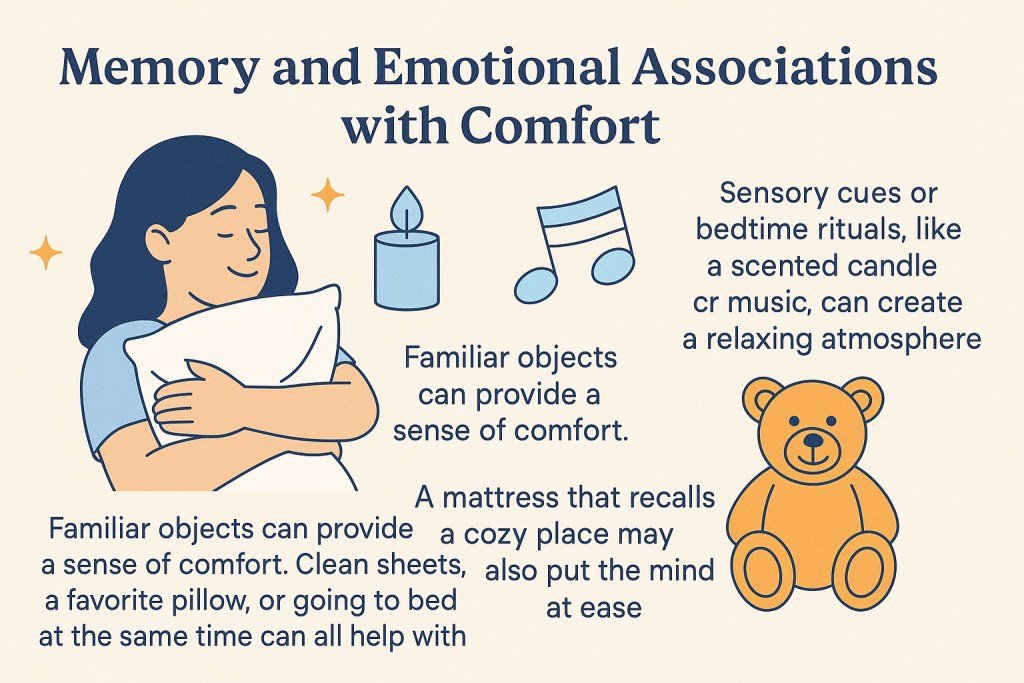
Memory and Emotional Associations with Comfort

Comfort is not purely in the body, it often has deep emotional roots. People often feel most at comfortable on sleep surfaces that remind them of wonderful moments or items they know.

For instance, the smell of clean sheets, a pillow you know well, or the fact that you go to bed at the same time every night can all help you sleep. Psychologists explain that youngsters typically feel safe with “transitional objects,” which include things like a favorite teddy bear, blanket, or toy. Your brain starts to link these items to safety.

Memory and Emotional Associations with Comfort

We may not always know it, but our brains still form associations. For example, a certain shape of cushion, the depth of a mattress, or even a smell in the house might help us rest.

Simple activities like lighting a certain scented candle, listening to the same music, or doing the same things before bed might help relax the brain. You could find it easier to relax if the surface of your mattress reminds you of a calm environment, like your childhood bedroom or a cozy hotel room on vacation.

Sleep therapists say that many adults have a pillow or blanket they “want to use” at night, just like a youngster has a favourite toy. These practices keep happening, which demonstrates that patterns and emotional familiarity help us relax in bed.

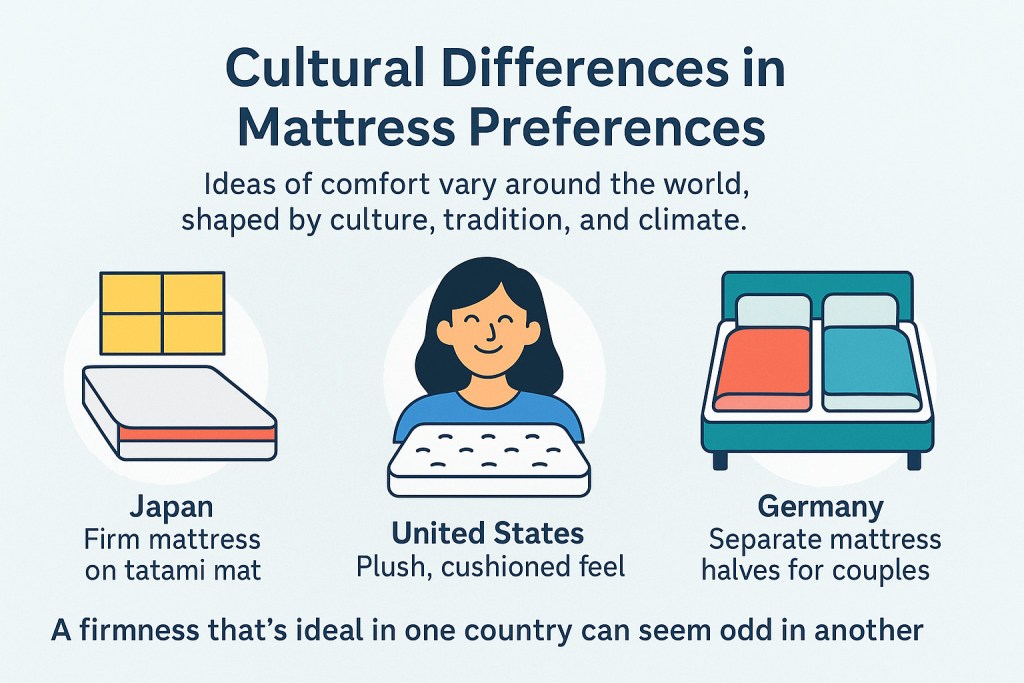
Cultural Differences in Mattress Preferences

Ideas of comfort vary widely around the world. Mattress norms are shaped by culture, tradition and even climate, so a firmness that feels ideal in one country can seem odd in another.

For example, traveler’s’ surveys show stark contrasts: in one study, 62% of Chinese respondents preferred a medium-firm mattress with only 16% choosing firm mattresses, whereas British traveler’s were almost evenly split between firm (43%) and medium (41%).

In Japan, traditional tatami mats and firm “western-style” beds dominate, so the Japanese are accustomed to a quite hard sleep surface. In contrast, Americans often expect a plusher, cushioned feel, reflecting a home industry that popularised pillow tops and thick foam layers.

Cultural Differences in Mattress Preferences

Sleep specialists claim that many Europeans prefer a harder bed since it supports them and is better for their health. Americans, on the other hand, tend to seek soft comfort straight quickly.

Regional customs are also important. In some European nations, like Germany or Scandinavia, it’s common for couples to have two different mattress halves on the same frame, with each person deciding how firm they want their side to be.

In Asia, on the other hand, couples might sleep on thin futons or mats on the floor, which makes the whole space feel softer and more grounded. People who grew up in a culture that emphasises strong back support may find a firm bed natural and comfortable, whereas people who grew up with soft duvets may find the same bed uncomfortably hard.

These cultural preferences are not just legends. This means that the way a bed seems “right” relies on the individual who sleeps on it and the world they grew up in.

When buying a new mattress, it’s important to test the firmness first. Consider your body weight, height, sleeping position, and preferences to find the right firmness level for you.

Find Your Perfect Mattress Firmness

Discover the ideal mattress firmness for your sleep position, body type, and support needs — backed by sleep science.

Take the Assessment ->

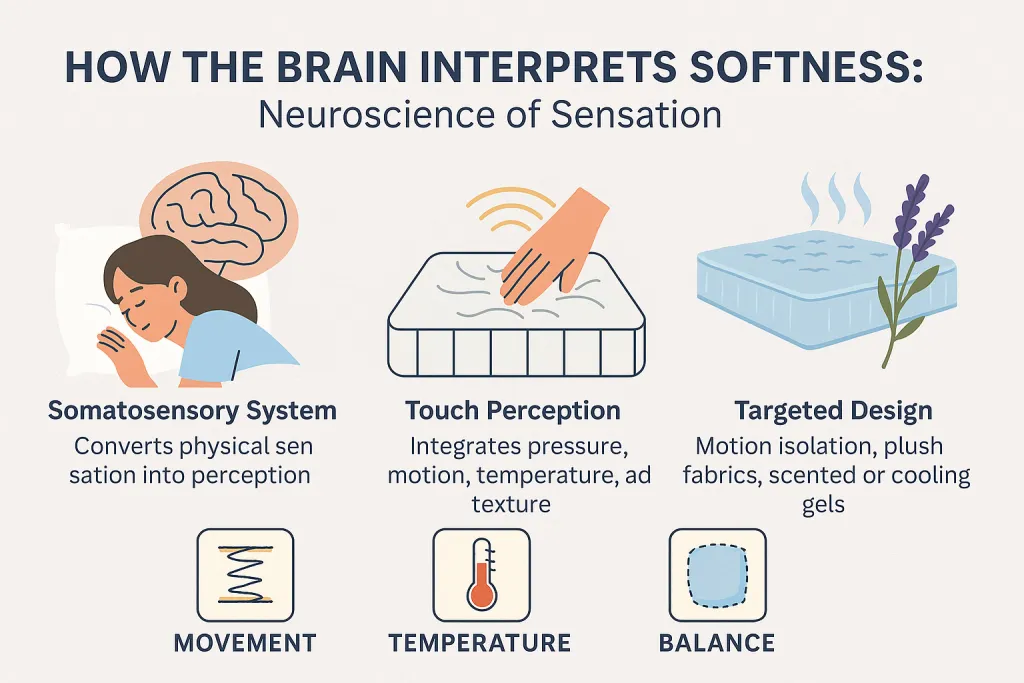
How the Brain Interprets Softness: Neuroscience of Sensation

Our brains are wired to interpret every stimulus in bed, from a gentle caress of the sheets to a cooling mattress topper. The somatosensory system converts physical sensations into perception.

As one neuroscience overview notes, tactile signals travel to the thalamus and then to the somatosensory cortex, “where signals are translated into a touch perception”. This cortical “touch map” integrates pressure, motion, temperature and texture.

Thus, if you shift your hips on a mattress, pressure sensors report how much you sink; if the mattress warms slightly under you, thermal receptors send that signal too.

Design elements in a mattress specifically target these perceptions. For example, motion isolation (found in pocket coils or dense foam) can reduce the movement you feel when a partner rolls over, which the brain registers as uninterrupted rest.

How the Brain Interprets Softness

The smooth fabrics and padded surfaces feel comfortable and cozy on your skin right away, making you feel “plush.” Some mattresses even use fabrics with built-in scents or cooling gels to help the brain relax. If the mattress smells like clean cotton or linen, it might be clean and lovely. People have been able to fall asleep faster when they smell things that are soothing and familiar, like lavender or clean sheets.

The brain also pays attention to things like music and balance. A frame that squeaks or an edge that hangs down could be a concern, but platforms that are sturdy and silent tend to feel better.

You might even be able to adjust how rapidly your heart beats or how you breathe, which can help you feel better. In short, the neuroscience of mood shows us that our brains are always getting messages from all around our body that make us feel happy. The support zones, ability to breathe, and soft feel of a well-made mattress tell your brain that everything is fine. This will usually help you get a better night’s sleep.

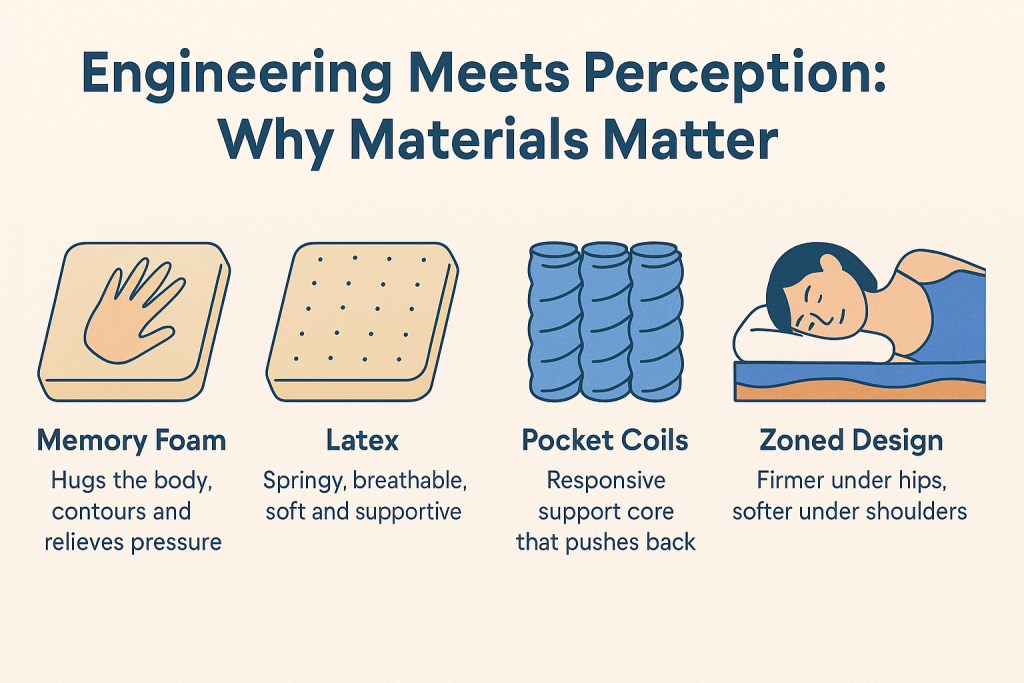
Engineering Meets Perception: Why Materials Matter

Of course the raw materials and construction of a mattress do influence the comfort feeling, they are the basis on which perception is built. Different layers and components create the body sensations that the brain will interpret.

For example, memory foam is known to hug the body, contouring to curves and relieving pressure. LuxeMattresses notes that its memory foam models provide “superior comfort and pressure relief” by molding to your shape.

Latex, by contrast, offers a springy bounce and remains breathable; many sleepers describe it as feeling both soft and supportive. Pocket coils or springs give a responsive support core – when you press down, adjacent springs compress slightly less, producing a sense of support pushing back.

Engineering Meets Perception: Why Materials Matter

Mattress designers often use zoned layers so that the firmer part of the mattress is directly under the hips and the softer part of the foam is under the shoulders. This zoned design caters to our spine’s shape and keeps the body aligned even as the top feels soft.

The art is finding the right balance. An NHS guidance on sleep and posture emphasises that a mattress should not be so soft that your spine collapses, nor so firm that it creates pressure points. It “molds” just enough to cushion hips and shoulders, while maintaining straight spinal alignment.

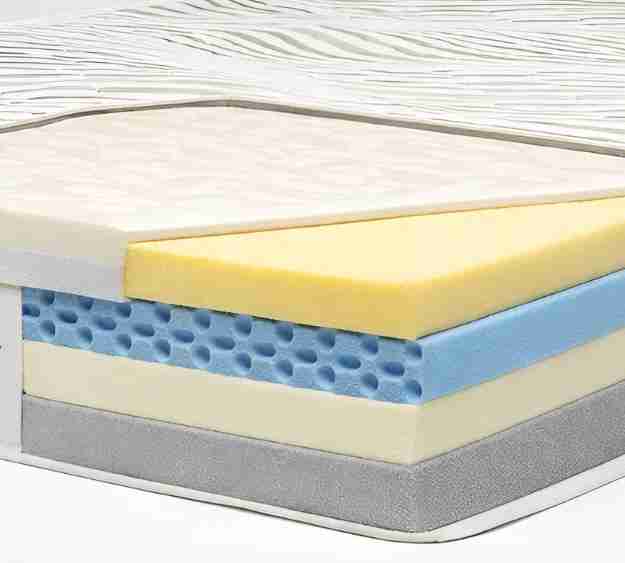
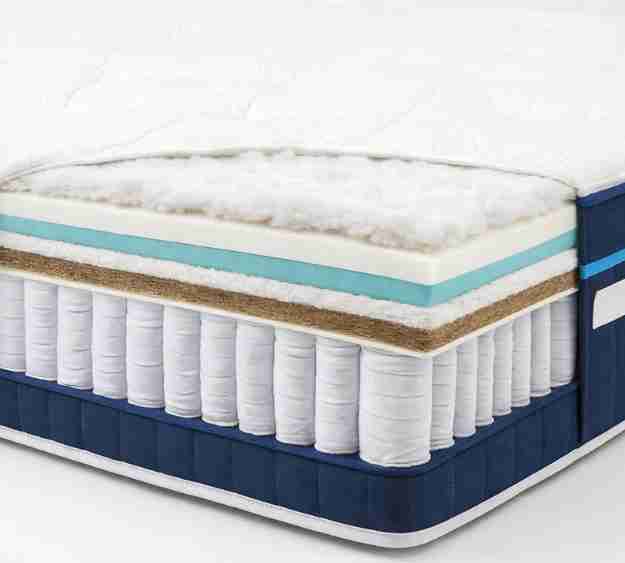
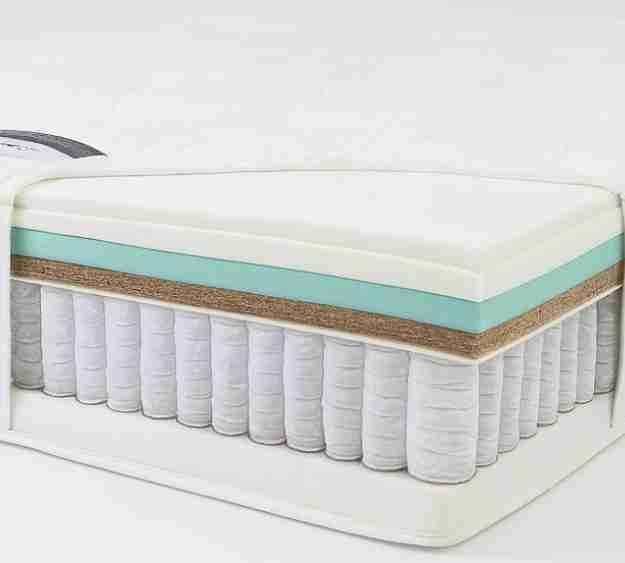
Luxe Mattresses’ own products reflect this principle: our Hybrid collection, for instance, “integrates memory foam with pocket springs” to combine plush cushioning with sturdy core support. In practice, our Hybrids layer high-density base foam for durability with comfort foams and cooling gels on top. The result is a surface that feels soft yet upholds the body’s frame thanks to the coils.

The bottom line is that high-quality materials can achieve both the subjective “softness” and the objective support we need. At LuxeMattresses our design ethos is to offer “affordable mattresses without compromising on quality”, meaning we invest in the right foams, springs and fabrics so that perception and reality go hand in hand.

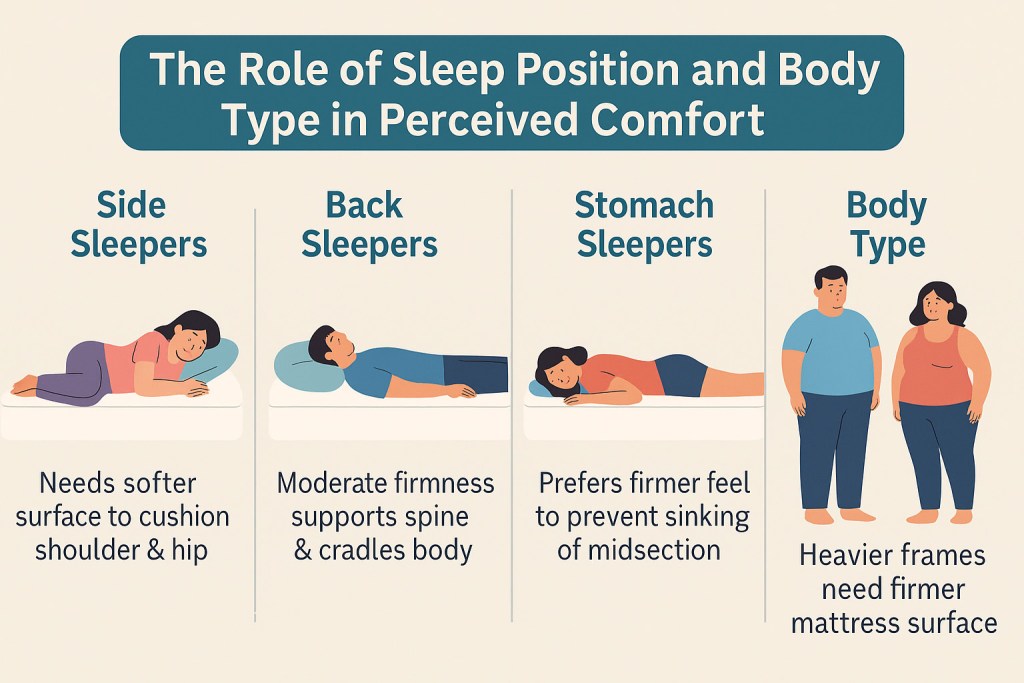
The Role of Sleep Position and Body Type in Perceived Comfort

Even the best-designed mattress will feel different depending on who’s using it. The way you sleep, how much you weigh, and the form of your body all affect how much pressure is exerted on it.

For example, those who sleep on their sides put their weight on one shoulder and hip. The surface needs to be soft to keep those pressure points safe. They’d desire the upper layers of their mattress to be a little softer since a mattress that is too hard under the hip bone can hurt.

But people who sleep on their backs spread their weight out more equally. They usually want moderate firmness: enough support under the lower back to keep the spine neutral, but also gentle cradles under the shoulders and pelvis.

The Role of Sleep Position and Body Type in Perceived Comfort

Stomach sleepers put a lot of pressure on the pelvis and chest; if the mattress is too soft, their midsection will sink and arch the spine. Stomach sleepers often do best on a firmer surface.

Body type is another factor. Heavier individuals such as plus-size people compress mattress layers more, so they typically need firmer cores or denser materials to prevent sinking too deeply.

Lighter sleepers may find a very firm mattress feels unyielding, since their lighter weight doesn’t push far into the layers. Many brands, including LuxeMattresses note that back or side sleepers often prefer firmer or zoned mattresses that support the low back, whereas lighter side sleepers can often enjoy plusher padding without losing support.

As the NHS guide suggests, the best approach is to choose a mattress that can mold just the right amount to your body shape while holding your alignment.

Modern beds often come in multiple firmness grades such as extra firm, medium, and soft. The good thing is you can test any of these mattresses at home. LuxeMattresses, for example, offer many firmness options and even orthopaedic models which are specifically used to optimise back health. There are also internal support zones in mattresses designed for side or back sleepers. In the end, comfort is highly individual: what feels like a cloud to one person could be a sinking hole to another.

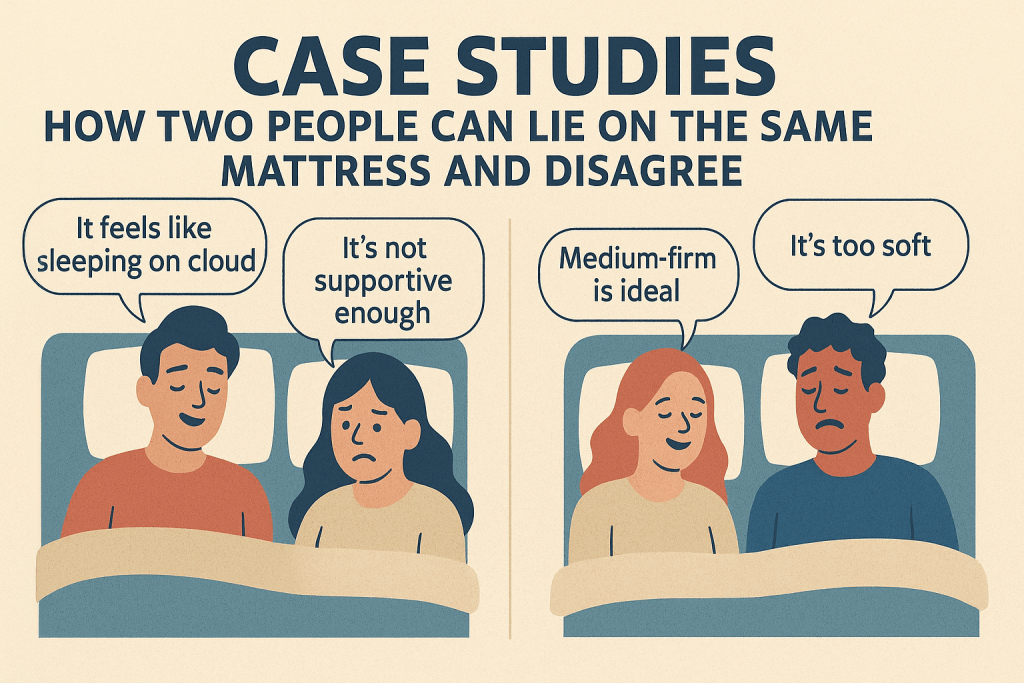
Case Studies: How Two People Can Lie on the Same Mattress and Disagree

Real-world experience shows how subjective mattress comfort can be. Imagine a couple sharing a bed: one partner might love the plush softness, while the other feels it’s not supportive enough.

In customer feedback, it’s common to hear divergent opinions on the same model. Online reviews for midrange beds often include comments like “feels like sleeping on a cloud” alongside complaints of “sagging and backache,” often by people of different builds or expectations.

How Two People Can Lie on the Same Mattress and Disagree

Another common example: a side-sleeper might praise how a mattress cradles their shoulder and hip, while a stomach sleeper of similar height may report the same bed causes a low-back arch.

Similarly, personal habits matter: someone who grew up on a traditional firm mattress might describe a medium-firm bed as “too soft,” whereas someone used to a pillow-top might describe it as “ideal”.

These anecdotes underscore that comfort is highly individual. There is no single “perfect” bed for everyone; it is a dialogue between body and mind, and what works for one person can feel quite different to another.

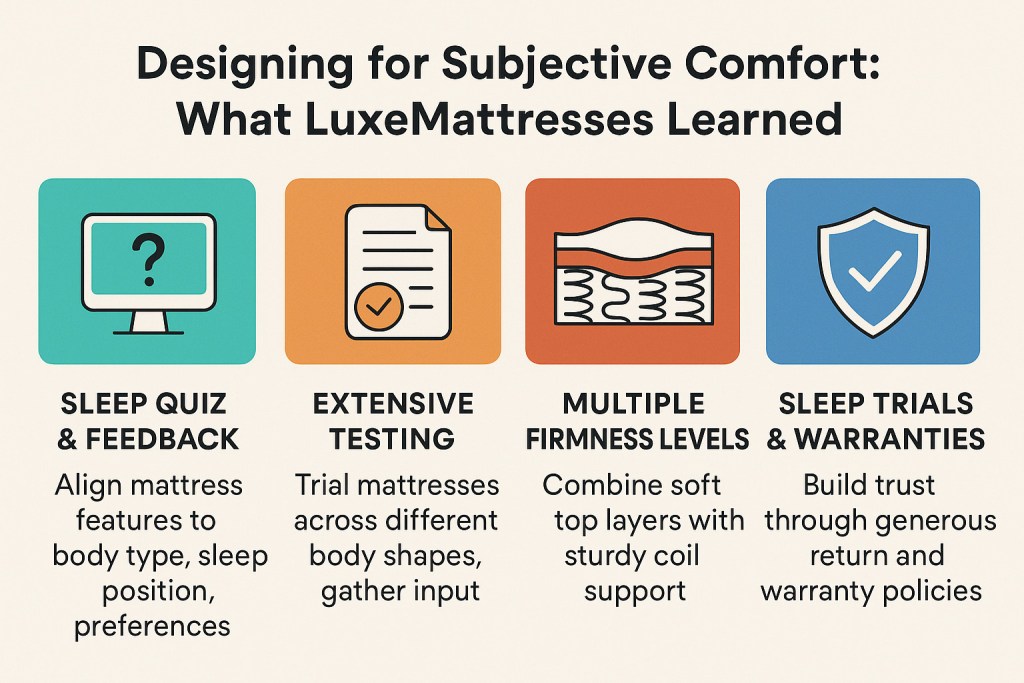
Designing for Subjective Comfort: What Luxe Mattresses Learned

At LuxeMattresses, the lesson is clear: you have to combine good engineering with customer understanding. The company invests heavily in research and feedback to get this balance right. For instance, our online Sleep Quiz built with sleep scientists, has matched over 3,000 customers to a mattress they ended up sleeping better on, with 80% of users reporting improved sleep quality within a month. This high satisfaction rate reflects that aligning mattress choice to personal factors (body type, position, heat sensitivity, etc.) pays off.

Luxe Mattresses also emphasises extensive product testing. We trial mattresses with people of different shapes, getting direct feedback on comfort. If one person’s shoulders feel numb or another’s hips feel pinched, they tweak layer thickness or firmness zoning. Marketing data like return rates and reviews guides them too.

Designing for Subjective Comfort: What Luxe Mattresses Learned

In practice, this has led us to offer multiple firmness levels and hybrid designs. For example, our Hybrid range uses memory foam for immediate softness but places a reinforced coil base (EnduraSpring™) for long-term support. By blending materials, we aim to let sleepers have a first feeling of softness without “losing” the spinal alignment.

Another focus is trust and testing. LuxeMattresses offers 100-night sleep trials and 10-year warranties, signalling confidence that their beds maintain comfort. Our About Us states we strive for “affordable mattresses without compromising on quality”.

That means real-world durability (materials that don’t sag prematurely) matches the initial “wow” factor. The design philosophy explicitly takes psychology into account: gentle curves in foam layers to mimic body shape, cooling fabrics to allay the fear of overheating, and even use of colors/textures meant to look plush.

In essence, LuxeMattresses has learned that subjective comfort isn’t left to chance. By combining neuromuscular design with smart customer profiling, we “engineer” the perception of comfort too. The result is a conversation between body and brain, guided by science that shapes the feel of the perfect mattress.

Conclusion: Comfort is a Conversation between Body and Brain

A truly comfortable mattress is more than the sum of its parts. It is where engineering meets psychology. The perfect bed for you will depend on a dialogue, not only between your body and the mattress, but between your expectations, memories and the mattress’s material responses. One person’s soft cloud could be another’s sinking trap; one person’s firm orthopaedic surface could be another’s ideal spine-saver. All of these experiences are valid because comfort is deeply subjective.

In deciding what feels best, it’s worth remembering the many influences: your sensory thresholds, your childhood associations, and even your cultural background. Brands like LuxeMattresses acknowledge this by offering a range of mattress types and firmness levels, and by giving tools like sleep quizzes and trials so that each customer finds their fit. No one mattress is perfect for everyone, but by understanding the psychology behind comfort, you can find the one that’s perfect for you.

Explore more on our resources: if you’re curious about your own preferences, check out our Blog for guidance. Sweet dreams start with finding what your body and brain agree on.

FAQs

What exactly makes a mattress “feel soft”?

A mattress feels soft because its comfort layers, such as memory foam or quilted foam, contour under your weight, easing pressure on shoulders and hips. A plush top layer combined with a supportive base gives a cushioned yet stable sensation. Too much softness, however, can allow your body to sink too deeply, so the best designs balance soft covers with firmer cores.

How do my expectations about a bed affect comfort?

Expectations act like a placebo: if you believe a mattress is high-end or promises better sleep, you’re more likely to perceive it as comfortable. Branding, price and presentation can prime your mind to notice positives and overlook minor flaws. It’s always wise to test a mattress firsthand rather than rely solely on reputation.

Why do preferences for firm or soft beds vary between countries?

Cultural norms and upbringing shape our comfort benchmarks. Europeans often favor firmer beds for back support, whereas Americans may prefer plusher mattresses; in Asia, traditional futons or tatami mats set a firmer standard. Each region’s typical bedding and sleep habits inform what its people consider comfortable.

Does the material (latex, foam, and springs) really change comfort?

Yes. Memory foam hugs the body and relieves pressure points, latex offers a springy, breathable feel, and pocket springs provide responsive support and airflow. Combining materials, like memory foam over pocket springs in LuxeMattresses hybrids, creates both a soft initial feel and reliable support.

How can I tell if a mattress supports my spine properly?

A supportive mattress molds to your shape while keeping your spine aligned. Lie on your back: there should be only a slight gap at your lower back, and on your side, the mattress should fill the space between your shoulders and hip. If your spine curves too much or your joints press painfully, the mattress is either too soft or too firm.

How does mattress comfort affect sleep satisfaction?

 Sleep satisfaction is your perception of how well you slept, and comfort plays a big role. A mattress that helps you fall asleep quickly and stay undisturbed leads to feeling more rested and alert during the day. In turn, better subjective sleep quality often boosts overall well-being.

My partner loves a very soft mattress but I prefer firm. What should we do?

Try a mattress with zoned support or dual-firmness, firmer under the hips and softer at the shoulders, or use a mattress topper to adjust one side. You could also consider separate mattresses on a shared frame, a common European approach. Many brands, including LuxeMattresses, offer trial periods so you can test and find the right compromise together.

Product has been added to your cart