


How Sleeping Positions Determine Your Mattress Choice
Your preferred choice of sleeping position could actually have a big impact on which mattress is the best one for you. Find out more over on the blog now.
 May 20, 2026
Your preferred choice of sleeping position could actually have a big impact on which mattress is the best one for you. Find out more over on the blog now.
 April 16, 2026
Choosing the best mattress for back pain is not as straightforward as picking the firmest or most expensive option. One of the biggest mistakes people make is assuming that a single type of mattress will work for everyone. In reality, mattress selection is highly personal and depends on multiple factors that most people don’t even consider before making a purchase.
There are several variables involved, including body weight, sleeping position, body temperature, geographical location, previous mattress experience, and whether you sleep alone or with a partner. Even factors like how much you sweat at night or how sensitive you are to motion can significantly affect your choice. All of these elements play a role in determining what truly becomes the best mattress for back pain for an individual.
You cannot generalise mattress suitability because every individual has different sleeping habits and physical requirements. Someone who sleeps on their back in a cold environment will need a completely different mattress compared to someone who sleeps on their side in a warm, humid climate.
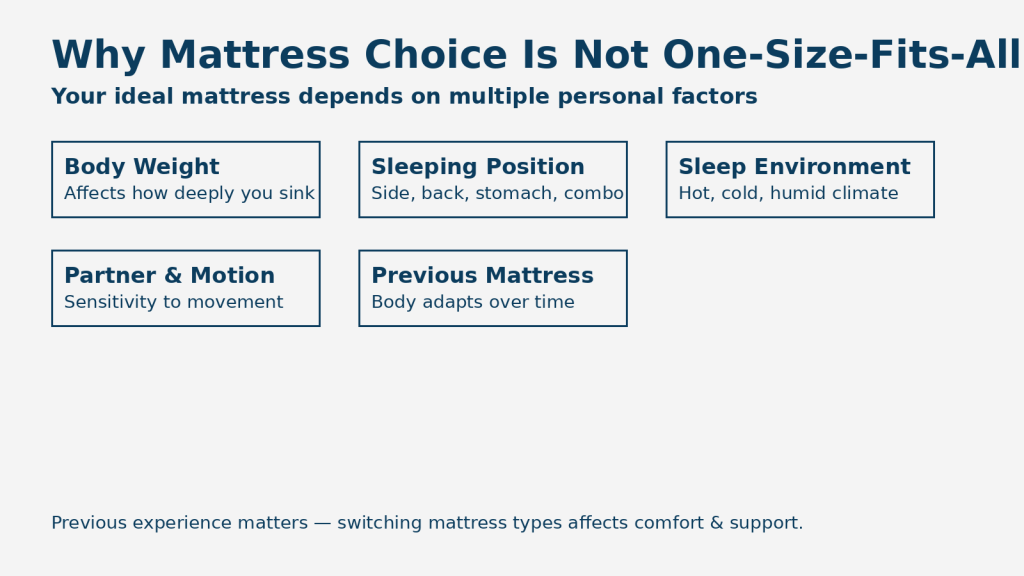
For example, your decision should always consider:
Previous experience matters more than most people realise. If someone has always slept on a firm foam mattress, switching directly to a soft hybrid can feel uncomfortable and even worsen back pain initially.
When people search for the best mattress for back pain, they often don’t realise that back pain itself varies.
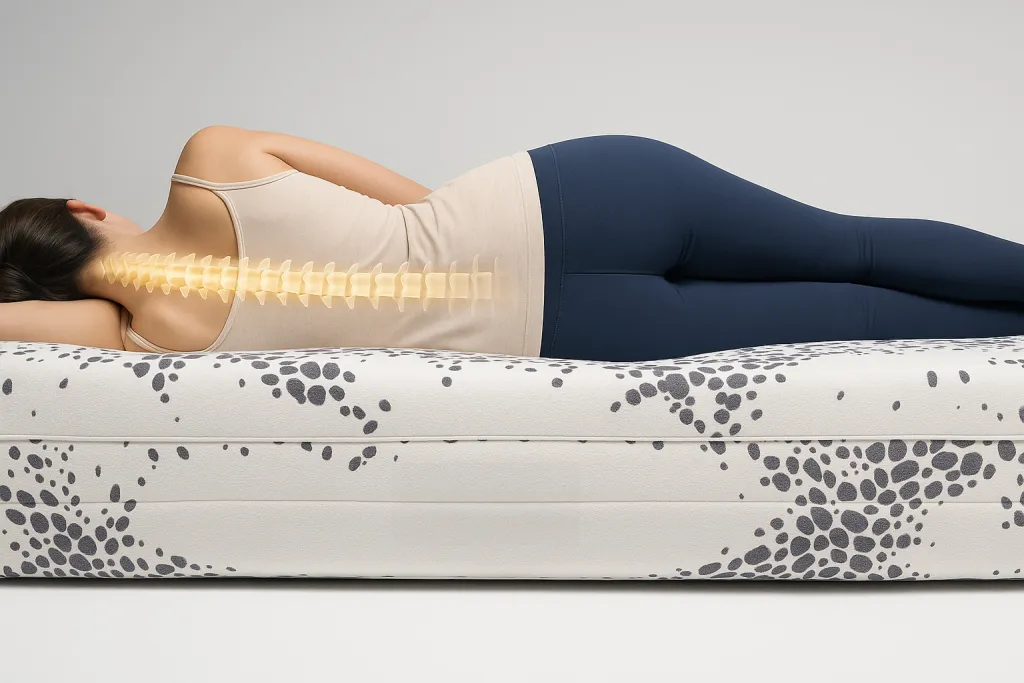
Lower back pain is the most common issue and is usually caused by improper spinal alignment during sleep. This happens when the shoulders remain on the surface of the mattress, but the hips dip too deeply due to uneven weight distribution. As a result, the spine curves unnaturally, creating pressure throughout the night. read more…
This issue can occur regardless of sleeping position, whether you sleep on your back, side, or stomach. The key problem is always the same: lack of proper support.
Upper back pain, on the other hand, is more common in side sleepers. It is typically caused by pressure building up around the shoulders and upper back when the mattress does not allow enough contouring.
Sleeping position plays a crucial role in determining the best mattress for back pain.
If you are a side sleeper, an extra firm foam mattress may not be the best option. Firm foam mattresses are not flexible and do not allow your shoulders to sink into the mattress. This creates a gap between your shoulders and hips, leading to spinal misalignment and increased pressure.
In such cases, better options include:
Pocket springs are particularly effective because they respond individually to body weight, allowing proper alignment.
If you are a back or stomach sleeper, the situation is different. You generally need a more stable surface that prevents your hips from sinking too much. This is where firmer mattresses, especially high-density foam, can be more effective.
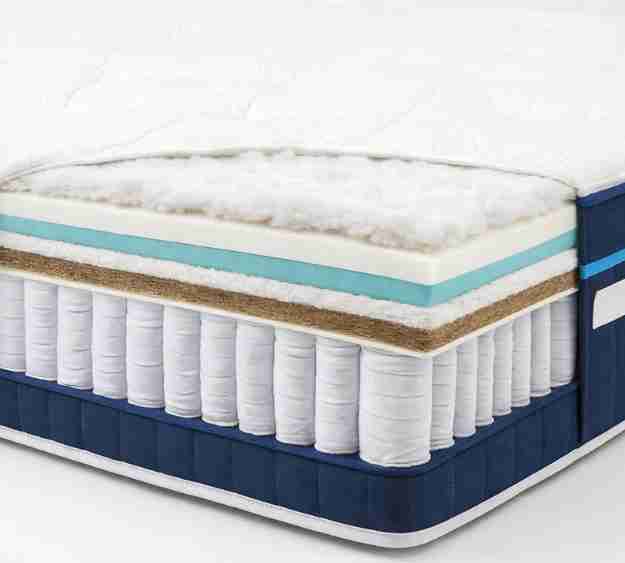
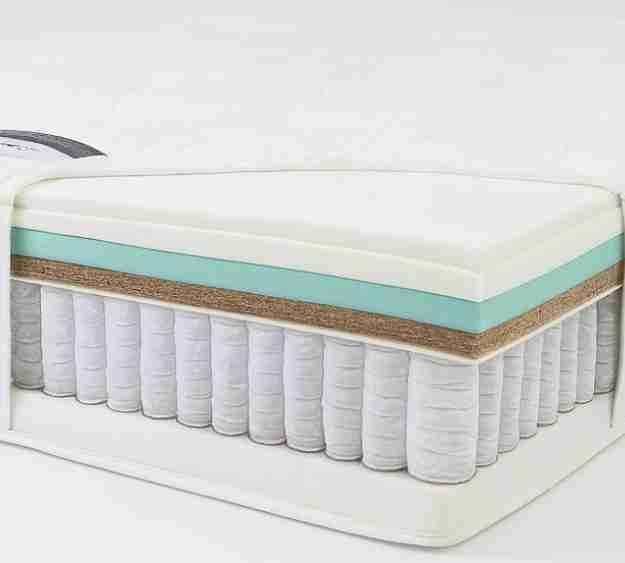
Hybrid mattresses are often considered the best mattress for back pain because they combine multiple materials to deliver both comfort and support.
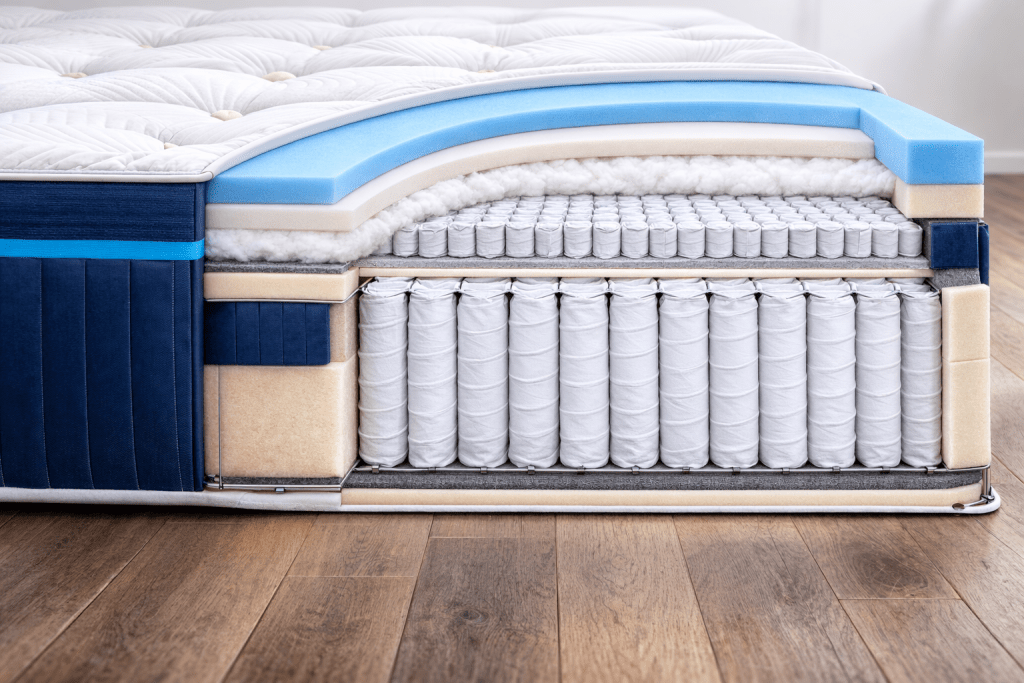
A true hybrid mattress includes:
Premium hybrid mattresses use dual or even triple spring systems, which significantly improve support, reduce motion transfer, and help regulate temperature.
These mattresses provide a balanced feel, not too soft, not too hard and adapt to different sleeping positions. They also offer strong edge support, especially when built with reinforced or metal framing, making them more durable than standard “mattress-in-a-box” designs.
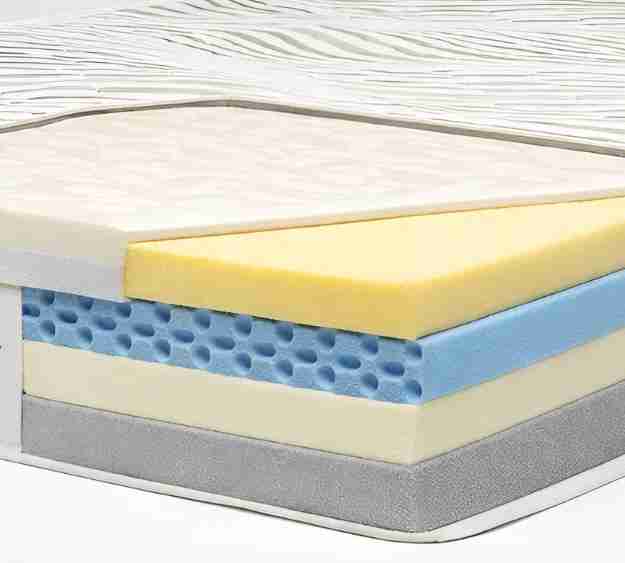
Memory foam mattresses are a popular choice and can work well for combination sleepers, as well as back, stomach, and side sleepers.
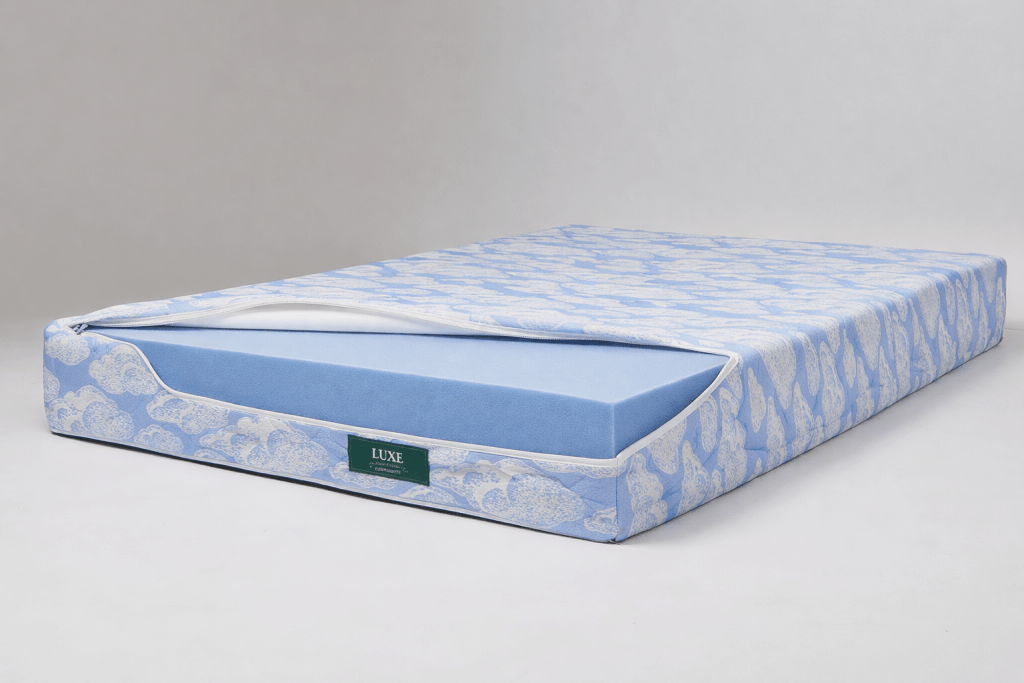
They are particularly effective for:
However, one common drawback is temperature regulation. Memory foam tends to retain heat, which can make it uncomfortable for hot sleepers.
Foam mattresses made from high-density materials are the firmest option available. These mattresses provide minimal to no sink and do not contour to the body.
The feel is often described as:
“Sleeping on a wooden surface with slight flexibility.”
These mattresses are commonly preferred in countries like India, Pakistan, and China, where people are more accustomed to harder sleeping surfaces.
However, they may not be suitable for everyone, especially for those who have never used a firm mattress before. It usually takes a few weeks for the body to adjust.
If you have already tried multiple pocket spring or hybrid mattresses and still experience back pain, switching to a high-density foam mattress may be necessary.
Initially, it may feel uncomfortable for 3–5 weeks, but once your body adapts, it can significantly improve spinal alignment and reduce long-term back pain.
Based on experience and practical results, here are the three best options:
This is a true hybrid mattress with a dual spring system.
It includes:
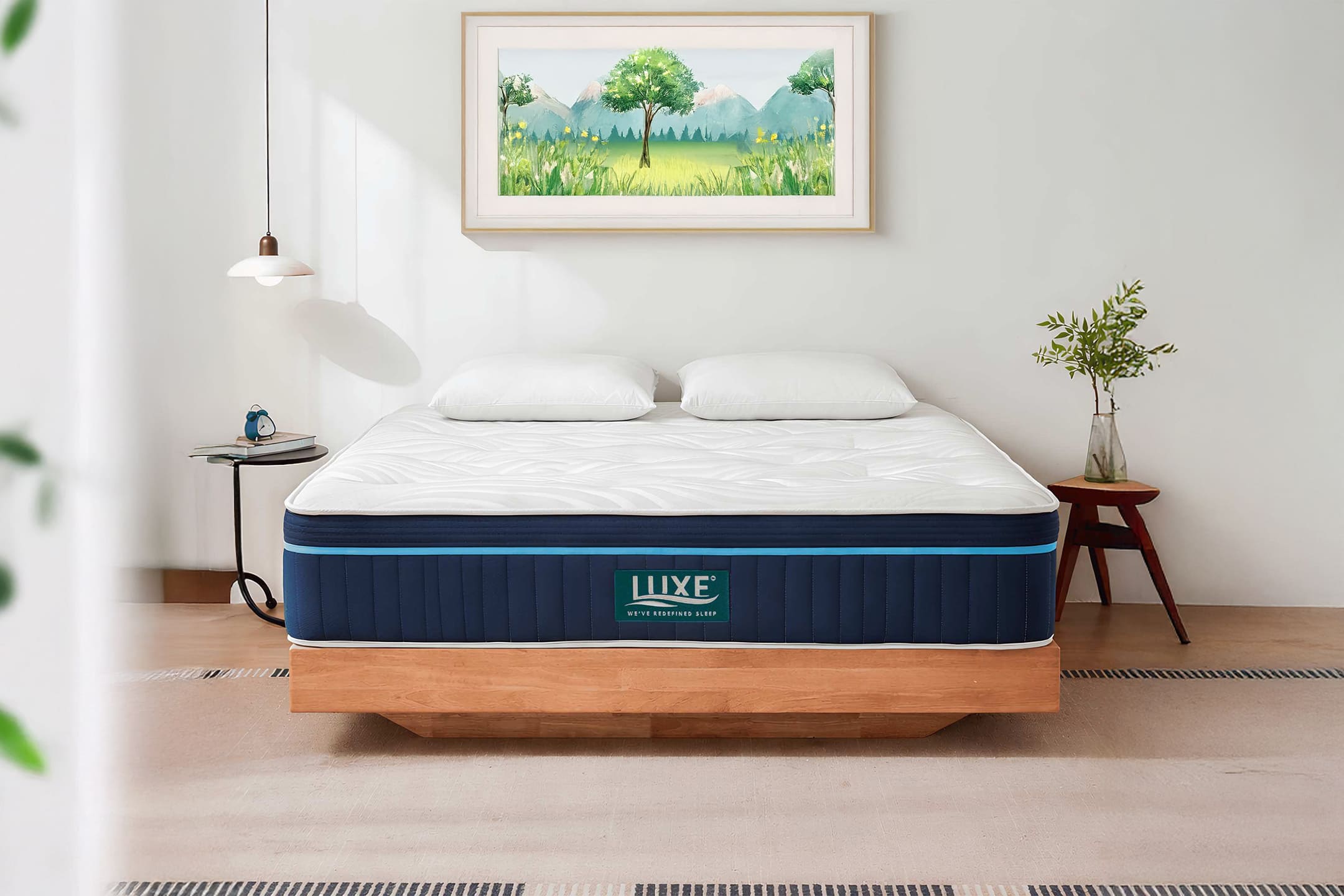
It provides:
This mattress comes in both firm and extra firm options and is widely recommended for back pain.
For those who need solid, no-sink support, this is one of the best options.
It is made using high-density foam (CP-C48 to CP-C52) and is available in:
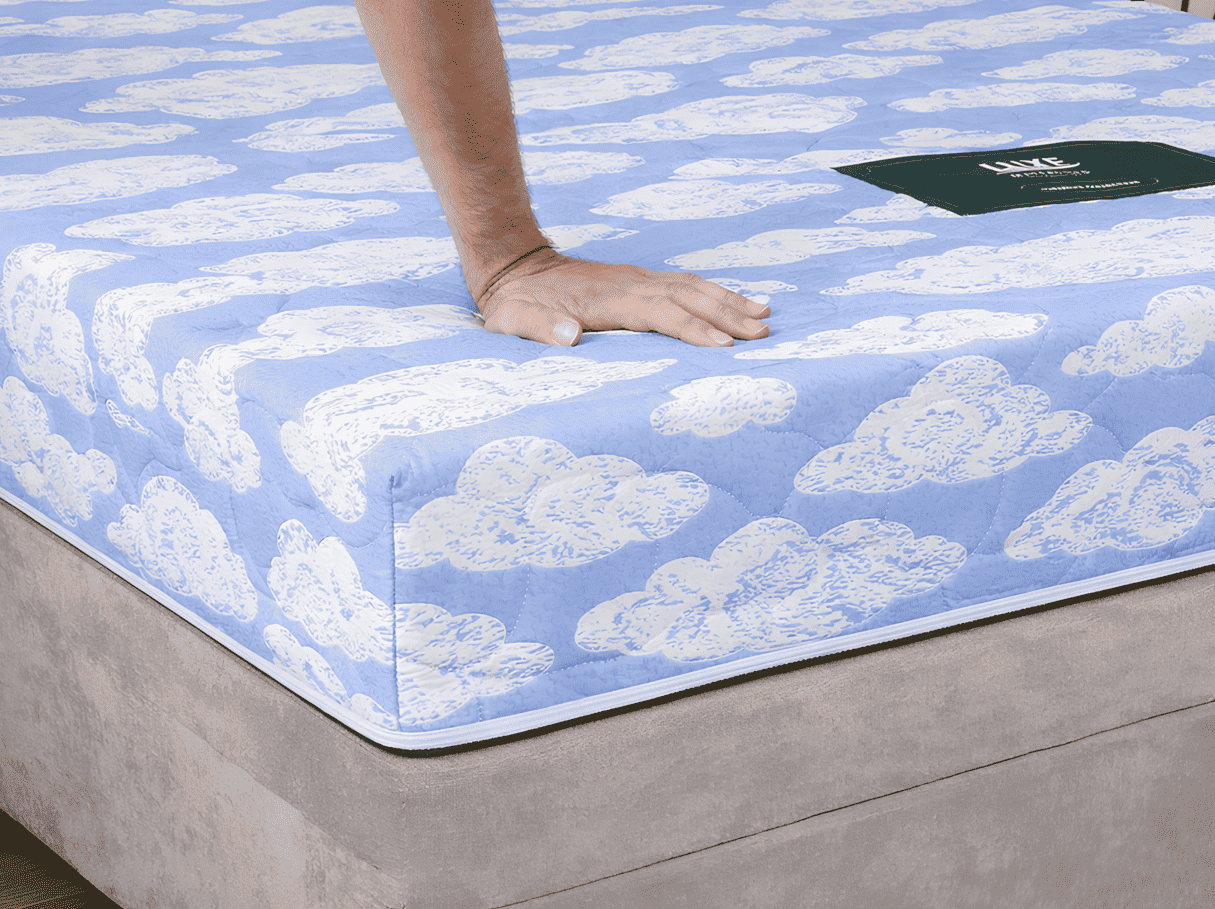
The rock hard version provides an ultra-stable surface with no sinking at all. It is ideal for back and stomach sleepers and people who require strict orthopaedic support.
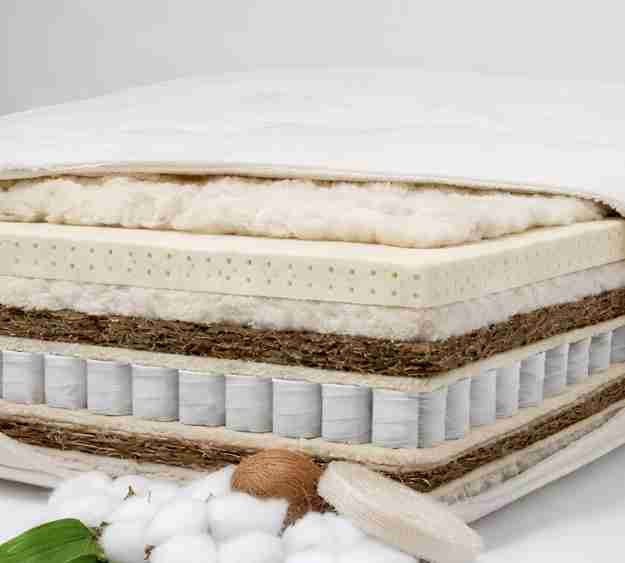
This mattress is made using natural materials such as:
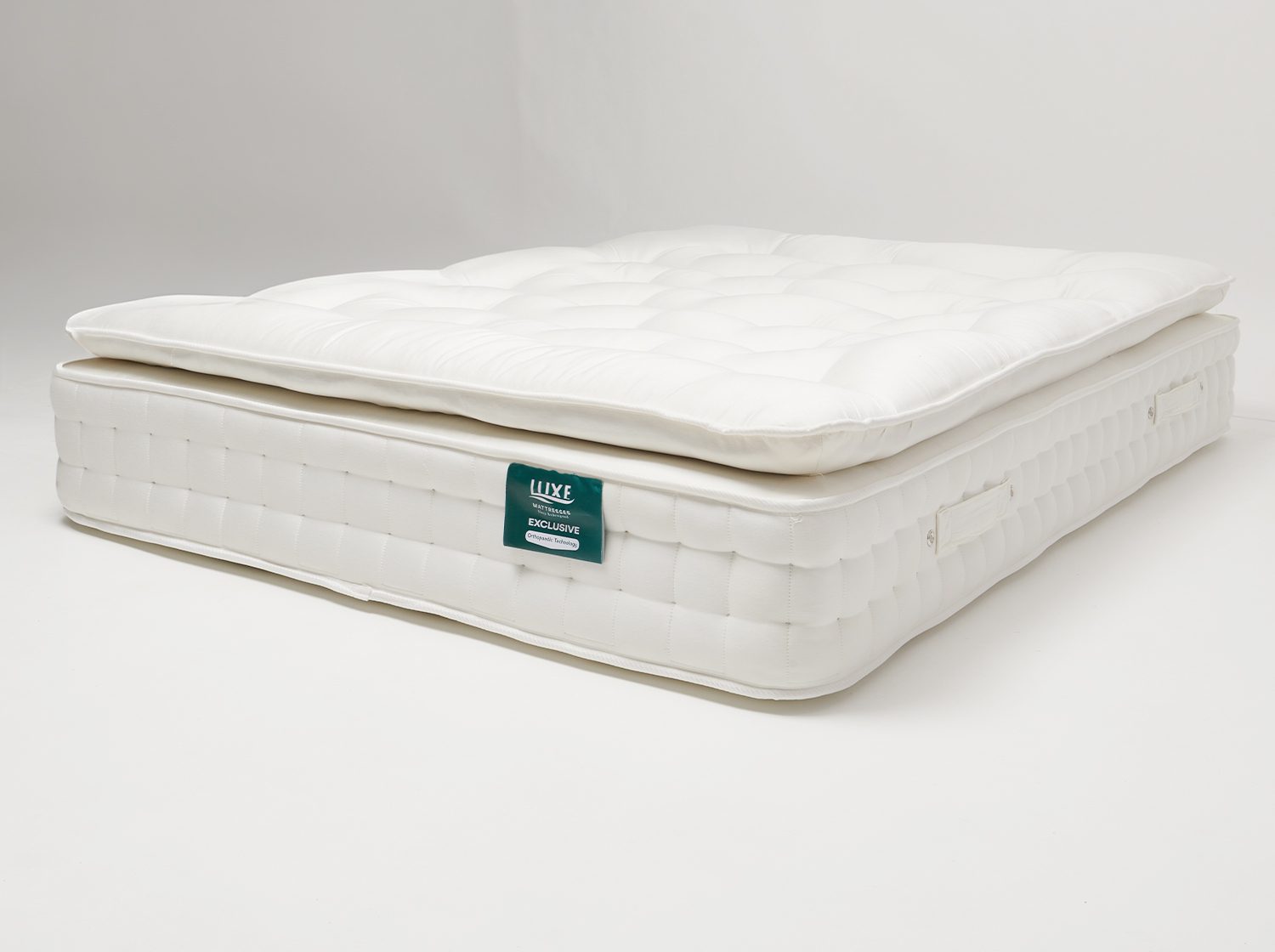
It offers a more luxurious feel while still maintaining strong support. It is suitable for those who prefer natural materials with a balance of comfort and stability.
If you are searching for the best mattress for back pain, the most important thing to understand is that the right choice depends on your body, your sleeping position, and your previous experience.
Hybrid mattresses like the Luxe Ergo 3400 are generally the safest and most effective option for most people. However, if you need maximum support and sleep on your back or stomach, a high-density foam mattress like the Majestic 11000 can be a better solution.
For those who prefer natural materials with a premium feel, latex-based hybrid mattresses provide an excellent balance.
At the end of the day, the best mattress is the one that keeps your spine aligned, reduces pressure, and allows your body to recover properly during sleep.
The best mattress for back pain is one that keeps your spine in a neutral, straight position while you sleep. For most people, a hybrid mattress Luxe Ergo 3400 works best because it combines support from pocket springs with cushioning from foam or natural layers.
If you need stronger support, especially for back or stomach sleeping, a high-density foam mattress (extra firm or rock hard) can be more effective. For side sleepers, a mattress with more cushioning, such as a hybrid or memory foam, is usually better to reduce pressure on shoulders and hips.
A firm mattress can help with back pain, but it is not always the best option for everyone.
If the mattress is too soft, your hips may sink, causing poor spinal alignment. However, if it is too firm, especially for side sleepers, it can create pressure points on the shoulders and upper back.
The key is balanced support:
Back and stomach sleepers ? benefit from firmer mattresses
Side sleepers ? need some cushioning along with support
Back pain after sleeping is usually caused by poor spinal alignment during the night. This can happen when:
The mattress is too soft and your body sinks unevenly
The mattress is too firm and doesn’t allow natural contouring
Your sleeping position puts pressure on certain areas
The mattress has lost support over time
When your spine is not properly aligned, pressure builds up for several hours, leading to stiffness and pain in the morning.
 April 14, 2026
Sleep is not just physical, it is deeply linked to your emotional health. When stress, anxiety, or overthinking take over, your mind stays active, making it harder to fall and stay asleep. Many cases of poor sleep quality come from emotional imbalance rather than bad sleep habits.
From racing thoughts to disrupted sleep cycles, your mental well-being directly affects how well you rest. Understanding this connection is the first step to improving sleep quality and achieving deeper, more restorative sleep.
It’s hard to separate sleep and feelings. After a bad night’s sleep, most of us know that we can be cranky or nervous the next day. This is often caused by stress, sadness, or anxiety. We now know that not getting enough sleep can make you feel lousy and that being mentally sick can make it hard to sleep. A lot of mental health problems can make it hard to sleep.
This article talks about some of them. When people are terrified, angry, or unhappy, they typically can’t stop thinking. This is because not getting enough sleep might hurt your brain. We’ll also speak about typical triggers, some mental skills that can help you, and bedroom ideas that can help you break the cycle and get the sleep you need.
Stress makes the body want to fight or run away all the time, even when it’s time to sleep. Your nerve system gets incredibly busy when you’re terrified or worried. This makes it hard to relax and go to sleep. Sleeping experts note that people with this disease think a lot, have tense muscles, and their hearts beat quickly. A lot of thoughts, tense muscles, and a racing heart are all signs of this illness.
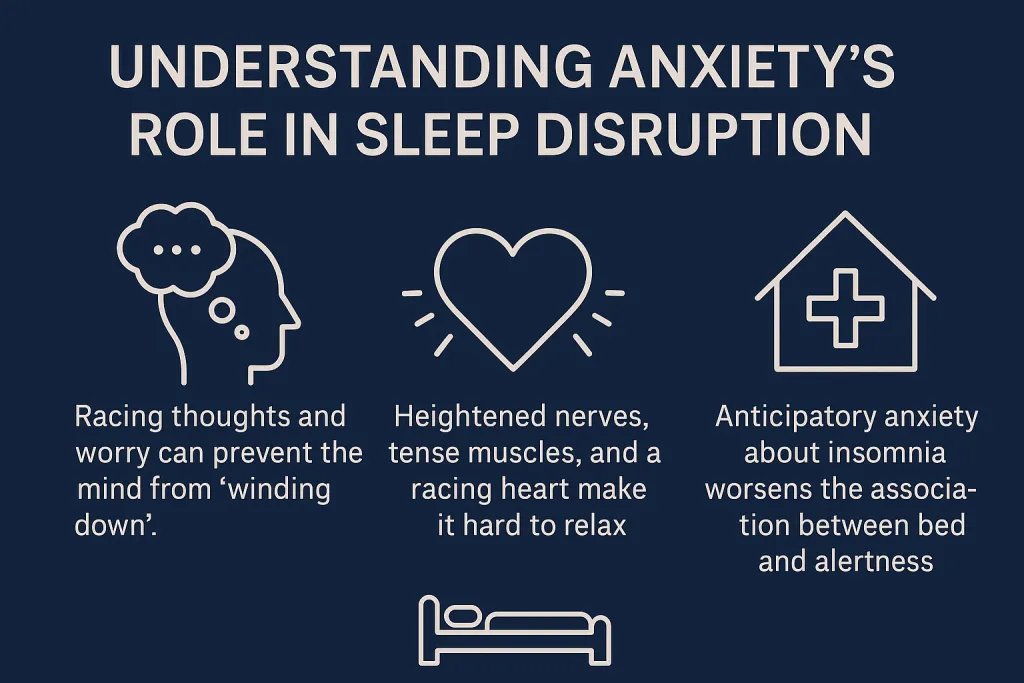
When you’re anxious, your body releases stress hormones like adrenaline, which make your heart beat faster and your body heat rise. Stress, a racing heart, and tight muscles can all make it hard to fall asleep or stay asleep. People who are troubled tend to worry about their troubles all the time. Whether you’re thinking about a talk you had or making a list of things you need to do tomorrow, these kinds of thoughts can come in a lot before bed and stop your brain from “winding down.”
Many people experience anticipatory anxiety about sleep itself. For example, “What if I lie in bed all night and still feel tired tomorrow?” is a common fear that people have before going to sleep. In a strange way, this fear of not sleeping can keep them up even longer. As time goes on, the bedroom continues to make you think of tension instead of sleep, which makes insomnia even worse.
In short, anxiety keeps your body and mind over-alert at night. This over-alertness is considered a central contributor to insomnia. The more anxious you feel, the harder it becomes to fall or stay asleep. Without intervention, this pattern can quickly spiral into a chronic problem.
Both sleep and mood can influence each other. Just as anxiety and stress makes it hard to sleep, poor sleep can also make your mental health worse. Sleep deprived brains handle stress poorly. People tend to get bothered easily by little things, feel more annoyed and sad, and find it hard to regulate their emotions. In fact, the NHS warns that “longer stretches of bad sleep can…have a negative impact on our mental health or wellbeing”.
Biologically, not getting enough sleep makes cortisol rise and makes it harder for the brain to process positive feelings. This makes you feel dull or concerned. Not getting enough sleep can reduce your mood, make anxiety or depression worse, and even raise your chance of having new mental health conditions over the course of weeks or months. Because of this, not getting enough sleep makes stress and anxiety worse, which makes it much harder to get to sleep.
Research confirms this loop. One study found that chronic insomnia not only often follows anxiety and depression, it can actually predispose otherwise healthy people to develop anxiety disorders later. Likewise, sleeping better has been shown to improve mental health outcomes. For example, therapy that targets insomnia (CBT-I) not only improves sleep but also reduces symptoms of depression and anxiety. In other words, better emotional health and better sleep go hand-in-hand, ignoring one can undermine the other.
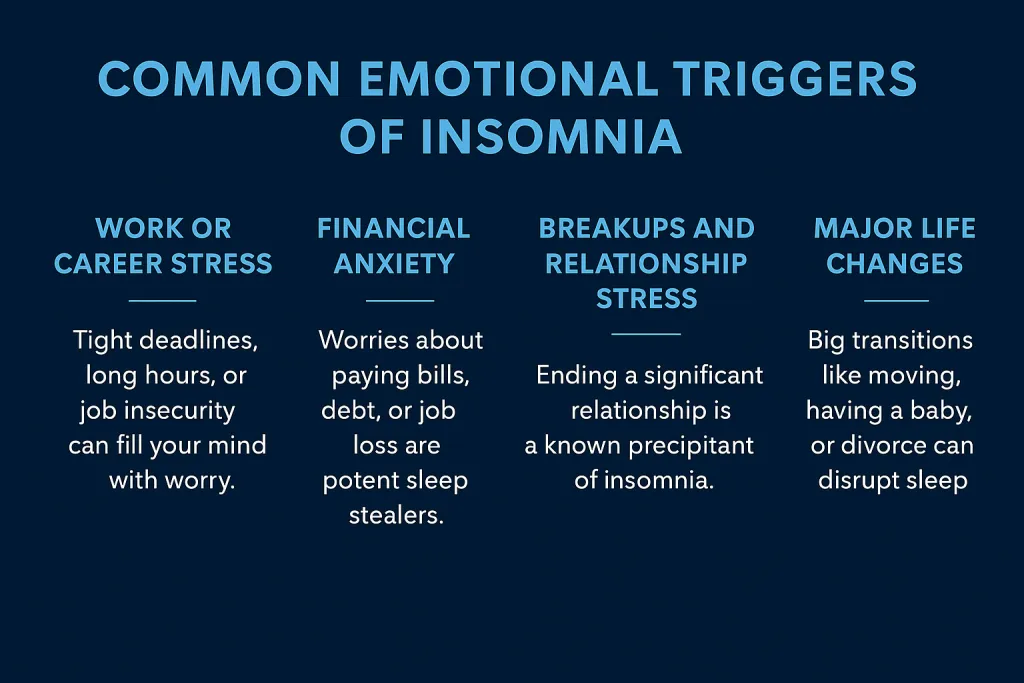
Many everyday stressors and life events can trigger sleeplessness. Here are some of the most common emotional triggers, along with brief examples of how they manifest:
i. Work or Career Stress: Tight deadlines, long hours, or job insecurity can fill your mind with worry.
ii. Financial Anxiety: Worries about paying bills, debt, or job loss are potent sleep stealers. In a recent survey, 77% of U.S. adults admitted they lose sleep over money worries at least some of the time. But seriously though, I totally get them. Making budgets or worrying about debt can easily put sleep at the back corner of one’s mind.
iii. Grief and Loss: Losing a loved one can be quite upsetting and it often disrupts sleep. Health sources note that “trouble sleeping is common with grief.” Anxiety or sadness over the loss of a loved one can cause frequent awakenings or early morning wake-ups.
iv. Breakups and Relationship Stress: Ending a significant relationship is a known precipitant of insomnia. Behavioral scientist Wendy Troxel notes that losing a partner either through a bad breakup or death makes people feel vulnerable and triggers sleeplessness.
Major Life Changes: Big transitions like moving to a new city, starting (or losing) a job, having a baby, or going through divorce can also be stressful enough to disturb sleep. The emotional upheaval and broken routines during these times often spill into the bedroom.
Recognizing these triggers is the first step. The body’s natural response to worry often is to make sleep difficult. Identifying your trigger can help you tackle the insomnia associated with it.
While anxiety typically causes difficulty falling or staying asleep, depression can affect sleep in a different way. About 75% of people with depression report insomnia symptoms, but surprisingly many depressed patients also experience hypersomnia (sleeping too much). Studies show that roughly 40% of young adults with depression have hypersomnia. In practice:
These differences also show up in sleep architecture. Anxiety keeps the mind wired and awake, while sadness can leave someone dragging all day or waking painfully early. Both disrupt the restorative functions of sleep, but through somewhat different mechanisms.
When sleep is elusive, it’s tempting to reach for quick fixes. But many common coping strategies backfire, further disrupting sleep and fueling anxiety. These include:
i. Taking Alcohol or Sedatives before Bed: While a nightcap could make you feel drowsy initially, alcohol fragmented sleep later in the night and lowers REM sleep. This can make you feel fatigued and stressed the next day.
ii. Late-Night Screen Time: Scrolling on your phone or watching TV right before bed throws off your internal clock. Melatonin, the hormone that makes you sleepy, is shut off by blue light from screens, keeping your brain alert. NHS experts advise avoiding electronic devices at least an hour before bedtime. Instead, unwind by reading or listening to calm music.
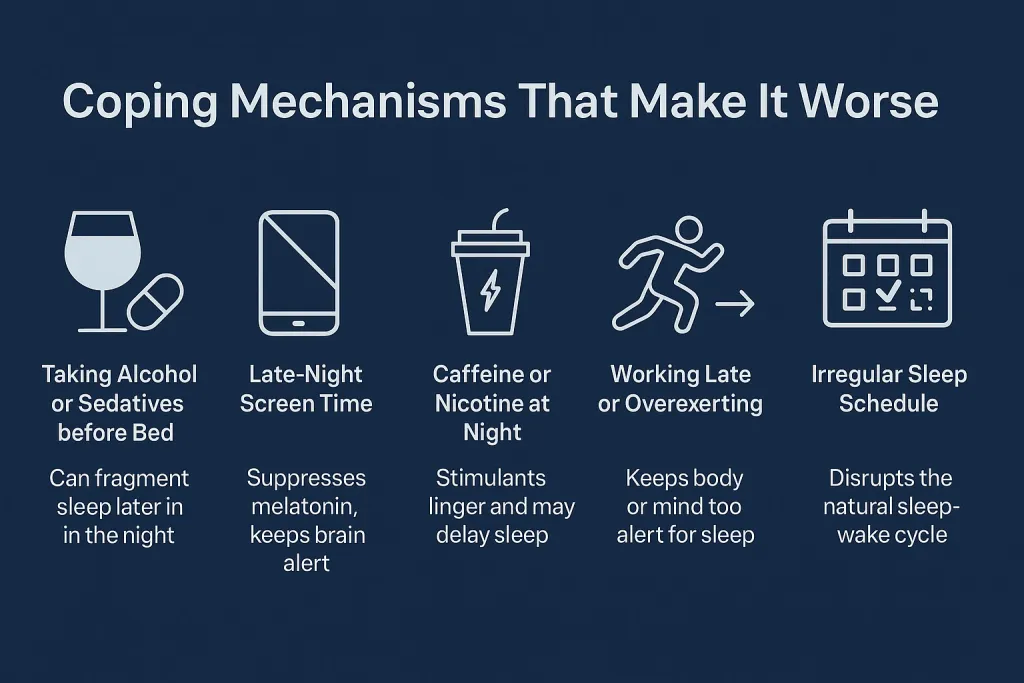
iii. Caffeine or Nicotine at Night: Stimulants like coffee, tea, energy drinks, or nicotine from cigarettes can linger in your system and make it hard to fall asleep. The NHS notes that things like nicotine, coffee, and other stimulants might make it hard to sleep. Even sweets or some medicines taken in the evening can also be harmful.
Iv. Working Late or Overexerting: Doing work in bed or thinking about things that need to be done can make you feel stressed. Similarly, if you perform a lot of strenuous activity close to bedtime. When it’s time for bed, it’s hard to fall asleep if your mind or body is still awake.
V. Irregular Sleep Schedule: Staying up late on the weekends or changing your bedtime a lot can mess up your body’s natural sleep-wake cycle. A chaotic plan makes it hard for the brain to figure out a time of rest.
These strategies can feel like instant relief or productivity boosts, but they ultimately worsen sleep and anxiety. For example, stimulants are a common cause of sleep problems and should be avoided before bed. Likewise, SleepFoundation experts recommend good sleep hygiene: steady bedtimes, pre-bedtime wind-down routines, and a phone-free bedroom.
Beyond general insomnia, there are specific sleep disturbances linked to emotional health, which include:
i. Sleep Anxiety (Anticipatory Insomnia): This is when fear of not sleeping actually keeps you awake. A person might dread bedtime, worry about falling asleep, or even develop somniphobia (fear of sleep). Sleep experts call this “sleep performance anxiety.”
ii. PTSD-Related Nightmares and Hypervigilance: People with post-traumatic stress disorder often dream about awful events that happened to them and are particularly vigilant at night. A study found that more than 90% of combat soldiers with PTSD say they have trouble sleeping. People can have bad dreams and wake up many times. They can’t sleep because their bodies are always “on guard.”
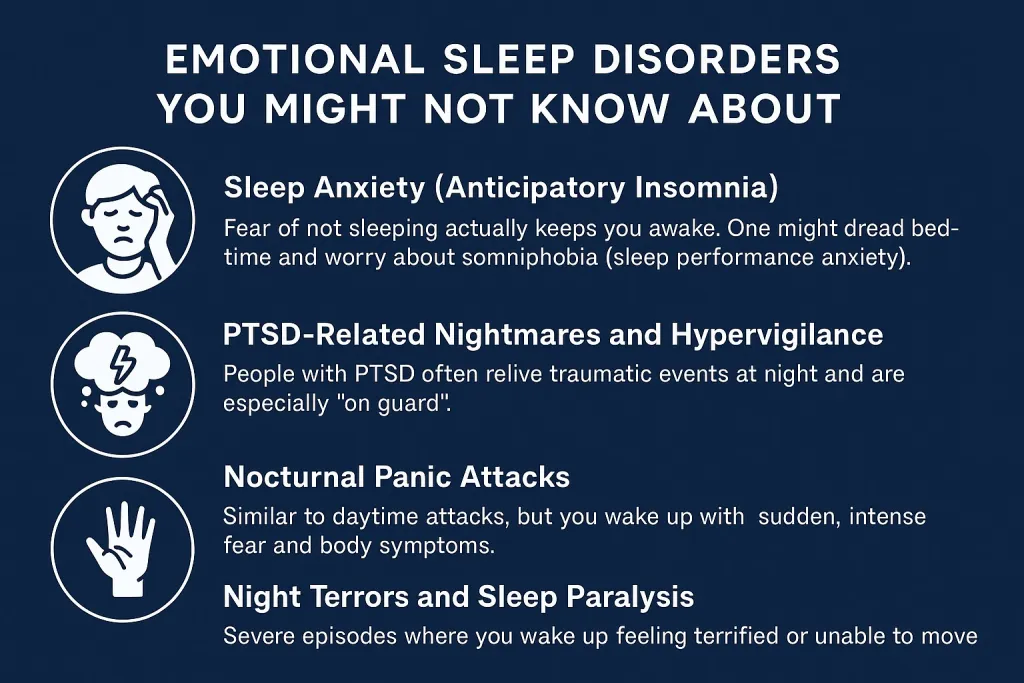
iii. Nocturnal Panic Attacks: People with panic disorder don’t want to have panic attacks in the middle of the night, but some do. It’s the same at night: they wake up scared, their heart racing, and they can’t breathe. The Cleveland Clinic says that as many as seven out of ten people with panic disorder also have panic attacks at night. They might be scared, think they’re going to die, and worry that bad things are going to happen, but it wasn’t an emergency; it was just a panic attack.
iv. Night Terrors and Sleep Paralysis: In severe cases, one might experience night terrors, or sleep paralysis. Although more common in children, these disorders can occur in adults under extreme stress or trauma. They are more complex disorders, but are essentially manifestations of the same mind-body fear responses at night.
In all of these disorders, the sufferer wakes up feeling terrified or agitated. For example, having a panic attack at night means feeling very scared quickly, sweating, having a fast heartbeat, and being out of breath. The person is fully awake and afraid, which is not typical. It is vital to note that these indications are not “normal” but are instead induced by worry or stress. People who are hurting should get help because there are effective treatments available, like medication or therapy from a professional.
The good news is if your emotions are keeping you up, you can sleep better with the right techniques. Several evidence-based psychological approaches target the anxious thoughts and behaviors keeping you awake, such as:
i. Cognitive Behavioral Therapy for Insomnia (CBT-I): This structured, short-term therapy has been shown to help people who can’t sleep by changing the way they think about and act when they sleep. As part of CBT-I, patients typically learn to examine negative beliefs and build a soothing practice before bed. Big studies have shown that CBT-I not only helps people sleep better, but it also makes them feel less anxious and sad.
ii. Mindfulness and Relaxation Practices: Mindfulness training, like meditation, teaches the brain to stay in the now instead of worrying about the future. Harvard researchers showed that older adults who had difficulties sleeping and exercised mindfulness were much less likely to be weary, depressed, or unable to sleep. You can elicit this “relaxation response” by focusing on your breath or doing some gentle yoga before bed. Progressive muscular relaxation and deep breathing are two easy ways to calm down your heart rate and clear your mind.
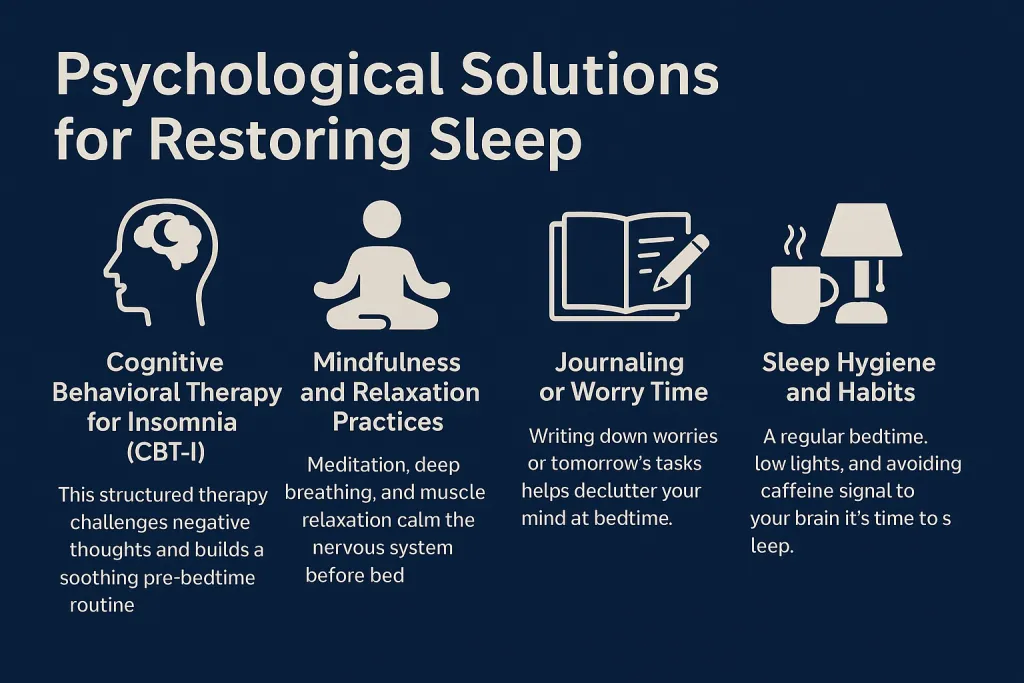
iii. Journaling or Worry Time: Giving anxious thoughts a specific outlet can prevent them from hijacking bedtime. The NHS suggests writing down tomorrow’s tasks before bed as a way to “put your mind at rest”. Writing in a worry book or a thankfulness notebook can also help you relax. The most important thing is to do something peaceful and alone, and then stop when you’re done with your book.
iv. Sleep Hygiene and Habits: Your brain knows it’s time to sleep when you have a regular bedtime routine, like drinking herbal tea and turning off the lights. Don’t eat a lot, drink a lot of coffee, or work out hard straight before bed. Getting outside in natural light and working out regularly can help you fall asleep sooner. These little modifications make it easier for the brain to link bedtime with relaxation instead of worry over time.
If your worry or trauma is really bad, you usually require support from a specialist. Psychologists and sleep experts can make therapies work for you. Getting more sleep can assist your mental health just as much as or more than dealing with stress. For a lot of people, breaking the practice of worrying at night might make them feel better throughout the day.
Your bedroom environment can either make your mental tension worse or better at night. The colors, warmth, and mood of the room can all affect your brain and instruct it to relax. Walls painted in gentle blues, greens, or even light gray tend to make individuals feel pleasant and relaxed. People who sleep in blue or green rooms are the most relaxed and get the greatest sleep, according to surveys. You might want to avoid bright reds or yellows, as they tend to make you feel more energized.
Silence is “golden” for sleep. To filter out unpleasant sounds, use earplugs or a white-noise machine. Blinds or eye masks that block off light can assist. Put your phones on silent or in another room. Most individuals sleep best in settings that are a little cold, between 65°F and 68°F (18°C and 22°C). The NHS suggests to keep the bedroom cool and “well ventilated” because being too hot or stuffy might make you feel restless.
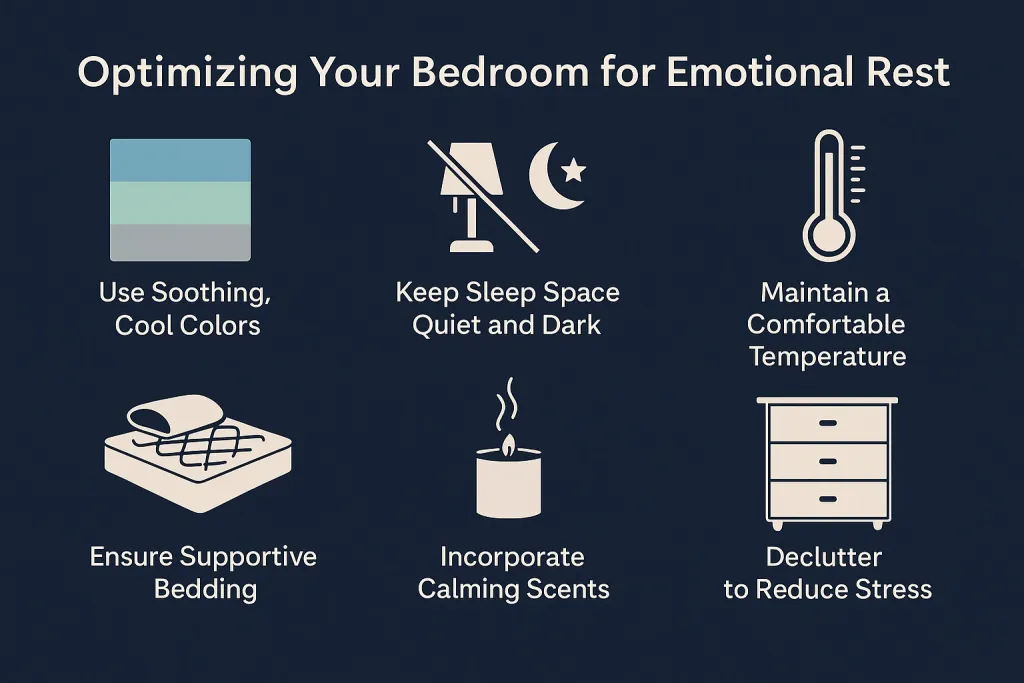
Experts suggest that bedding should be the most comfortable and supportive. You need a mattress that fits your body and supports your spine, as well as a pillow that maintains your neck straight. For example, Luxe Mattresses’ contouring memory foam or hybrid mattresses are high-end and have characteristics that relieve pressure. These mattresses can aid with pain and help the body sleep. Sheets that let air flow and blankets that are soft and cozy might also help you feel safer.
Some smells might help you feel better. For instance, studies have shown that the scent of lavender might help you relax and feel less stressed. You can relax by putting a lavender bouquet next to your pillow or spraying your pillow with lavender. People have employed mellow scents like chamomile and jasmine for a long time to help them sleep. Make sure the smell isn’t too overpowering and doesn’t take over.
A clean bedroom with little mess is finally a place where you can relax and not worry about anything. Keep work things, bills, and notes out of sight. If you can, set up a little “sanctuary” area. A favorite image or plant can help you feel better, but don’t put too much in it, such games or junk.
When your bedroom is safe, tranquil, and comfortable, it helps you forget about the issues you had during the day. The Sleep Foundation suggested that making your bedroom more sleep-friendly and getting into “habits that help you sleep” can help you get more sleep. A good mattress, like the pressure-relieving ones from Luxe Mattresses, and a well-planned room layout will help you relax both physically and mentally.
In summary, sleep and emotional health are intimately linked. Anxiety, stress, depression and trauma all create physiological and mental arousal that can sabotage sleep. Left unchecked, this leads to a vicious loop: poor sleep raises stress hormones and impairs mood, which in turn makes sleep even harder. By contrast, interventions that target the emotional side of insomnia – therapy, relaxation practices, journaling, environment tweaks – can restore the cycle of sleep and healing.
The key message is hopeful: improving one side often helps the other. Tackling anxiety and stress (through CBT, mindfulness, or counseling) will improve sleep, and improving sleep hygiene will lift your mood and resilience. If sleep struggles persist, consider seeking professional advice – a sleep coach, therapist or doctor can guide you to the right resources. You might also explore LuxeMattresses’ sleep wellness guides and products designed to support both physical comfort and emotional rest.
Remember, the path to a peaceful night often begins with a calm mind. By addressing the emotional roots of sleeplessness, you can find your way back to deep, refreshing sleep – and wake up to brighter days ahead.
Yes. Anxiety and chronic worry can directly interfere with sleep. When the mind is racing or tense, the body stays alert and can’t easily transition to sleep. This “hyperarousal” state is a known trigger for insomnia. Over time, anxiety about not sleeping can further entrench the problem. Fortunately, treating the anxiety often brings significant sleep improvement.
Absolutely. Studies show that improving sleep through therapy, or good sleeping habits can reduce symptoms of anxiety and depression. For many people, simply getting more rest makes daily stressors feel more manageable, and it can even improve cognitive function and mood. Think of sleep as part of your mental health toolbox: better rest is both a result of feeling better and a cause of feeling better.
Focus on comfort and calm. Keep the room dark, quiet, and slightly cool. Decorate in soothing colors like blue or green. Remove electronic distractions such as phones and computers from the bedroom. Invest in a supportive mattress and pillows that relieve pressure and keep your spine aligned. You can also introduce relaxing scents like lavender and chamomile while starting some bedtime routines such as reading, stretching, and having a warm bath to help you feel better. Each positive environmental cue sends a signal to your body that it’s time to sleep.
If you implement these strategies and still struggle, it may help to consult a sleep specialist or mental health professional. There are effective treatments available; you don’t have to battle chronic insomnia or anxiety alone. By addressing both your mind and your sleep setting, you can break free from the cycle of anxiety?induced sleeplessness.
 March 13, 2026
Are you not sleeping well? You’re definitely not alone. Whether it’s racing thoughts, stuffy air, or the blue glow of your phone, a lot can get in the way of a good night’s sleep. But one thing that often gets overlooked is bedroom greenery.
According to RHS, adding the right plants for sleep to your room can have a powerful effect, not just on how you sleep, but also on how you feel during the day.Some plants purify the air. Others help calm your mind. And a few even release oxygen while you sleep.
This article will look at ten of the best low-maintenance bedroom plants that improve air quality, ease anxiety, and help you switch off. If you’re building a healthier sleep environment, this is an excellent place to start.
Yes, certain houseplants can genuinely improve air quality while you sleep, making your bedroom a healthier place to rest. According to studies, including NASA’s Clean Air Study, plants like snake plant, peace lily, and aloe vera can filter out common indoor pollutants such as formaldehyde, benzene, and carbon monoxide.
Some, like the snake plant and aloe vera, are especially useful because they release oxygen at night unlike most plants that only do so during the day. This can lead to better airflow, fewer sleep disturbances, and a generally calmer breathing environment, particularly in modern UK homes where windows are often kept shut. While plants won’t replace a ventilation system, they’re a simple, natural, and visually calming way to support cleaner air and better sleep.
Let’s break it down. Plants aren’t magic, but they do a few simple things well:
They clean the air – Certain varieties remove toxins like formaldehyde, benzene, and even mould spores. You’ll breathe easier, especially in modern homes where windows stay shut most of the year.
They give off oxygen – Some houseplants release oxygen at night, improving airflow in your bedroom and reducing sleep disturbances.
They ease stress – Just being near greenery can be calming, according to Mind.org.uk. Plants reduce cortisol levels, and some even give off scents that naturally lower your heart rate.
And let’s be honest coming home to a room that feels fresh, clean, and alive makes it easier to relax.
These plants were picked not just for their sleep benefits, but also for being realistic. You don’t need a background in botany to keep them alive.

Why it helps: It emits oxygen at night and removes toxins
Good for: Busy people, forgetful waterers
Care level: Practically bulletproof – water once every couple of weeks
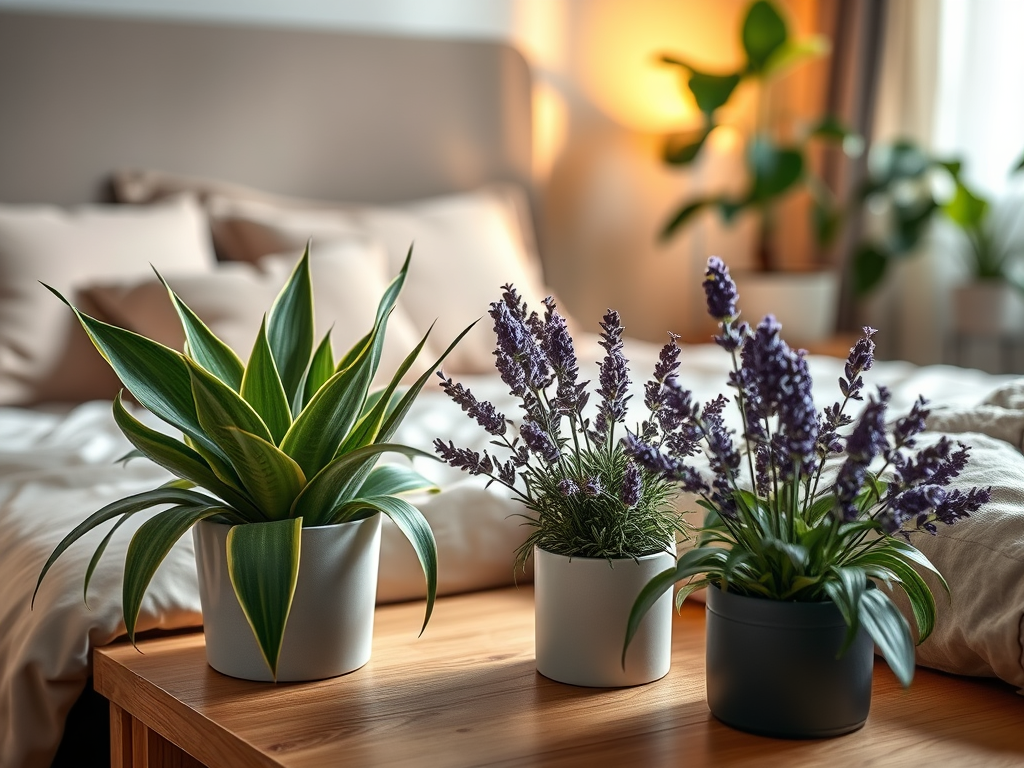
With its upright leaves and sculptural look, the snake plant fits into any style of room. It’s a brilliant pick if your bedroom doesn’t get much sunlight perfect for UK winters.

Why it helps: Its natural fragrance reduces anxiety and promotes deep sleep
Good for: Light sleepers, stress-prone minds
Care level: Medium – likes regular misting and indirect light
One study even found that jasmine helps people fall asleep faster and feel more alert in the morning. A proper multitasker.

Why it helps: Calms the nervous system with a subtle scent
Good for: Those who struggle to unwind at night
Care level: Needs bright light and good drainage
Lavender is often used in pillow sprays and bath oils, but having the actual plant by your bed adds an extra layer of calm to your sleep setup.

Why it helps: Cleans indoor air and tolerates pretty much anything
Good for: Low-light rooms and people who forget to water
Care level: Easy – water sparingly and let it do its thing
It doesn’t flower or scent the air, but the ZZ plant earns its place by being low-effort and visually striking great for modern spaces.

Why it helps: Purifies the air and boosts humidity
Good for: Those with allergies or dry skin
Care level: Medium – keep the soil damp and avoid direct sunlight
This one’s great if you live in a flat with dry air. Its air-purifying abilities are well-documented, including by NASA’s Clean Air Study.

Why it helps: Reduces mould and airborne allergens
Good for: Smaller bedrooms or shared rooms
Care level: Needs occasional pruning and a bright spot
Hang it from a shelf and let it trail down for a gorgeous, cottagecore touch. A favourite in older UK homes where damp is a concern.

Why it helps:It emits oxygen at night and looks sleek
Good for: Minimalist bedrooms
Care level: Very easy – water every few weeks, give it some sun
Aloe does double duty: it purifies air and acts as a natural remedy for burns or dry skin. Plus, it never clashes with your decor.

Why it helps: Fights indoor pollution and increases oxygen
Good for: First-time plant parents
Care level: Super low maintenance – tolerates neglect
It also produces little “baby” plants you can snip off and pot elsewhere. Very satisfying.

Why it helps:It adds humidity and clears carbon dioxide
Good for: Dry homes with central heating
Care level: Moderate – likes regular watering and bright light
This one adds a lush feel to any room. Think calming, resort vibes without the price tag.

Why it helps: The scent of its flowers has a sedative effect
Good for: People who struggle to stay asleep
Care level: Slightly fussy – needs full sun and good drainage
It’s less common indoors, but definitely worth a try if you want something beyond the usual lavender and jasmine.
Your bedroom shouldn’t feel like a greenhouse. Even one or two well-chosen plants can completely change the feel of the space.
Speaking of which, if your mattress is old, noisy, or just not cutting it, it might be time to upgrade. At LuxeMattresses, we design sleep surfaces that support deeper rest and look great in any bedroom. Explore our mattress collection for calm environments or check out our guide to improving sleep quality.
This isn’t just about sleep. The act of nurturing a plant watering it, seeing new leaves can be grounding and therapeutic. Mind.org.uk encourages nature connection as a way to manage stress, depression, and overwhelm.
You don’t need a garden to benefit. Even a single plant on your windowsill gives you something to connect with. And when it’s part of your bedroom, it reinforces the idea that the room is for rest, not scrolling or stressing.
Plants are one piece of the puzzle. To make the most of their benefits, combine them with good sleep habits:
LuxeMattresses offers solutions tailored to all of the above whether you sleep hot, need back support, or just want something that fits your minimalist, plant-filled haven. Find your perfect mattress here.
Bringing a few plants for sleep into your bedroom won’t solve everything, but it can absolutely help. Cleaner air, a calmer mind, and a cosier space are all steps in the right direction. Start simple. Add one plant. See how it feels. Then layer in more when you’re ready.
Because in the end, better sleep doesn’t always come from big changes. Sometimes it starts with something as small as a single leaf.
Lavender, snake plant, jasmine, and peace lily are excellent choices for air quality and relaxation.
Yes. Some remove toxins and release oxygen, especially the snake plant, aloe, and spider plant.
Some, like peace lily and ivy, are toxic if ingested. Stick to a spider plant or a palm if you’ve got furry companions.
Absolutely. ZZ plants, snake plants, and spider plants all tolerate low light, which is great for UK winters.
Start with one or two. Too many might raise humidity or feel cluttered. Keep it calm and balanced.
 March 12, 2026
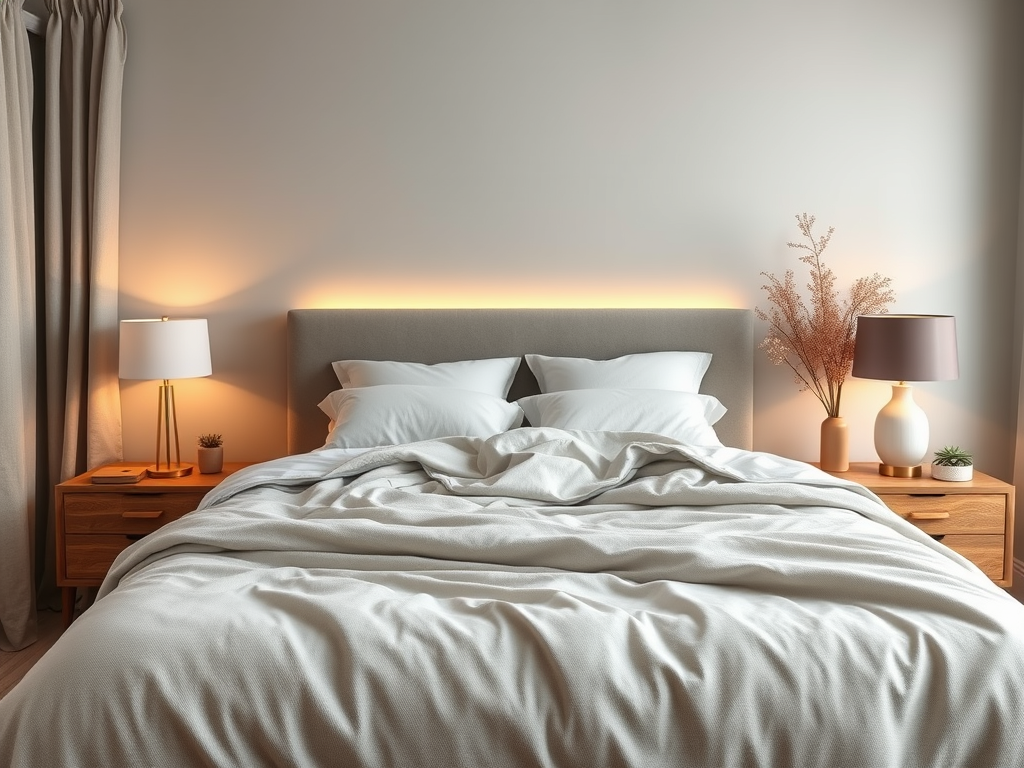
After a long day, your bedroom should feel like a retreat, not just another room in the house, but a space where stress melts away and rest comes naturally. Sadly, for many of us, our sleep space is anything but relaxing. Cluttered, noisy, poorly lit, and let’s not get started on the old mattress that’s seen better years.
So, how do you create a truly stress-free bedroom? One that supports both physical comfort and emotional calm? In this article, we’ll explore exactly that, from lighting and colour to texture, layout, and sound, helping you build a bedroom setup for sleep that genuinely restores you.
Good sleep isn’t just about how tired you feel at bedtime. Your body needs certain signals, low light, cool air, and quiet surroundings, to switch into rest mode. And your mind? It’s even fussier. A cluttered or chaotic bedroom can trigger stress and keep your nervous system on high alert.
According to NHS sleep guidelines, creating the right environment is one of the most effective ways to improve both sleep quality and duration. When your bedroom actively supports relaxation, falling asleep becomes easier, and staying asleep does too.
Your sleep environment affects your brain more than you might think. Light affects melatonin. Colors influence mood. Texture, sound, even smell, all signals to your brain whether it’s safe to unwind or whether it should stay alert.
When done well, these small sensory cues combine into one message: it’s time to rest. When done poorly, they keep your brain stimulated, long after your body is ready to lie down.
Light is arguably the most important factor in a calming bedroom. Harsh overhead lighting tells your brain to stay awake, while soft, warm-toned lighting signals wind-down time.
Your lighting should mimic dusk in the evening. Too much brightness can delay the release of melatonin, the hormone that helps your body fall asleep naturally.
Colours influence how we feel, often without us even realising. For a stress free bedroom, stick to soothing tones that encourage stillness rather than stimulation.
Avoid bright reds, stark whites, or anything overly saturated. A bedroom isn’t the place for visual energy; it’s a space to downshift.
We often think of décor as visual, but touch matters just as much, especially when it comes to comfort. The goal is to create layers of softness that feel inviting the moment you enter the room.
Importantly, don’t overdo it. A few well-placed textures are better than an overload of soft furnishings that feel fussy rather than restful.
A truly stress-free bedroom needs to feel insulated from the outside world. Even low-level noise, from traffic, neighbours, or inside the home, can disrupt sleep cycles and raise cortisol levels.
If you share a bed, consider a mattress with motion isolation, like those from LuxeMattresses, so your partner’s movements don’t disturb your rest.
Scent affects memory, mood, and even stress hormone levels. A light, calming fragrance can subtly cue your brain to relax, but it must be gentle, not overpowering.
Try a pillow spray, oil diffuser, or natural sleep mist. Consistency helps. When your brain starts to associate that scent with bedtime, it strengthens your wind-down cue.
The way you arrange your room matters more than you think. Cluttered spaces trigger low-level stress. Clean lines, open space, and an uncluttered floor give your brain a sense of calm.
Of course, make your bed every morning. It’s a simple gesture that sets the tone for calm and makes returning to bed feel more intentional.
Even if your room is beautifully styled, if your mattress causes discomfort, your nervous system won’t fully relax. A lumpy, unsupportive, or overly warm mattress can prevent you from entering deep sleep or make it harder to fall asleep in the first place.
LuxeMattresses offers beds designed specifically for comfort, airflow, and pressure relief. Whether you sleep hot, share with a partner, or simply haven’t upgraded in a decade, the right mattress can transform your entire sleep environment.
To learn more about which mattress fits your needs, see our expert mattress guide.
Creating a stress-free bedroom doesn’t require a full renovation; it just takes some intention. Soften your lighting. Choose calming colours. Clear the clutter. Add texture that invites rest, and scent that calms the mind. And above all, ensure the space physically supports your sleep, starting with a mattress designed for it.
When you give your bedroom purpose, as a sanctuary, not just a storage space, your sleep improves. And when sleep improves, so does everything else.
To learn more about designing your sleep space or investing in comfort that truly lasts, visit the LuxeMattresses blog or explore our premium sleep solutions made to support better nights, naturally.
Start with lighting. Switch to warm-toned bulbs, add a lamp for evenings, and use blackout curtains. That one change often has the biggest impact.
Yes. Soft, muted tones help reduce mental stimulation. Bold or bright colours, even if you love them, can keep your brain alert when it should be winding down.
Declutter. Clean the space. Add a warm-toned bulb, and swap your pillowcase for something soft and breathable. Small tweaks often go a long way.
Studies show lavender and similar essential oils reduce stress and improve sleep onset. A light spray or diffuser can signal to your brain that it’s time to relax.
Layer curtains, add soft furnishings to dampen sound, and use a white noise machine or earplugs. Also, choose a mattress with motion isolation to block internal disruptions.
Absolutely, A supportive, breathable mattress helps your body stay in deep sleep longer and prevents micro-wakeups caused by discomfort or heat. Explore the LuxeMattresses collection for the most sleep-supportive options.
Ideally not. Using your bedroom for work, TV, or exercise can confuse your brain’s sleep cues. Keep the space restful and dedicated to sleep and relaxation.
 March 11, 2026
Ever found yourself wide awake at midnight, even though you’re exhausted? Or struggled to feel alert in the morning, no matter how early you went to bed? You might be surprised to learn how much the light effect on sleep contributes to these issues. The connection between light and sleep is stronger than you may realize.
The light you’re exposed to throughout the day, and especially in the evening, plays a huge role in how well you sleep. And with so many of us staring at screens late into the night, our sleep cycles are taking a hit. The good news? With a few tweaks to your lighting setup, you can help your body rest when it’s meant to.
Let’s dive into how light affects your circadian rhythm, why timing matters, and what you can do to build a sleep-friendly bedroom even in the middle of winter.
Your body runs on a 24-hour internal clock, known as your circadian rhythm. It’s the reason you feel naturally tired at night and awake in the morning (well, on a good day, anyway). And this rhythm is mostly set by light.
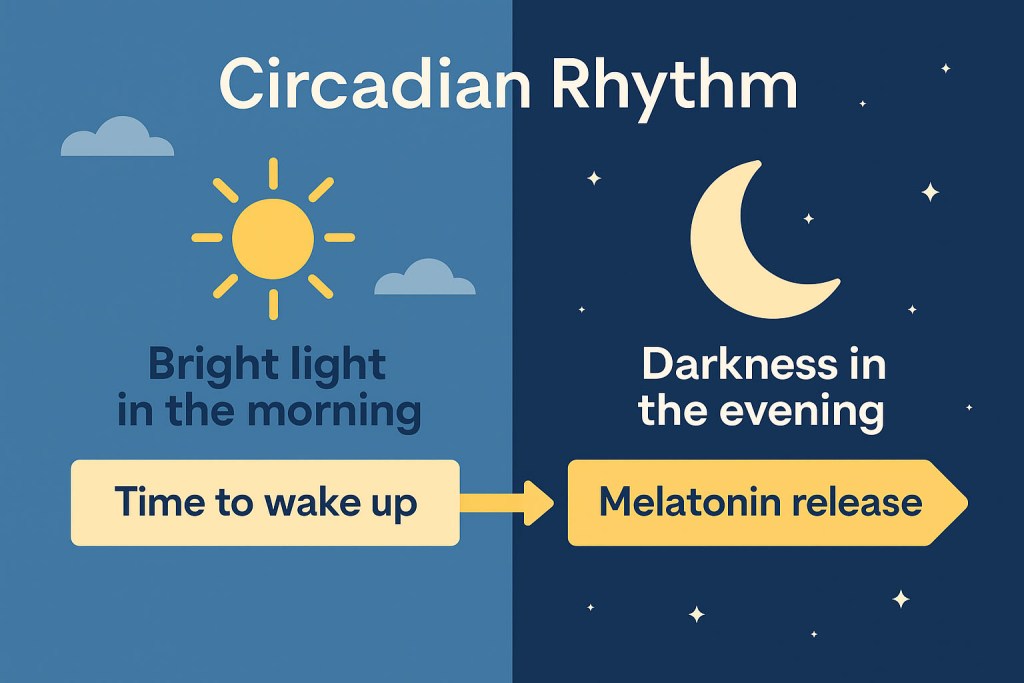
But here’s the catch: artificial light especially from overhead LEDs and digital screens can seriously mess with that system. According to the Sleep Foundation, too much light in the evening delays melatonin production, making it harder to drift off when you should.
Modern lighting is incredibly bright. Too bright, in fact. Especially if you’ve got white ceiling lights, recessed spotlights, or backlit TVs, and when those stay on late into the night, your body gets the message: stay awake.
The result? You might feel wired at bedtime, or worse, toss and turn for ages even after switching the lights off.
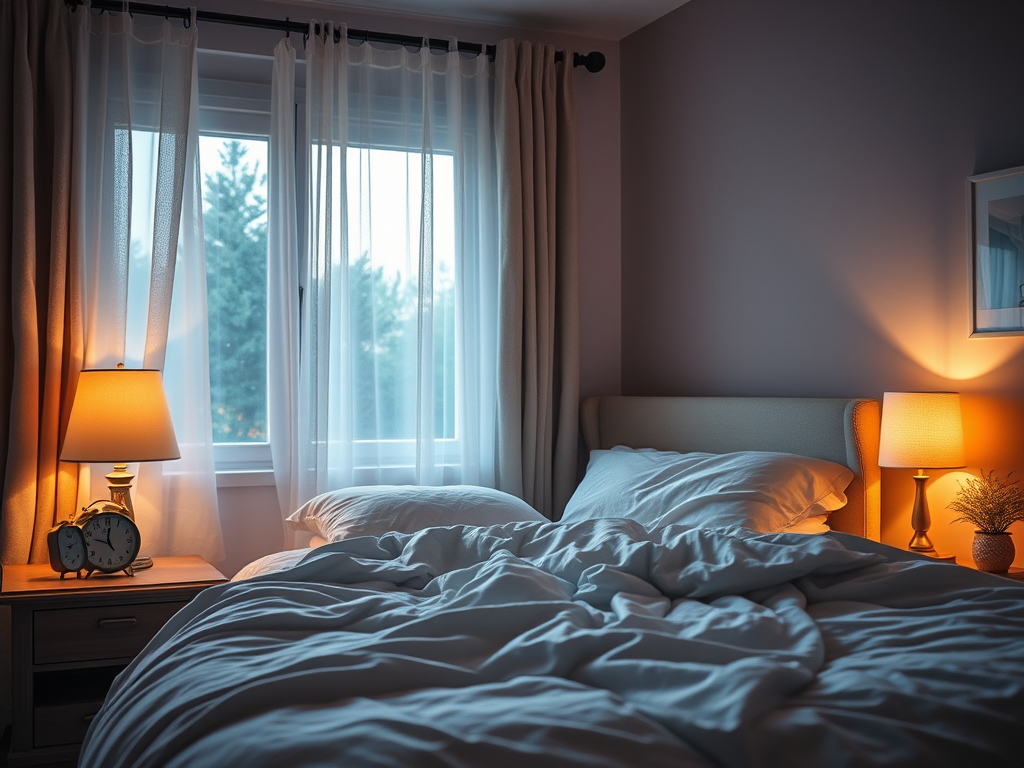
Here’s where bedroom lighting tips come into play. Soft, warm light in the evening helps your body wind down more naturally. Harsh overhead lighting? Not so much.
Let’s be practical. No one’s suggesting you sit in the dark after 6 pm. But you can adjust your lighting to better support your body’s natural sleep cycle.
Look for bulbs labelled “warm white” (2700K or below). These create a soft glow that mimics candlelight perfect for winding down.
Ceiling lights are fine for cleaning or getting dressed. But in the hour or two before bed, stick to table or bedside lamps with softer tones.
Dimmers let you gradually reduce brightness as bedtime approaches. Smart bulbs can even shift from bright white in the morning to amber at night.
(The Luxe Mattresses mattress setup guide includes more ways to create a restful evening atmosphere without overhauling your space.)
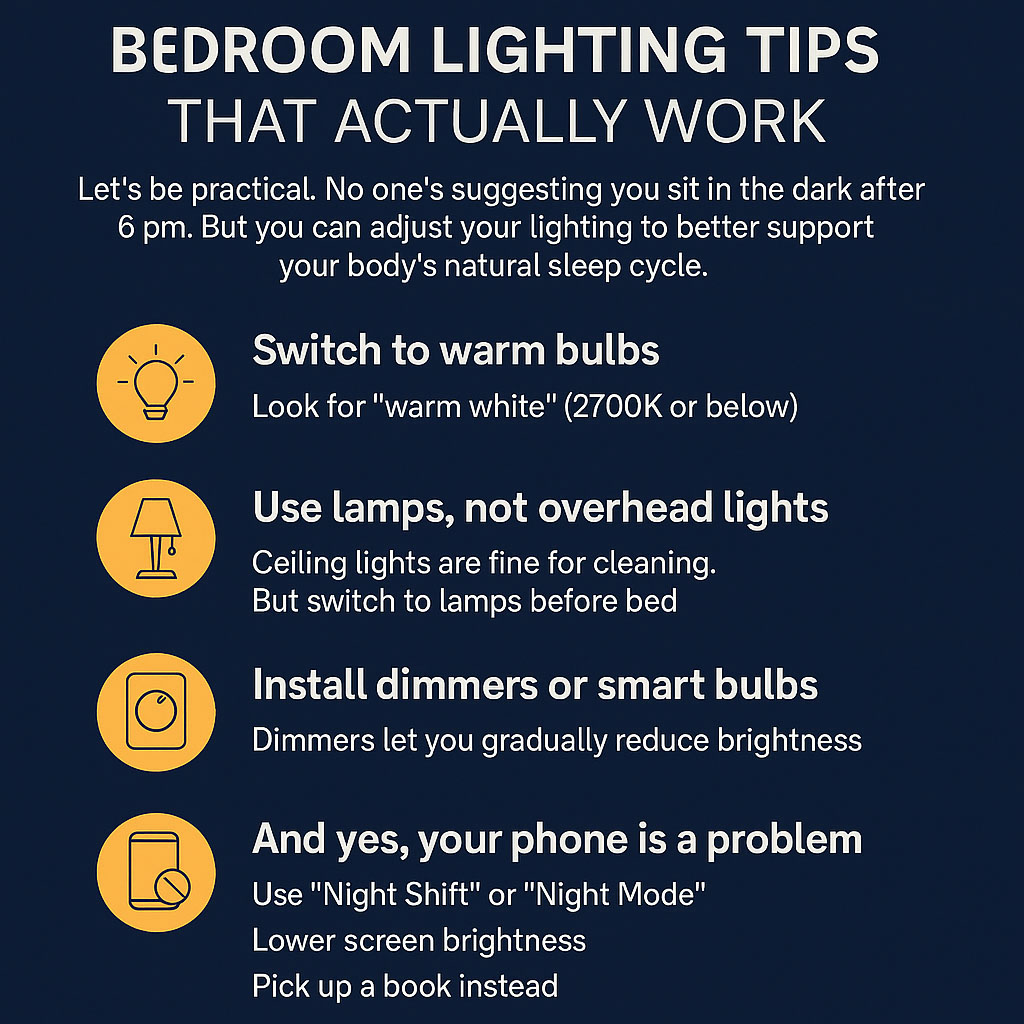
And yes, your phone is a problem.
We all do it check Instagram before bed or scroll through emails “just quickly.” However, blue light from screens is a well-known melatonin blocker. It tells your brain to stay alert when it should be powering down.
According to Mind.org.uk, reducing screen time at night doesn’t just improve sleep it also helps ease anxiety and racing thoughts.
While most sleep advice focuses on what you do at night, your morning light routine is just as important.
Getting natural daylight within the first hour of waking helps reset your body clock and boosts alertness. Even a walk around the block or five minutes in the garden can do the trick.
If you wake before sunrise or during dark UK winters, consider using a light therapy lamp or a sunrise alarm clock. These mimic natural light and can help with energy dips, especially for those dealing with seasonal low mood.
Light therapy isn’t just for people with Seasonal Affective Disorder. It’s helpful for anyone who:
Sit near a 10,000-lux light box for 20–30 minutes in the morning ideally between 6am and 9am. This exposure helps realign your circadian rhythm and can reduce the “midday slump.”
Your bedroom shouldn’t feel like an operating theatre. It should feel soft, cosy, and ready to wind down when you are. Here’s how to make that happen:
Table lamps and wall sconces beat overhead lights every time.
Use a mix of sources bedside lights, dimmable bulbs, maybe even string lights—for flexibility.
Streetlights and early sunrises can be just as disruptive. Blackout curtains or a good eye mask make a huge difference.
Pair this with a supportive mattress like the ones from Luxe Mattresses and you’ve got a recipe for better rest. Explore our collection of sleep-friendly mattresses or learn how to build the perfect minimalist sleep environment.
The connection between light and sleep, and how light effects on sleep cycles, goes deeper than just falling asleep quickly. It also affects mood, focus, and even symptoms of anxiety and depression.

As Mind.org.uk explains, proper exposure to light (especially natural light) can lift mood, reduce stress, and help regulate emotions something many of us could use a bit more of.
So, if you’re feeling low or out of sync, adjusting your light exposure might be a small but powerful step in the right direction.
Even well-meaning routines can include some lighting habits that quietly undermine your sleep. Keep an eye out for:
Sometimes, the simplest changes like switching a bulb or moving a lampcan bring surprising results.
We often focus on what we eat or how much we exercise, but overlook the impact of something as basic as light. The truth is, your body’s sleep rhythm isn’t just about bedtime routines or the number of hours you clock. It’s about timing. It’s about light. And it’s about teaching your body when to be alert and when to let go.
So, try adjusting your lighting, both natural and artificial, to match what your body actually needs. Pair that with a calm space, a supportive mattress from LuxeMattresses, and a phone that stays out of the bed, and you might just sleep better than you have in years.
Warm, soft lighting (around 2700K) is ideal. It mimics sunset tones and won’t disrupt melatonin production.
Yes, getting sunlight within an hour of waking helps reset your body clock and improve night-time rest.
They definitely let you shift colour temperature throughout the day and create bedtime-friendly lighting routines.
Night Mode helps, but it’s still best to limit screen use entirely before sleep. Try reading or journaling instead.
Use a sunrise alarm or light therapy lamp to simulate daylight. It helps signal to your brain that it’s time to start the day.
 March 9, 2026
Estimated reading time: 6 minutes
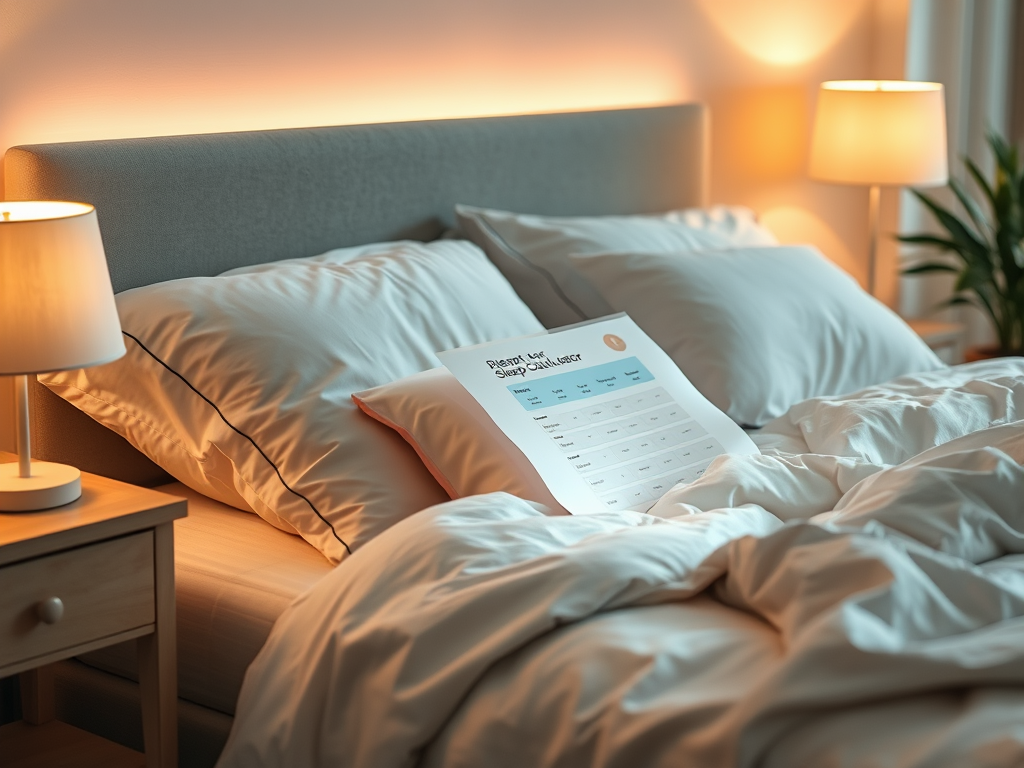
Sleep is a fundamental component of overall health, influencing everything from cognitive function to immune response. Using a sleep calculator can help you find the perfect balance. While general guidelines suggest that adults need between 7 to 9 hours of sleep per night, individual needs can vary based on age, lifestyle, and health conditions. Understanding your unique sleep requirements is essential for optimising rest and well-being.
Sleep is composed of multiple cycles, each lasting approximately 90 minutes. These cycles include stages of light sleep, deep sleep, and REM (rapid eye movement) sleep. Waking up at the end of a sleep cycle, rather than in the middle, can lead to feeling more refreshed and alert. Aligning your sleep schedule with these natural cycles can enhance sleep quality and daytime functioning.
Determining the optimal time to go to bed involves considering your desired wake-up time and the number of complete sleep cycles you aim to achieve. For instance, if you need to wake up at 6:30 AM and want to complete five sleep cycles (7.5 hours), your ideal bedtime would be around 11:00 PM. This calculation also accounts for the average time it takes to fall asleep, typically about 15 minutes.
Plan your optimal bedtime and wake-up times based on your body’s natural sleep cycles. Wake up refreshed and energized every morning.
Conversely, if you plan to go to bed at a specific time, calculating the best wake-up time involves ensuring you complete full sleep cycles. For example, going to bed at 10:00 PM and aiming for six sleep cycles (9 hours) would suggest a wake-up time of 7:00 AM.
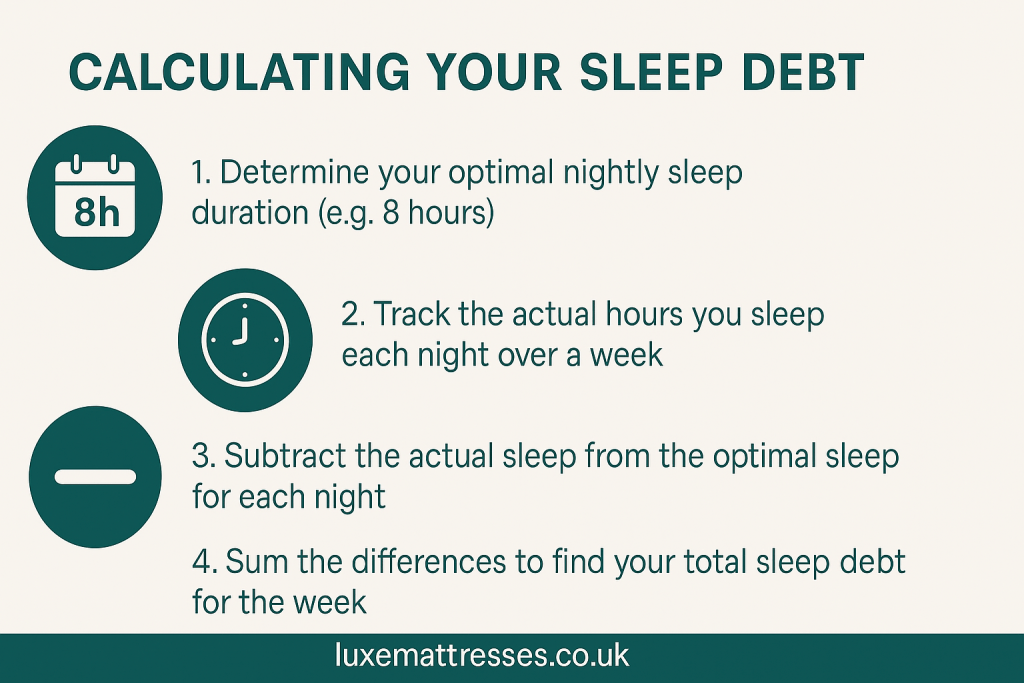
Sleep debt accumulates when you consistently get less sleep than your body requires. For example, if your body needs 8 hours of sleep per night but you only get 6 hours, you accrue a sleep debt of 2 hours per night. Over a week, this amounts to 14 hours of lost sleep.
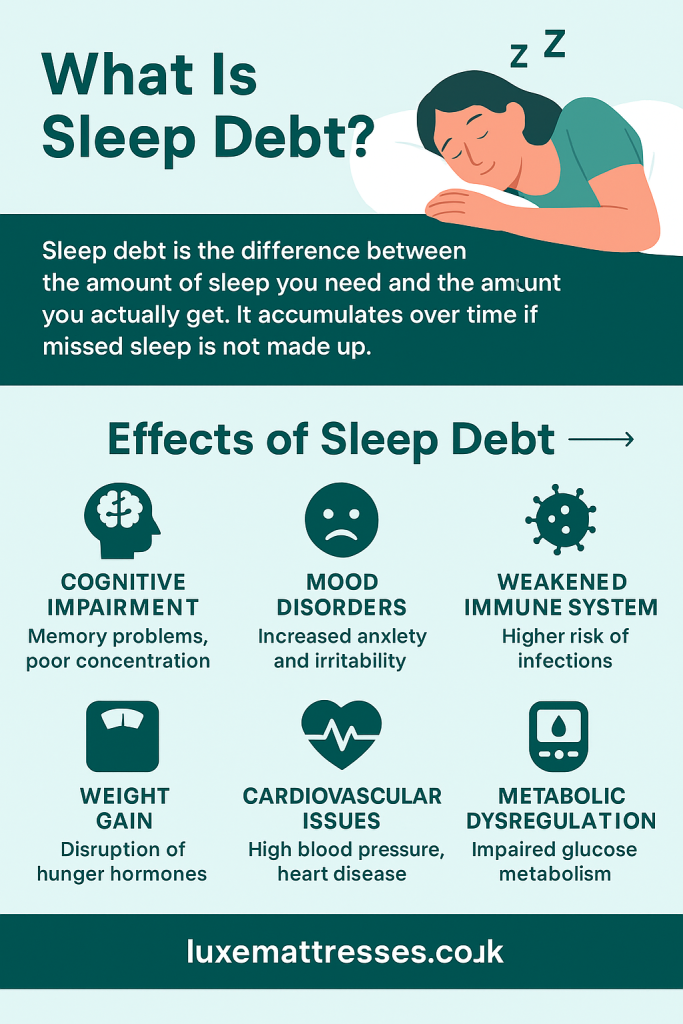
To calculate your sleep debt:
Discover your personalized sleep score and get expert recommendations to improve your sleep quality. This quiz takes about 5-7 minutes to complete.
Managing sleep debt involves adjusting your schedule to allow for additional sleep, improving sleep hygiene, and addressing any underlying sleep disorders.
Assessing sleep quality goes beyond duration. Key factors include:
Establishing benchmarks for these factors helps in identifying areas for improvement and tracking progress over time.
Understanding your sleep personality can provide insights into your sleep patterns and needs. Common sleep personalities include:
Identifying your sleep personality can guide you in tailoring your sleep environment and routines for optimal rest.
Based on your sleep assessments and personality, consider the following personalized recommendations:
Additionally, selecting a mattress that aligns with your sleep preferences can enhance comfort and support, contributing to better sleep quality.
Chronic sleep deprivation can have profound effects on both physical and mental health. Some of the potential consequences include:
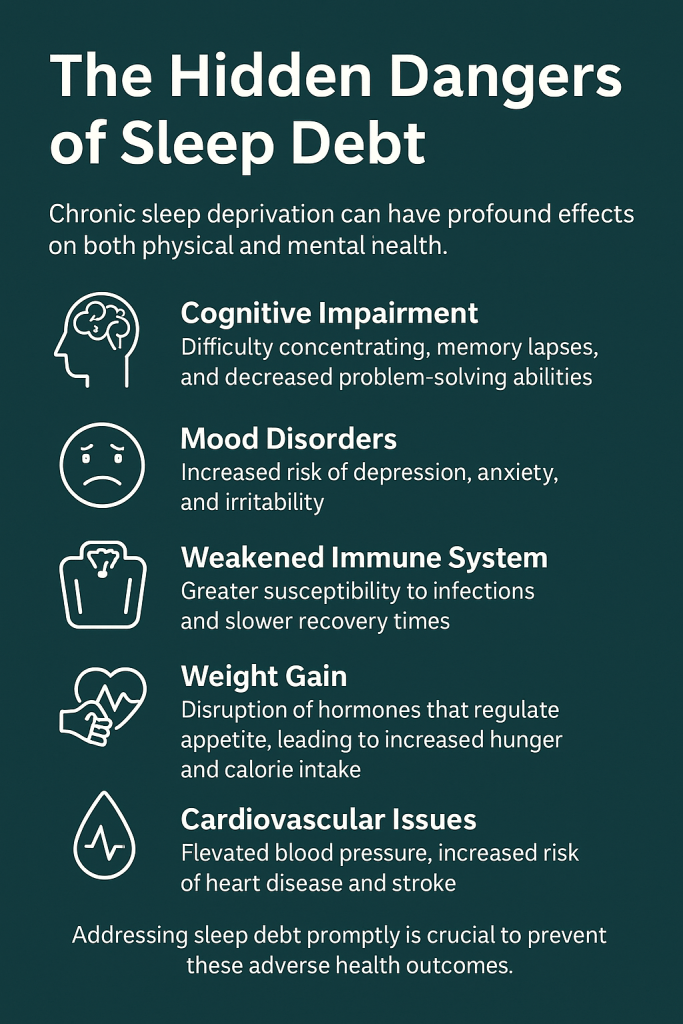
Addressing sleep debt promptly is crucial to prevent these adverse health outcomes.
Adults truly need 7-9 hours per night for optimal health, per AASM/CDC guidelines less increases risks like heart disease and cognitive decline.
No, 4 hours is chronically insufficient for most, leading to impaired cognition, weakened immunity, and higher chronic disease risk; only rare short sleepers thrive on it.
10 hours before bed: no caffeine; 5 hours: no alcohol/eat; 3 hours: no work/exercise; 2 hours: no naps; 1 hour: no screens promotes quality sleep.
Yes, some like those with hypersomnia or recovery needs require 10-12 hours, but most adults over 9 signals underlying issues like depression.?
Koalas sleep up to 90% (18-22 hours/24), an adaptation for low-nutrient eucalyptus diets requiring energy conservation.?
Understanding and aligning with your unique sleep needs is essential for maintaining long-term health and well-being. With the help of tools like our sleep calculator, you can evaluate your current sleep patterns, identify potential sleep debt, and uncover your individual sleep personality. These insights empower you to make smarter, more tailored decisions about your nightly routine. By adopting personalized strategies and enhancing your sleep environment, you’ll set the foundation for more restorative, high-quality sleep and better overall daily performance.
 March 7, 2026
Estimated reading time: 8 minutes
Imagine waking up tired, your body fighting off the common cold or flu despite every other preventative strategy. What if the secret to a healthier immune system isn’t expensive supplements or fad diets but the quality of your sleep? The connection between how sleep affects your immune system is stronger than most realise.
In today’s high-stress lifestyle, with stress and long working hours, sleep often gets pushed to the side, and so does your body’s ability to battle off illness. That’s why learning the science of sleep and immunity is more important than ever. From the mattress you rest your head on to your bedtime routine, small changes can make a difference in your immune health.
Sleeping is not a passive activity but a complex biological process necessary for immune function. Immune defense mechanisms that are in a dormant state when a person is awake are activated during deep sleep. It is the time of renewal when the immune system can rebuild and repair itself.
One of the key players is cytokines, which are small proteins that help regulate immune responses. Some cytokines are produced and released during sleep to fight infection and inflammation. Without adequate sleep, the body’s production of these protective cytokines is inhibited, making it harder for the body to defend against disease.

T-cells, which are white blood cells that detect and destroy infection, become more active while you sleep, too. Phases of deep sleep have been discovered to cause the proliferation and activation of these cells so your immune system becomes stronger.
Research explains that sleep assists the immune system as it enables the body to develop antibodies and fight infections. The body’s circadian rhythm, which is responsible for sleep and wakefulness, also manages immune function, which further strengthens the relationship between sleep and immunity.
Disturbed sleep patterns, such as decreased deep sleep, can undermine this immune stimulation process. That is why a proper sleeping environment is crucial to having a healthy immune system. A supportive mattress, such as the Luxe Nova Hybrid Mattress, promotes deeper and longer sleep. Ultimately, you get to start your day with a fight against infection.
When you understand these concepts, you will realise why sleep is so much more than simple relaxation. It’s an active time of immune restoration and rehearsal.
Long-term sleep deprivation has a proven ill effect on the immune system, making us more vulnerable to infection. So, theoretically, if you consistently sleep less than six hours per night, your body generates fewer cytokines and infection-fighting white blood cells, weakening your body’s natural defence.
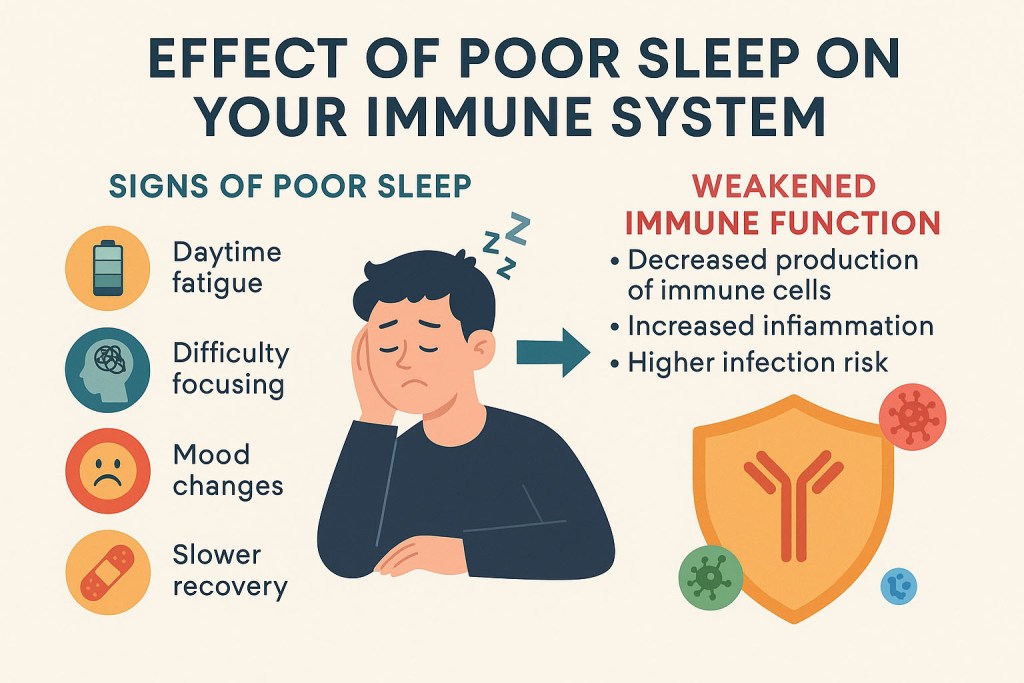
Research indicates that those who sleep normally fewer than the recommended hours a night are much more susceptible to catching colds and other illnesses.
Sleep deprivation also wreaks havoc with the body’s balance of inflammation, resulting in chronic low-grade inflammation, which is harmful in the long term.
Sleep deprivation influences the speed at which the immune system reacts to new infections. Vaccines, for instance, are less effective in individuals who have a poor sleeping pattern since the immune response is compromised. This is particularly relevant in the UK, where seasonal flu, influenza, and other infections strain the healthcare system annually.
Plan your optimal bedtime and wake-up times based on your body’s natural sleep cycles. Wake up refreshed and energized every morning.
Therefore, the answer to “Does sleep deprivation weaken the immune system?” is a resounding yes, and it is evidence-supported. Sleep deprivation renders your body less efficient at identifying and fighting off invaders and makes you more susceptible to attack.
Real-world situations testify to this. Night shift workers, who usually work nonstandard shifts, have increased infection and illness rates. Likewise, students who stay up all night to study for exams discover that their immunity is low and thus are susceptible to colds.
Poor sleep over the long term typically not only decreases immune function but potentially also raises the risk of inflammatory-linked chronic diseases like diabetes and heart disease.
Having quality sleep has a very positive impact on your immune system. As discussed before, when you get deep sleep, your body increases the production of infection-fighting cells, such as natural killer cells and T-cells, which roam around and destroy harmful viruses and bacteria.
Research also shows that well-rested people have a greater response to vaccines. For instance, people who are well-rested before, during, and after inoculation produce more effective protective antibodies that enable their bodies to develop long-lasting immunity.

Chronic inflammation, which accompanies poor sleep, harms tissue and breaks down immune defences. Proper rest keeps inflammation at bay, which promotes general health.
If you find it hard to get a good night’s sleep, it’s about time you invest in a good quality and comfortable mattress. Luxe Mattresses is all about creating mattresses that are specifically crafted for maximum comfort and support, which lead to longer deep sleep cycles. A better mattress will most likely provide you with the good sleep your immune system requires to operate at its best.
Good sleep also helps with mental health. Mind.org.uk discusses that poor sleep can worsen anxiety and depression, which can reduce immune response. In contrast, quality sleep enhances the mind and body.
Check out this article to learn how your mattress can impact mental health and stress levels.
In a nutshell, we can say that sleeping is the strongest natural way of increasing your immune system, reducing the risk of illness, and aiding in recovery.
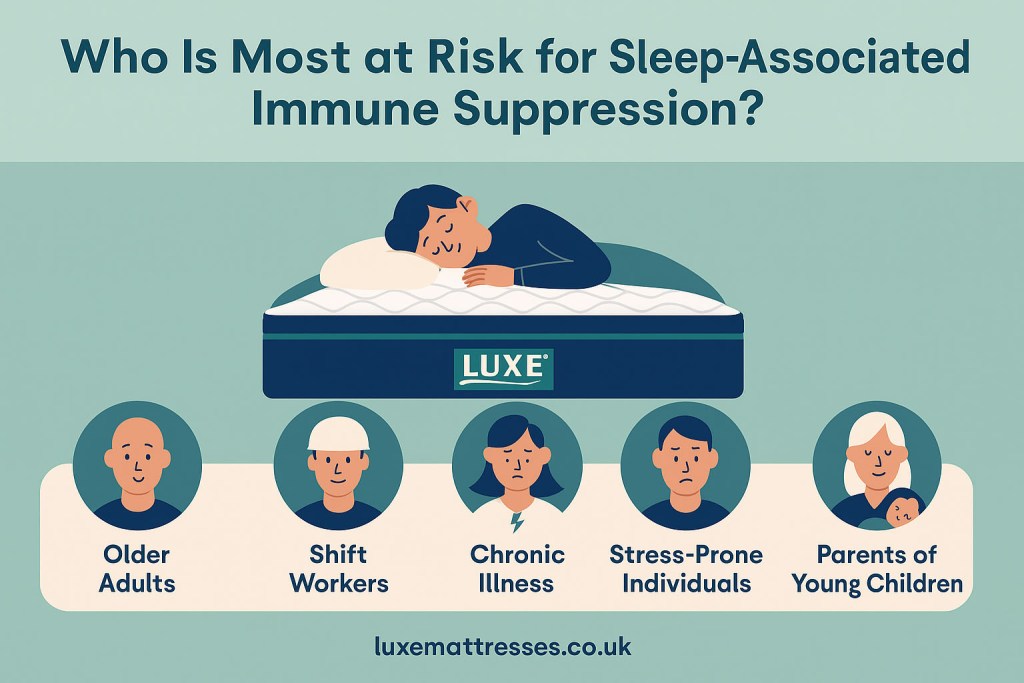
People often underestimate sleep affect on immune system, the Certain groups are particularly vulnerable to weakened immune systems due to insufficient sleep. They include shift workers whose sleep patterns are interrupted, which influences their immune system and predisposes them to infections and slower healing.
Students, especially during examination periods, lose sleep, weakening their immunity. The older people also experience alterations in sleeping behaviors and immunity naturally, making them susceptible to sickness if there is not good quality sleep.
Patients with chronic illness also sleep poorly and struggle with immunity. Diabetes or heart disease is exacerbated by sleep deprivation, contributing to a spiralling effect on health.
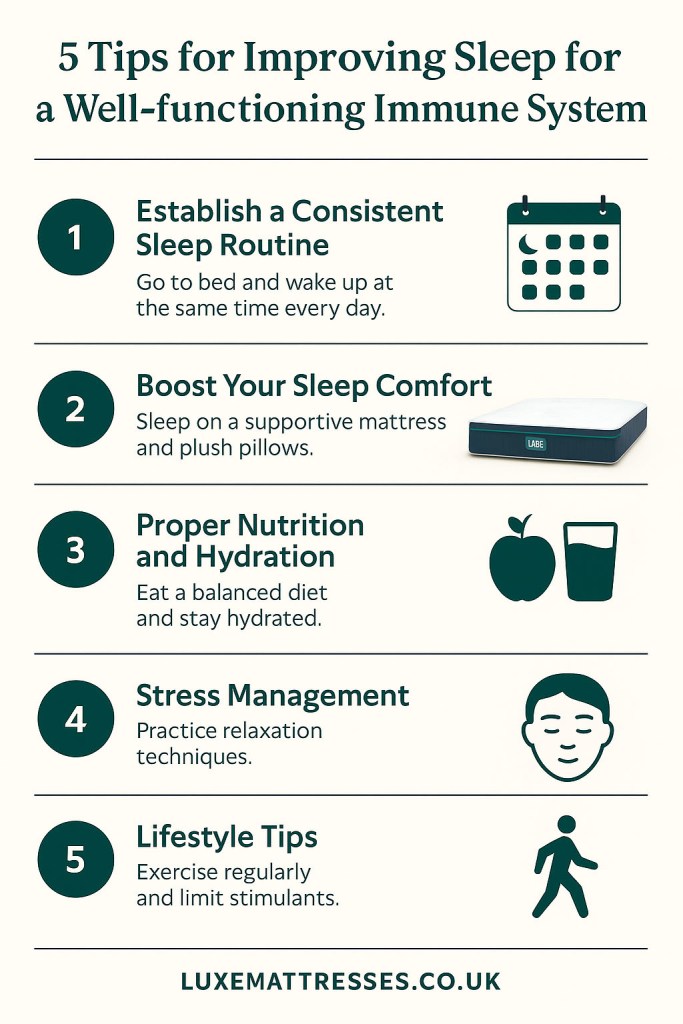
One of the easiest things to do to strengthen your immune system is to maximise the quality of your sleep. Establishing a regular sleep routine synchronises your body’s internal rhythm so that you sleep more soundly. Rising and retiring at the same time every day, weekends included, instills a rhythm that is immune-friendly.
Your sleeping arrangement matters. Having a good mattress, like the Majestic 9000, to support the body to avoid pains and facilitate uninterrupted sleep is very important. Keeping the room cool, dark, and quiet also facilitates deep sleep.
Choosing the right mattress firmness can also help reduce snoring and sleep apnea symptoms; learn more about this in can a firm mattress help with snoring and sleep apnea?.
Sleep and immunity are also affected by nutrition and hydration. Avoid heavy meals, caffeine, and alcohol close to bedtime as they disrupt sleep patterns. A proper diet rich in minerals and vitamins supports sleep and immunity.
Stress needs to be managed as stress upsets the quality of sleep. Techniques like meditation, mindfulness, or even deep breathing can calm the mind during the night, and the individual will be able to sleep comfortably. According to NHS reports, reducing stress improves sleep as well as immunity.
Cutting down on screen time at bedtime is another big step. Blue light emitted from screens will delay the release of melatonin, the hormone that makes your body sleep. It doesn’t take radical lifestyle adjustments to make these changes. Small, persistent habits can be a big sleep quality booster.
Sleep is the key to a robust immune system. When you priorities restorative sleep with better habits and a quality mattress like the Majestic 9000 or Luxe Nova Hybrid Mattress, you enhance your body’s natural protection. Remember: better sleep means better immunity, so invest in rest to protect your health from what lies ahead.
Sleep promotes the growth of infection-fighting cells and also maintains inflammation in check, thus making your immune system stronger.
Yes. Sleep deprivation over time depresses immune cell function and raises the risk of infection.
You should adhere to a regular sleeping pattern, establish a sleeping environment, control stress, and refrain from taking stimulants close to bedtime.
Most adults need 7″9 hours of quality nighttime sleep for optimal immunity.
Yes, definitely. Stress interferes with sleep and also directly impairs immune functions.
Supportive beds that permit deep, uninterrupted sleep, such as Luxe Mattresses, contribute to enhanced immune function.
 January 6, 2026
Tired of tossing and turning? You are not alone. While many blame stress or schedules, the truth is: your own habits might be sabotaging your rest. Even seemingly harmless routines like late-night snacking or scrolling can throw your sleep into chaos. Studies show that nearly 60 per cent of people suffer from sleep issues triggered by daily lifestyle choices.
Let’s break down ten common habits that might be keeping you up and what to do instead.
We get it checking Instagram or watching a quick show feels like a harmless way to wind down. But blue light from phones and screens suppresses melatonin, the hormone that signals to your brain that it’s time to sleep. Worse, digital content keeps your mind alert when it should be easing into stillness.
Put your screens away at least 30 to 60 minutes before bed. Try reading a book, journaling your thoughts or meditating instead. Unplug to unwind.
Sleeping in on weekends and staying up late during the week disrupts your circadian rhythm. Your body clock gets confused, making it harder to fall and stay asleep. The result? Shallow rest, groggy mornings and social jetlag come Monday. Stick to a consistent schedule even on weekends. Regularity helps your body anticipate rest, leading to deeper, more refreshing sleep.
That 4pm latte might feel necessary but caffeine lingers. It can remain in your bloodstream for up to eight hours, keeping your brain stimulated long after sunset. Coffee, tea, soda or even dark chocolate can all sabotage your ability to drift off. To play it safe, cut off caffeine after 2pm. Go for caffeine-free herbal teas like chamomile or peppermint in the evening.
A heavy meal right before bed may satisfy cravings but it wreaks havoc on digestion. Greasy or spicy foods trigger bloating, acid reflux and interrupted sleep. Your body needs rest, not a midnight shift digesting a three-course dinner. Aim to finish eating at least two to three hours before bed.
Sure, a glass of wine might make you feel tired. But alcohol disturbs your sleep cycle, especially REM, which is serious for memory and mood. It can cause you to wake up repeatedly, sweat excessively or feel groggy the next day.
Instead of using alcohol to wind down, try relaxing teas like lemon balm or magnesium supplements. Sleep that’s alcohol-free is far more restorative.
Exercise is excellent for sleep but not if it’s right before bed. Intense evening workouts elevate your heart rate and stimulate adrenaline and cortisol, both of which keep your body alert.
Try to finish workouts at least two to three hours before bedtime. If you crave movement in the evening go for light stretching or restorative yoga.
A nap can feel heavenly but too much or too late backfires. Oversleeping in the afternoon reduces your body’s sleep pressure, the biological need that builds throughout the day to help you fall asleep at night.
Keep naps short 20 to 30 minutes max and always before 3pm. This way, you recharge without sabotaging your nighttime rest.
A noisy, cluttered or overly warm bedroom makes it nearly impossible to unwind. Your brain associates the environment around you with how safe and calm you feel.
Use blackout curtains and/or white noise machines, and keep the room cool (ideally around 65°F or 18°C). And invest in a high-quality mattress like something from our Luxe Mattress Collection for breathable supportive comfort night after night.
Lying awake ruminating over your to-do list? You are not alone. But this habit teaches your brain that bed = worry. Elevated cortisol, the stress hormone, blocks melatonin and delays sleep onset.
Instead of overthinking, practise calming habits: deep breathing, gratitude journaling or calming audio. If you can’t sleep after 20 minutes, get up, move to another room and return when sleepy.
Without a wind-down ritual your brain has no signal that it’s time to shut down. Jumping straight from stimulation to bed leaves your nervous system in go-mode.
Build a gentle evening routine: lower the lights, brush your teeth, stretch and read. Repetition trains your brain to associate these actions with sleep, easing the transition into rest.
Great sleep doesn’t happen by accident, it’s built through small conscious habits. By identifying and replacing bad sleep behaviors with healthier alternatives you’ll notice big changes in your energy focus and mood.
Start with one shift then another. Soon restful nights will become your new normal. Want a real upgrade? Try a Luxe Mattress. Your best sleep begins with the right foundation.
Better sleep starts with awareness. Many of the habits we think are harmless like scrolling on our phones, late-night snacks, or inconsistent schedules can quietly sabotage our rest. By identifying these habits and replacing them with healthier routines, you can improve your sleep quality, boost your energy, and feel more focused during the day.
Start small, pick one habit to change at a time, create a calming bedtime routine, and make your sleep environment a peaceful retreat. With consistent effort, restful nights won’t just be a dream they’ll become your new normal.
Common sleep-disrupting habits include late-night screen time, irregular sleep schedules, caffeine or alcohol before bed, late-night meals, and high stress levels.
Using phones or screens before bed exposes you to blue light, which suppresses melatonin and keeps your brain alert, making it harder to fall asleep.
Yes. Caffeine can stay in your system for up to 8 hours, while alcohol may make you drowsy initially but disrupts REM sleep, leading to grogginess and night awakenings.
Try keeping a consistent sleep schedule, limiting screen time before bed, creating a calm sleep environment, practicing stress-reduction techniques, and following a gentle bedtime routine.
Start by identifying which habits are harming your rest. Gradually replace them with healthier routines like meditation, light evening stretches, early dinners, and limiting naps, plus investing in a supportive mattress.
 January 1, 2026
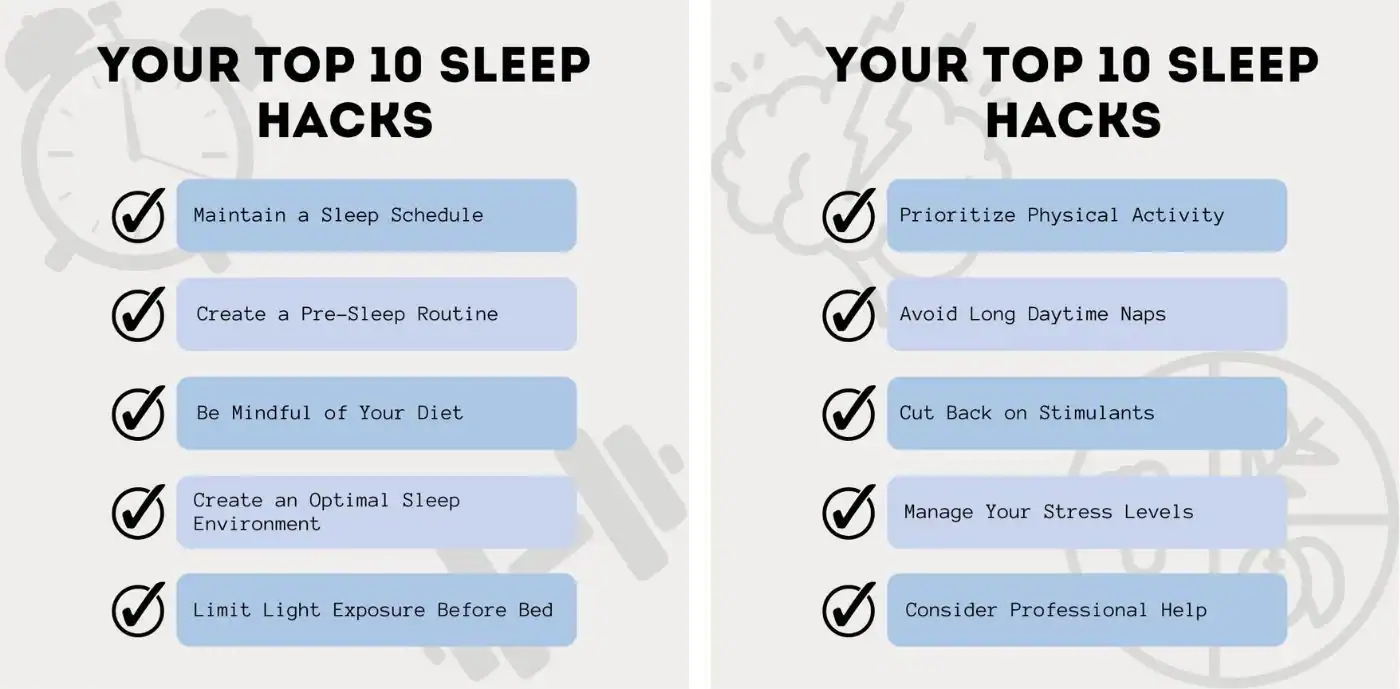
Trouble sleeping or waking up feeling rested? You’re not alone. Good sleep is essential for mental sharpness, immune function and overall health. The CDC (Centers for Disease Control and Prevention) reports that one in three adults do not sleep enough. A healthy sleep pattern can boost mood, metabolism and even memory.
Going to sleep and waking up at the same time is excellent for stabilizing and strengthening the circadian rhythm. This routine not only regulates sleep but significantly enhances sleep quality in the long run. Harvard Health proposes that this consistency goes a long way toward preventing daytime fatigue and reducing the risk of chronic diseases (Harvard Health).
It is important to stress that adherence to this routine on the weekend is also necessary for health purposes.
A worn-out mattress with sagging surfaces can cause back pain and sleep disturbances. One study found that people who replaced their old mattresses reported a significant improvement in sleep quality and reduced back pain (Jacobson et al., 2006). Luxe Mattresses are designed for both ergonomic comfort and temperature control. Consider investing in higher-quality bedding to enhance recovery and wake up free from pain.
It has been established that devices exude blue light, which reduces the secretion of melatonin and hence postpones the initiation of sleep. The Sleep Foundation suggests avoiding screens for at least one hour prior to bedtime. One may also make use of night mode or blue light filters. Reading a book works without a screen; you can really chill now.
As per the Sleep Foundation, the perfect sleep temperature is approximately 18 degrees celsius or 65 degrees fahrenheit. Blackout curtains block outside light and, therefore, promote melatonin production. A dark, cool room also tells the brain it’s time for sleep. A fan or great airflow through breathable bedding is helpful.
The effects of caffeine can stay in your system for up to eight hours, disrupting your sleep patterns and preventing restful sleep. Experts generally say to stop any caffeine-related activities after 2pm. Instead, you might want to use herbal teas in the evening. Be careful with dark chocolate since it contains caffeine too.
Soothing activities like stretching, taking a warm bath, or journaling can help you relax. Dr. Jade Wu recommends winding down for at least 30 minutes. This practice lowers stress hormones and facilitates faster sleep onset. Do not engage in stimulating activities during this period.
Natural light resets our inner clock and guides our melatonin cycles. A morning walk or even just drawing open the blinds can help us sleep better. Sunlight increases serotonin, which in turn elevates mood and alertness. Aim for 15-30 minutes of sunlight exposure every day.
Eating large meals may cause lots of indigestion and many hours of poor sleep quality. The Mayo Clinic suggests eating at least two hours before sleeping. Light snacks like yogurt or bananas can be eaten if hunger strikes. Avoid spicy foods, acidic foods or fatty foods in the evening.
Exercise enhances the quality of sleep and reduces the chance of sleeplessness. As per Sleep Foundation, schedule intense exercises at least two to three hours before bedtime. Gentle yoga or walking can bring about improvement later in the evening. Regular activity also helps regulate the circadian rhythms of the body.
Unwanted sounds can disrupt sleep cycles, leading to awakenings at night. Earplugs, white noise machines or fans can minimise disruptions. Another study in 2023 found that consistent ambient noise could increase deep sleep by 38%. A quiet atmosphere facilitates undisturbed rest.
Sleep is responsible for productivity, immunity and well-being. Add these ten hacks to change your sleep and energy levels throughout the day. Comfort is a must so check out our Luxe Premium Mattress Collection. Better sleep begins with better support.