You know how to select the best mattress according to your body shape, weight and other factors. You brought the mattress home but it did not fit in the bed. Are you wondering about the right UK mattress size guide? Did you know what the exact dimensions are of a king-size mattress in the UK? Well, selecting the right size of mattress is as important as choosing the right type of mattress.
Buying a new mattress or bed is an expensive decision. You need to get every little detail right from the very start. The initial step is to determine the exact mattress size required to accommodate you and your partner. Is a queen-size mattress good enough for you two? Is the super king bed too large for your space? The next sections have the answers to all these questions.
UK Mattress Size Guide
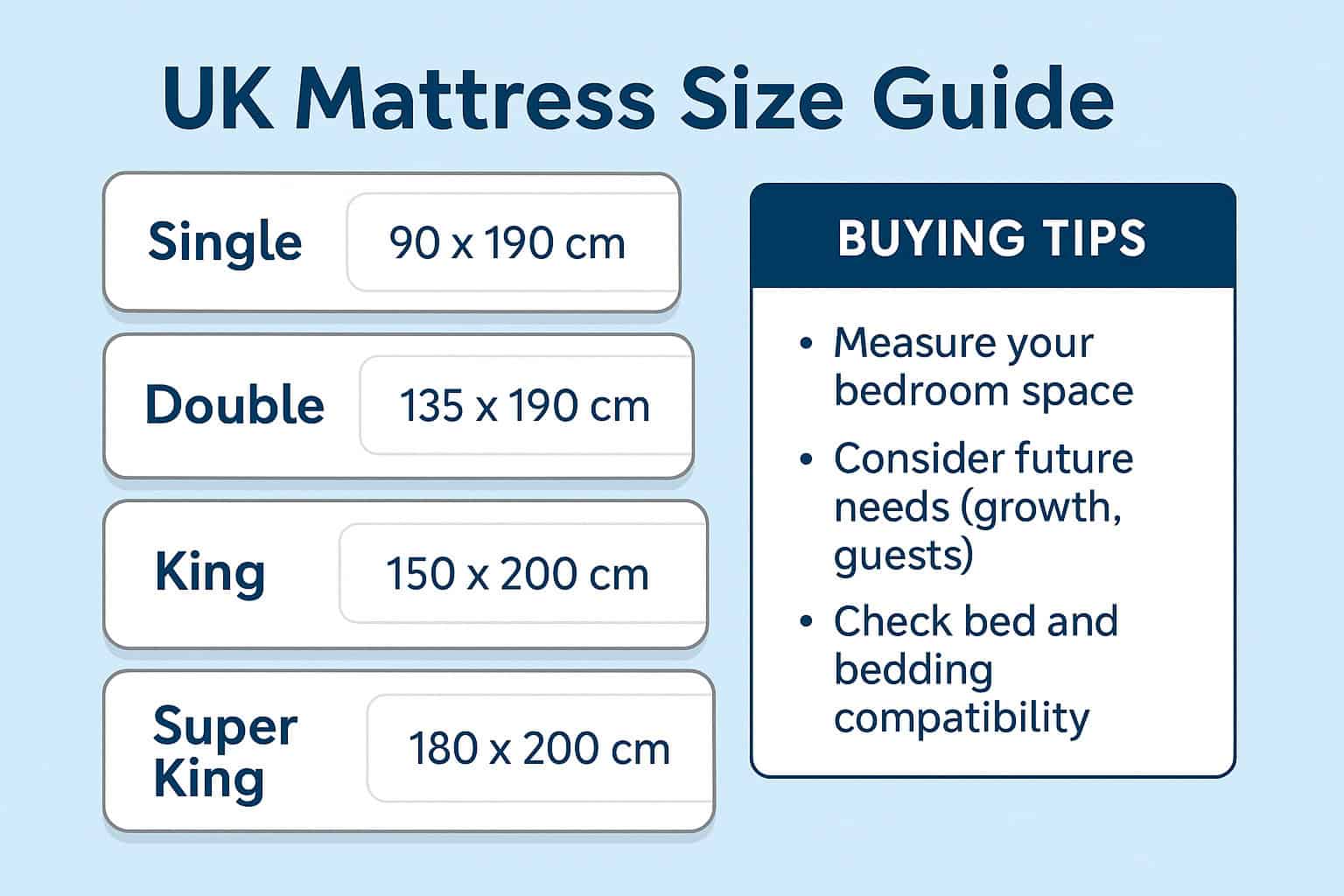
At Luxe Mattresses UK, we don’t just sell mattresses and beds, we promote peaceful sleep and comfortable experiences. For a smoother shopping experience, every customer must know the right bed sizes UK. Here is the simplest UK mattress size guide chart that will help you make the right purchase at Luxe Mattresses UK:
These sizes for UK mattresses are almost the same for all mattress brands in the UK. Before buying a new mattress, make sure to measure the available space in your room and your bed dimensions. Exact measurements will help you avoid any returns or extra shipping charges. If you don’t have any idea about which mattress size is suitable for your bed or space, contact customer support at Luxe Mattresses UK.
How to Choose the Right Mattress Size?
Every product displayed at Luxe Mattresses UK has clearly mentioned size options in the size chart. But most customers don’t know which mattress size is suitable for their needs. Here are some practical tips that can help you choose the right mattress size.
1. Measure Space in your Bedroom
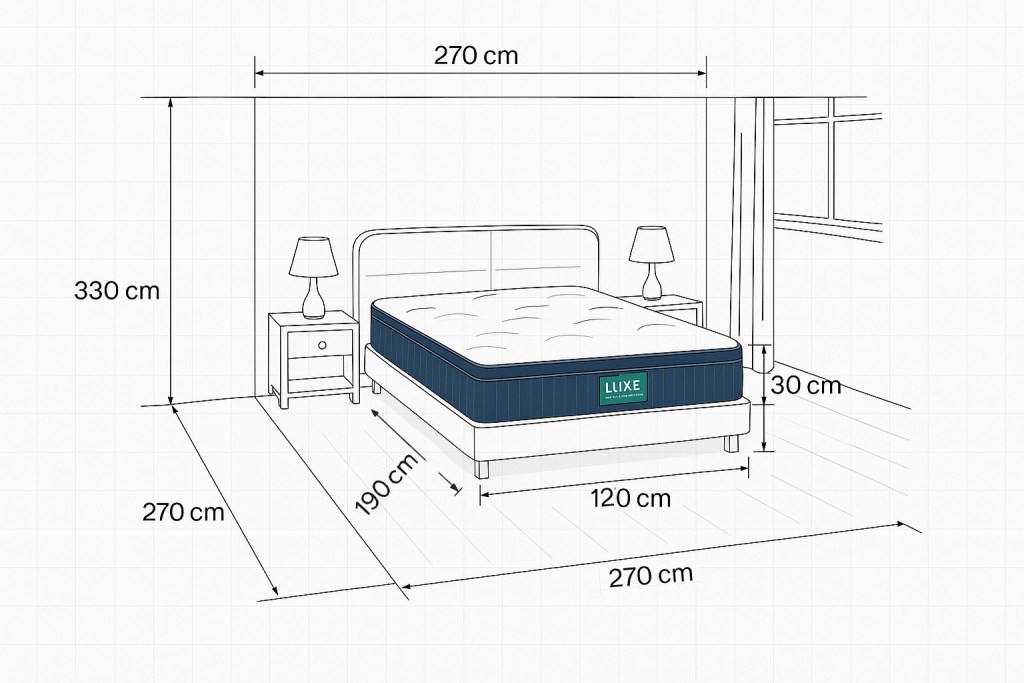
There is no hard and fast rule but it is advised to leave 60cm of space around your bed for easy movement in the room. Start with measuring the size of your room. A super king bed may not fit inside a small room. If a queen-size mattress can accommodate you, there is no need to get a bigger bed.
2. Who will use the Bed?
In a home, different people will use beds and mattresses. Different mattress sizes are available for different sleepers. Here is the right way to determine the mattress size based on the person sleeping on it:
Couples: a queen-size mattress is the bare minimum for couples. King or super king mattresses might also be comfortable if your kids or pet sleep with you.
Solo sleepers or teenagers: a small double bed will not take up too much space in your room and you still have space to stretch around.
Children: Single or small single mattress is good enough for kids
3. Consider Future Needs
If you are planning for a long term, buy a mattress that can be used for years. Kids grow quickly and buying a toddler bed will require a new bigger mattress pretty soon. Other lifestyle changes should also be considered.
Tips for Buying the Best Mattress
Are you ready to spend some time reading a few detailed reviews and mattress-buying tips? There are new technologies and mattress types that you may not be aware of. Here are a few practical tips that can help you find the best mattress for peaceful sleep every night.
1. Buy from a Trusted Brand Only
In the UK, there are only a few brands that are known to offer the best mattresses, specially engineered for British consumers. Luxe Mattresses UK is among those brands that understand the demands of local clientele. Buying from a trusted brand not only gives you peace of mind but you also get to choose from a wide range of mattresses.
2. Read Reviews of Test It.
Buying from a physical store does not offer any specific benefit these days. Users like to purchase online. You can try the real-time comfort and support of mattresses in-store but for online shopping, mattress descriptions or online reviews can be quite helpful. Go through a few reviews and clients’ feedback to identify the pros and cons of the mattress.
3. Check for Bed Base Compatibility
Not all mattresses suit all bed bases. Some bases may slightly alter the effective size due to headboards or side rails. Double-check compatibility to avoid mattress overhangs or gaps.
Final Words
Buying a mattress is not and trial method, you have to define your needs, size requirements and other needs before starting the shopping spree.
One more thing, buying the right mattress is not just about accurate size, it is about finding the balance between support and comfort, durability and price, and firmness and comfortable surface to sleep on. Don’t forget to check the size chart if you are unsure about the dimensions of any mattress available at the official Luxe Mattresses UK website.
FAQs
Are mattress and bed sizes the same all over the world?
No, UK mattress sizes are different from EU and US sizes. Usually, mattresses have the same dimensions in the UK but depending on the origin, these sizes may be different for every country or brand.
Is a queen bed comfortable for a couple with a kid?
If a kid sleeps with you, king-size is a better choice. The queen bed is suitable for two sleepers only. Couples with kids need a king-size or super king-size bed.
What is the average depth of a UK mattress?
Most mattresses in the UK have an average height of 9-12 inches. So, the average depth of mattresses in the UK is said to be 10 inches.
Back pain is one of the most common health problems with people over 30s. Sitting on chair for long hours, unhealthy eating habits, lack of active lifestyle and many other factors might be causing back pain. But have you ever thought about role of your mattress in the back pain issue? You spend 7-8 hours on the mattress, what if your mattress is the main culprit here?
Can a mattress cause back pain? Yes, a worn-out, or bad mattress can lead to back pain, shoulder pain and many similar health problems. Waking up sore or stiff isn’t just part of getting older; it could be your mattress. Switching to a better and orthopaedic mattress can solve the issue for you.
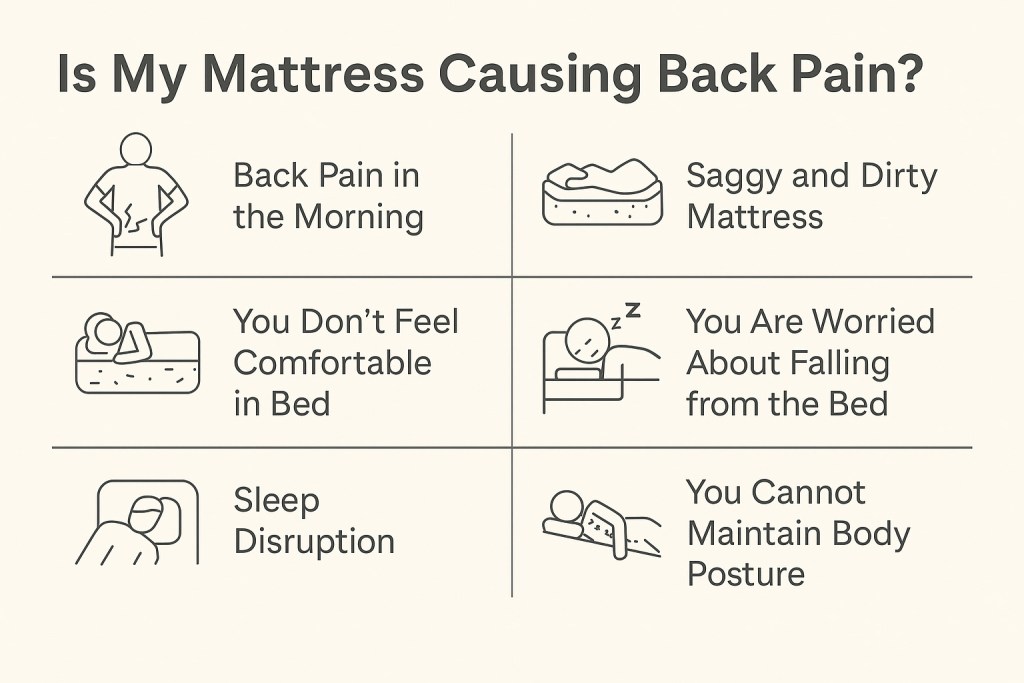
Is My Mattress Causing Back Pain?
Even a new mattress may cause back pain because the goal is not to buy the new mattress, but to buy the right mattress. If you are experiencing serious pain, visiting your doctor might be a good idea. But here are some checks that will help you determine if your issue is related to the mattress.
Back Pain in the Morning
Morning pain is the very first sign of a bad mattress. Quality sleep is supposed to make you feel energetic and fresh. Sleeping on a bad mattress will make things even worse for you. Did you feel fine before going to bed, and now woke up with back pain? It is clear that the mattress is the contributing factor here.
You don’t Feel Comfortable in Bed
Even after a hectic day at the office, you don’t feel comfortable in bed. In reality, you are supposed to fall asleep instantly, but you are struggling with finding the comfortable sleeping position. Changing sides and tossing around for the most part of the night means that mattress needs replacement.
Saggy and Dirty Mattress
A good mattress is supposed to last 8-10 years, but if you have purchased a cheap mattress, you should not expect this extended lifespan. Poor usage and lack of care can also result in a saggy mattress.
As a result, you don’t get the support where you need it most. For better sleep experience, support and comfort, choose Luxe Nova Hybrid mattress and you will see significant improvements in back pain within few weeks.
Sleep Disruption
Peaceful sleep means drifting off easily at night and waking up in the morning with a clear mind and a body that feels rested. Unfortunately, a poor-quality mattress can prevent this from happening.
Over 25% of people report waking up at least once during the night, while many others experience multiple disruptions. Choosing the right mattress, one that offers proper support and comfort, significantly increases your chances of enjoying deep, uninterrupted rest. For more insights, check out Sleep Foundation guide to healthy sleep habits.
You are Worried about Falling from the Bed
A worn out mattress will not provide edge support. After changing side, you feel like rolling off the edges of the mattress. Edge support not only makes it easier for you to get in or out of bed but also indicates the structural integrity of your mattress.
You cannot Maintain Body Posture.
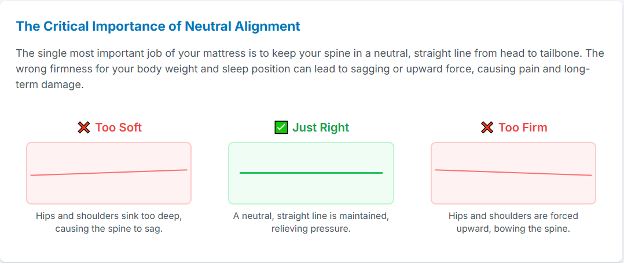
For back pain relief, your body must maintain a good spinal curve. Sleeping like a folded taco will make your back hurt in the morning and your mattress is the reason behind this poor sleeping position. A too soft surface fails at supporting the spinal alignment, eventually causing back pain.
How to Ease Back Pain with the Right Mattress?
You need to make healthy changes for better physical health. Start by including some physical activities in your routine. Next, consider getting an orthopaedic mattress designed to help with back pain, which can improve your sleep at night.
Majestic 9000 mattress by Luxe is one of the best mattresses in the UK with orthopaedic-level support and comfort. This mattress reduces pressure points and evenly distributes the body weight across the mattress. If you are in your 30s and dealing with a bad back, get the right Luxe mattress. Here are some unique benefits of switching to an orthopaedic luxury mattress:
Targeted support for the lower back
Even weight distribution
Improved posture during sleep
Reduced tossing and turning
Better muscle recovery and joint relief
Medium-firm and firm mattresses perform well for sleepers with bad back. You cannot expect the back pain to go away overnight. Adjusting to the new mattress will take some and that’s why all mattresses by Luxe come with 100-night trial period. Take your time and within a few weeks, you will see improvements in your sleep quality.
Other Tips to Ease Back Pain in Your 30s
Changing your mattress and getting good sleep are important, but there are some other changes that you must make for a fit lifestyle. Most of the issues causing back pain are related to your sleeping habits. Here are some other changes that can help you get rid of back pain in your 30s:
Replace your mattress if it’s over 8 years old
Use a pillow that matches your sleep position
Stretch gently before bed
Keep your sleep space cool and quiet
Avoid slouching or working in bed during the day
Final Words
Good night sleep is not a luxury; it is an essential part of a healthy lifestyle. Your age has an important role to play in your health but with the right approach, you can ease different health problems.
Switching to an orthopedic mattress is easy as Luxe Mattresses in the UK offers a wide range of premium and luxury sleep accessories. Mattresses with orthopedic-level support and medium-firmness are ideal fit for sleepers in their 30s experiencing back pain.
FAQs
Can a bad mattress cause back pain in your 30s?
A bad mattress can lead to back pain and other challenges for sleepers of any age. You are more likely to notice the level of pain in your 30s, but a bad mattress is bad for every sleeper.
What is the right mattress firmness for back pain relief?
Mattresses with medium-firm or firm surfaces perform well for sleepers with back pain. Luxe is the perfect luxury mattress brand in the UK, with firm and medium-firm mattresses.
How can I tell if my mattress is causing my back pain?
If you wake up with stiffness or pain that improves throughout the day, your mattress could be the culprit. A sagging, overly soft, or uneven surface often fails to support your spine properly while you sleep.
What type of mattress is best for back pain?
Medium-firm or orthopaedic mattresses tend to offer the best balance of support and comfort. These help keep the spine aligned and reduce pressure on joints and muscles.
How long should a mattress last before it starts causing problems?
Most mattresses should be replaced every 7 to 10 years. However, signs of wear such as sagging, lumps, or a noticeable dip can lead to discomfort much sooner.
Can a luxury mattress really help with back pain?
Yes, if it combines supportive structure with quality materials. A luxury mattress that includes memory foam or zoned support can improve posture during sleep and help reduce chronic discomfort.
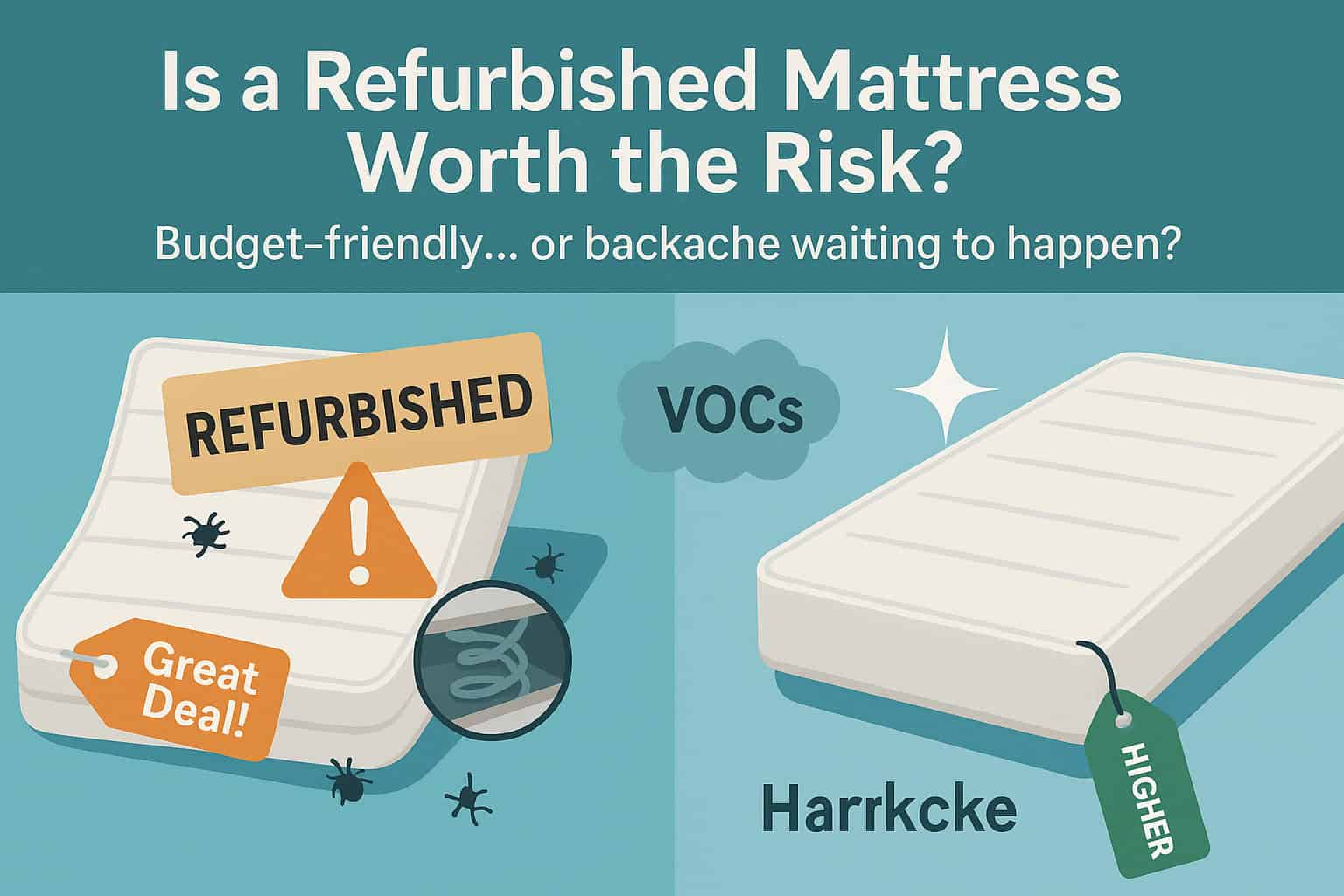
A refurbished or reconditioned mattress at a tempting price may attract your attention instantly. These mattresses look nice, and they cost less than a New mattress. Refurbished mattresses may seem a good grab, but there is always a catch; there are risks involved.
In this article, we will review the pros and cons of a refurbished mattress. If you are a budget buyer, we have some amazing options that are better than reconditioned mattresses and offer better value for money. Instead of risking your health, invest in good quality new mattress and enjoy peaceful sleep every night.
What is a Refurbished Mattress?
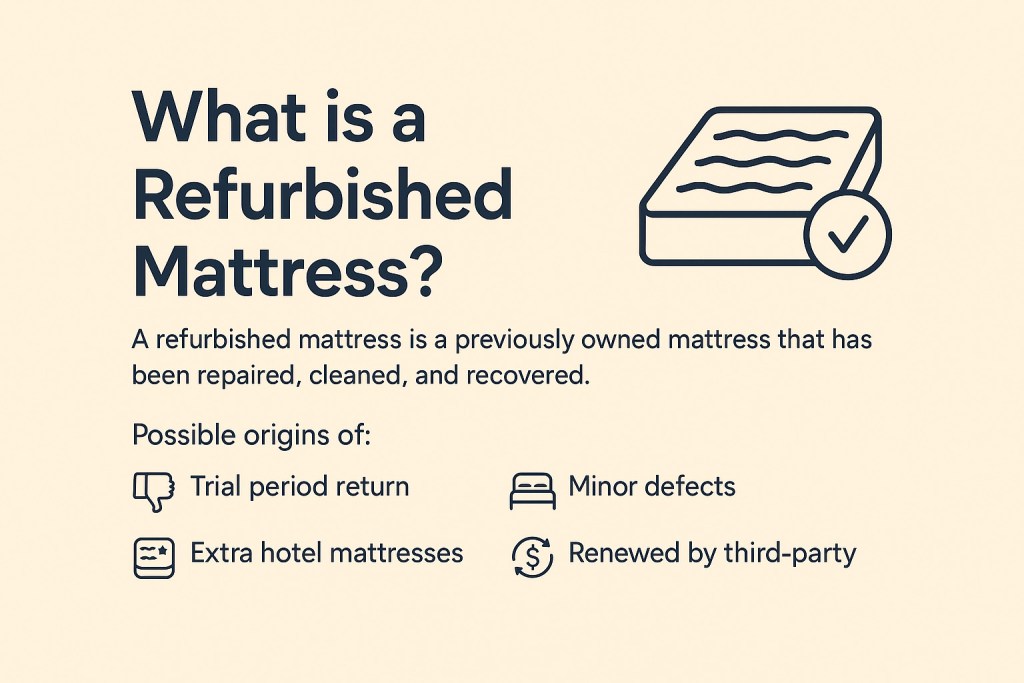
A refurbished mattress is previously owned or returned mattress. These are not second-hand or used products and most of the time, owners return almost new mattresses due to some minor faults. But can a refurbished mattress compete with a new luxury mattress?
Brand repair, clean and recover these previously owned mattresses and then resell them as refurbished or reconditioned mattresses. Here are some possible origins of refurbished mattresses:
The customer did not like the mattress during the trial period
Hotels and guestrooms returned extra mattresses
Mattresses with minor defects
Used mattresses renewed and refurbished by 3rd party sellers
Not every refurbished mattress is worth buying. The level of repair may vary and if you end up with a bad product, your money and wasted and your sleep too. Are these refurbished mattresses worth the risk when you can buy a new mattress for a competitive price?
Risks of Refurbished Mattresses
When buying a refurbished mattress, you don’t know the previous history of the product. Who has used the mattress, and how was it maintained and for how long? You may not find answers to these questions.
Buyers need to understand that buying a reconditioned mattress in the UK is a blind bet. Here are some potential risks involved with buying a reconditioned mattress in the UK.
1. The Hidden Health Risks of Refurbished Mattresses
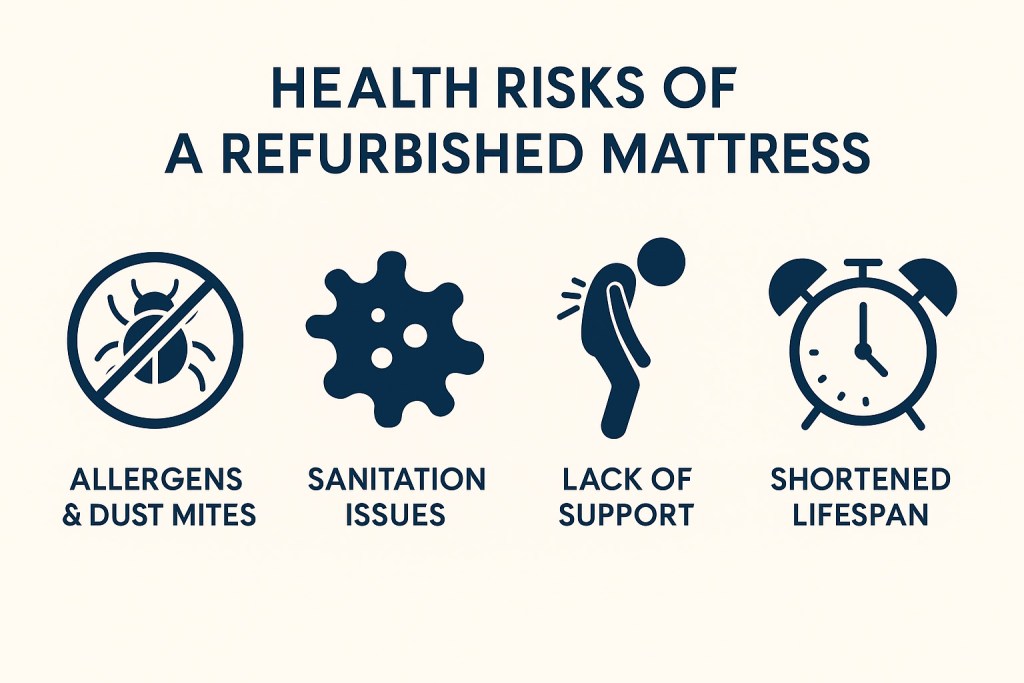
While refurbished mattresses may appear clean and cost-effective on the surface, they can harbor invisible health threats, especially for individuals with allergies, asthma, or compromised immune systems.
Hygiene & Allergen Exposure:
Refurbished mattresses often retain traces of sweat, skin cells, dust mites, pet dander, and bacteria from previous users. Even with surface-level sanitisation or new covers, these contaminants can remain embedded deep in the mattress layers. these are the main risks associated with refurbished mattress:
Respiratory irritation (due to dust mites or mold spores)
Skin reactions and rashes (from residual irritants or cleaning chemicals)
Aggravation of asthma or eczema, particularly in children or sensitive sleepers
Bed Bug and Mold Contamination:
Unlike new mattresses, refurbished ones may have been exposed to pests or water damage, both of which are difficult to detect without internal inspection. Bed bugs can survive inside crevices and seams, while mold thrives in foam layers if the mattress was stored in damp conditions.
Structural Integrity and Back Pain:
Reused springs and foam may lack the support needed for spinal alignment, especially if the previous owner’s body impression remains in the structure. This can result in chronic back, neck, and hip pain, or disturbed sleep due to uneven pressure points.
Real case: A 2022 investigation by consumer protection group Which? in the UK found that some renewed mattresses failed hygiene tests, showing elevated levels of allergens and irregularities in spring support even after supposed refurbishment.
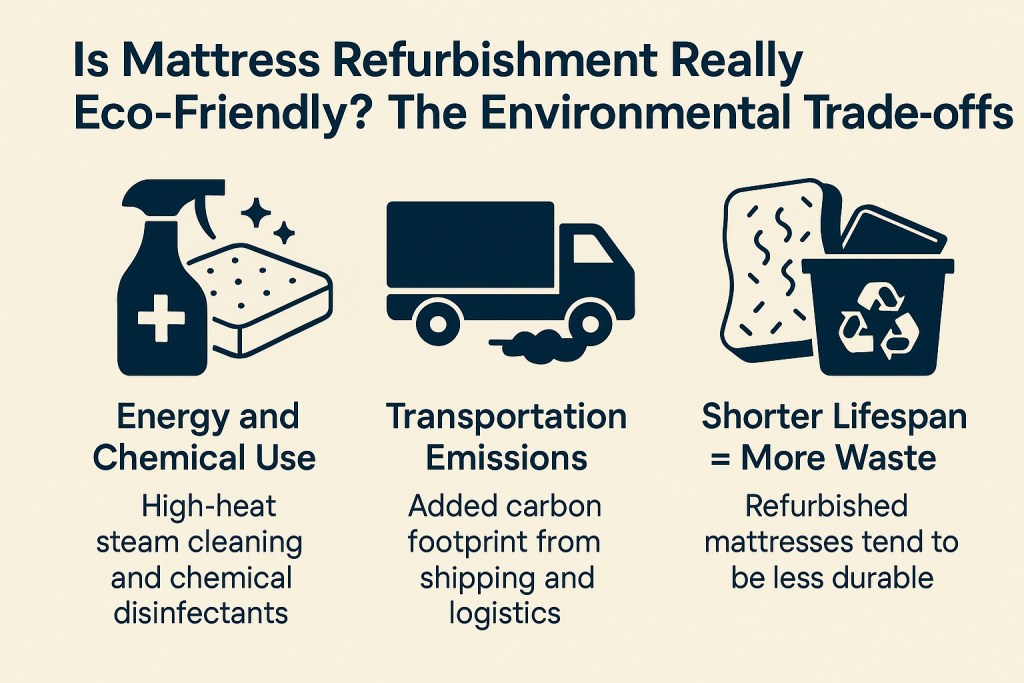
2. Is Mattress Refurbishment Really Eco-Friendly? The Environmental Trade-offs
Mattress refurbishment is often marketed as a sustainable solution and often considered as eco friendly mattress production approach, but its actual environmental footprint is more complex than it appears.
Energy and Chemical Use:
The cleaning and restoration of mattresses typically involve high-heat steam cleaning, chemical disinfectants, and new textile materials (such as foam and fabric). These processes consume significant energy and may introduce volatile organic compounds (VOCs) or bleach-based substances into the waste stream.
Transportation Emissions:
Refurbished mattresses are often shipped back and forth between collection, cleaning, and reselling centres. This added transport increases the carbon footprint, particularly if the refurbishing company lacks local facilities.
Shorter Lifespan = More Waste:
Most refurbished mattresses do not last as long as new ones due to compromised internal materials. This means consumers often discard them sooner, leading to double the landfill contribution over time. Instead of reducing waste, it can delay it temporarily, resulting in circular inefficiency.
Conclusion: While mattress refurbishment reduces immediate landfill volume, the process still involves energy, chemicals, and emissions. It is only truly sustainable when strict standards and high-quality restoration are maintained, which is not always the case.
3. What Really Happens During the Mattress Refurbishment Process?
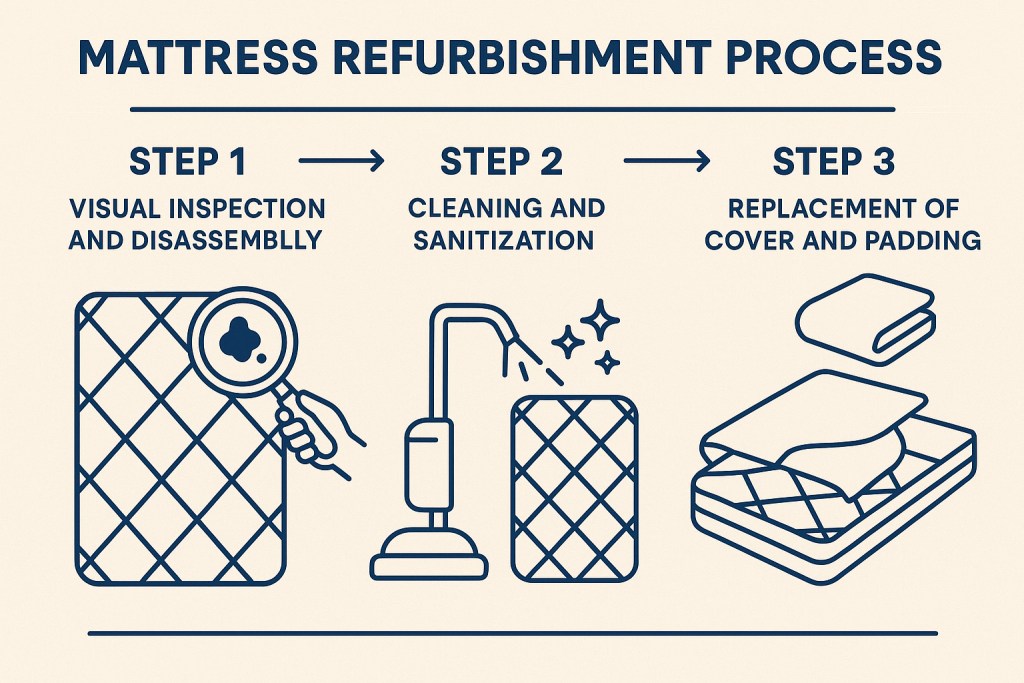
The process of refurbishing a mattress is not universally standardised and can vary widely depending on the company, region, and type of mattress. However, most refurbishment operations follow a general sequence that includes inspection, cleaning, cosmetic improvements, and resale. Here’s a closer look at what typically happens behind the scenes:
Step 1: Visual Inspection and Disassembly
Once a mattress is returned, collected, or discarded, it undergoes an initial visual inspection. Trained workers look for visible damage such as stains, tears, sagging, or broken springs. If the mattress appears too degraded or unhygienic for reuse, it is often rejected and either sent for partial material recycling (e.g., metal springs) or disposed of entirely.
If it passes inspection, the mattress is partially disassembled. This usually involves removing the outer cover to assess the integrity of the internal components, particularly the foam layers, support cores, and spring systems. The goal is to determine whether the structure can be salvaged or requires replacement.
Step 2: Cleaning and Sanitisation
For mattresses that are deemed salvageable, a cleaning process begins. Most refurbishers use steam cleaning, ultraviolet (UV) treatment, or chemical disinfectants to sanitize the surface and immediate inner layers. While these methods can eliminate surface-level contaminants such as dust, bacteria, or minor odors, they rarely penetrate the deep core of the mattress, where mold, allergens, and microscopic debris may still exist.
In many cases, companies focus on restoring a mattress to look and smell fresh rather than ensuring full hygienic integrity. This step is also where the greatest variation occurs, some companies go through rigorous sanitation, while others perform minimal cleaning.
Step 3: Replacement of Cover and Padding
After cleaning, the mattress is cosmetically improved. This usually means applying a new outer fabric cover, often branded or styled to mimic the original. In some cases, the top layer of foam or padding, the comfort layer is also replaced to improve appearance and feel.
However, it is important to note that the support core (springs or base foam) is often retained, even if it has been compressed or structurally weakened from prior use. This is where refurbished mattresses can underperform compared to new ones, as the internal components may have already undergone significant wear.
Step 4: Basic Functionality Testing and Repackaging
Once reassembled, the mattress is subjected to basic mechanical testing, such as compression or bounce response checks. These tests are typically superficial and do not include the comprehensive pressure mapping, durability trials, or material stress tests that are performed on new mattresses during manufacturing.
After testing, the mattress is re-covered, sealed, and repackaged for resale. At this stage, it is often labeled as renewedrefurbished or like new but the description may not disclose the exact extent of the refurbishment. Consumers are rarely informed about which components were replaced, how the mattress was cleaned, or how old the internal materials are.
4. Poor Comfort and Support System
A quality mattress can easily last for years but the support system may not remain efficient. When you buy a refurbished mattress, there is no proper way to verify the structural integrity of the mattress. A saggy mattress is not worth buying, even at the cheapest rates.
Luxury mattresses by Luxe are praised for optimal support and comfort. If you compare the prices of refurbished mattresses with those of Luxe mattresses, new ones seem a better purchase. There is no point in risking the comfort and support for a cheaper mattress.
5. No Warranty or Trial Period
Every new mattress by Luxe Mattresses UK comes with a 100-night trial period and a 10-year warranty. For a decent investment, you are getting a reliable product and peace of mind. On the other hand, refurbished products usually don’t come with any warranty or trial period. Once you have made the purchase, the mattress is yours.
What Mattress Brands Don’t Tell You About Refurbished Beds
Many large mattress companies market refurbished or renewed mattresses as sustainable alternatives, but what’s often left out is how inconsistent the refurbishment process can be. While some may sanitise and re-cover the mattress properly, others merely patch up surface damage and sell it as nearly new.
Refurbished Mattress Companies (UK)
âš ï¸ Warning: While refurbished mattresses may seem budget-friendly and eco-conscious, they can pose hidden hygiene, durability, and safety risks. Always verify what “refurbished” mean ”some may simply be cleaned returns with unknown wear or damage. You deserve full transparency and peace of mind when it comes to your sleep and health.
Refurbished Mattress Companies in the UK
Company
Client Type
Highlight
Green Sleep Ltd
Consumer & Retailers
Eco-conscious refurbishment of unused/returned mattresses
TFR Group
Retail & Local Authorities
Large-scale refurbishment and recycling for partners
Simba Sleep
Consumers
Returned mattresses inspected, refurbished & discounted
Eve Sleep
Consumers
Premium refurbished mattresses with new covers
Bensons for Beds
Consumers
22-point check, UV sterilised, 1-year guarantee
Emma (Second Life)
Consumers
Sanitised, refitted, ~35–40% lower cost
Dormeo UK
Consumers
Certified rejuvenated memory foam & hybrids
OTTY
Consumers
Eco-refurbished, re-covered, deep-cleaned
Naturalmat
Consumers
Full refurbishment or recycling with TFR
TEMPUR UK Outlet
Consumers
Factory outlet refurbished TEMPUR mattresses
For instance, in a widely reported UK case, cot death researcher Dr. Jim Sprott raised concerns that second-hand or inadequately refurbished mattresses may contribute to sudden infant death syndrome (SIDS). His investigation found that reused baby mattresses, especially those with unknown histories, can harbor harmful bacteria, fungi, or chemical byproducts.
Since there is no strict regulation for refurbishing or reselling mattresses in many regions, terms like refurbished or pre-owned can mean anything from light surface cleaning to complete structural overhaul. Crucially, parents are often not told what level of cleaning was performed or whether the inner materials were replaced, making it difficult to judge the real safety of the product.
In short, the transparency around refurbishment processes is limited, and what you get might be far from what’s promised.
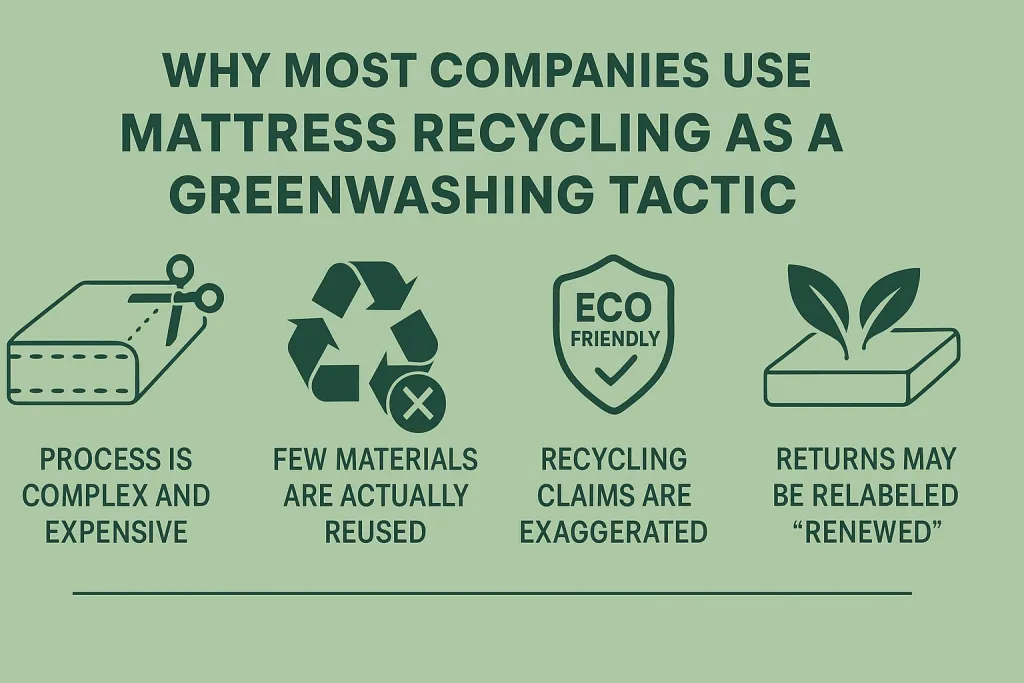
Why Most Companies Use Mattress Recycling as a Greenwashing Tactic
Mattress recycling sounds like a win for the planet. Less waste, fewer landfills, and a smaller carbon footprint. But in reality, for many companies, it is little more than a marketing strategy. Beneath the surface, mattress recycling often becomes a case of greenwashing, a way to appear eco-conscious without making meaningful changes.
The truth is that mattress recycling is complex and expensive. It requires taking apart layers of foam, springs, textiles, adhesives, and covers. In most cases, only a small portion of these materials, usually metal and some foam, can actually be reused. The rest is still discarded, just delayed before reaching the landfill.
One clear example comes from California state-run mattress recycling program. Although advertised as fully recyclable, reports revealed that only 45 percent of the materials were actually reused. The rest ended up in incinerators or landfills.
Even more concerning, some companies resell lightly used or returned mattresses under labels like renewed or recycled without explaining how much of the mattress was truly restored.
In the end, the eco-friendly image often hides cost-cutting tactics or a way to profit from returned inventory. The promise of sustainability becomes a selling point, not a real commitment.
Should You Buy a Refurbished Mattress? The Hidden Risks You Must Know
Buying a refurbished mattress might save you money, but it comes with serious trade-offs especially regarding hygiene, durability, and health.
Hygiene Risks: Even with steam cleaning, it’s hard to eliminate dust mites, bacteria, or mold from inner layers of used mattresses. For allergy sufferers or those with sensitive skin, this can be a real issue.
Lack of Warranty or Return Options: Refurbished mattresses often come with no or limited warranty, and returns may not be accepted. That’s a big gamble if the mattress turns out uncomfortable or faulty.
Unknown Wear and Tear: The inner support (springs, foam density) might have already degraded, leading to poor spinal support or early sagging. It’s like buying used shoes they are shaped to someone else body, not yours.
Real-life case: A UK customer shared on Trustpilot that a refurbished mattress they purchased online developed a significant dip within 3 months, only to discover the internal foam had not been replaced only a new outer cover was added. They ended up replacing it with a new one, doubling their cost and stress.
When a Refurbished Mattress May Be Acceptable
If you have the budget and want to invest in premium products only, a new mattress is always the best decision. For some users, affordability may be a serious factor, and even then, there are some rare scenarios where a refurbished mattress may be acceptable:
A trusted reseller has listed the mattress, and a detailed previous history is available
The refurbished mattress is clearly labelled as a lightly used product
You are using the mattress for commercial use
Orthopaedic Mattress for Back Pain- Better Alternative
Back pain is a common and serious issue, and your mattress plays a major role in this health problem. Sleepers don’t realise the importance of a quality mattress. They end up sleeping on a worn-out mattress for years, and when they realise the issue, the damage is already beyond repair.
Instead of risking your health and quality of sleep, get a brand-new orthopaedic mattress for back pain. The price tag for a new mattress might be higher than a reconditioned mattress, but you won’t regret your decision.
Benefits of Orthopaedic Mattresses
As the name suggests, these mattresses are specially designed to offer optimal support to ease back pain. At Luxe, we partner with renowned sleep experts and chiropractors to develop luxury orthopaedic mattresses that can help with back pain relief and pressure point relief.
Switching from a refurbished or worn-out mattress can make a huge difference in the quality of your sleep. Here are some potential benefits that you can enjoy with a new orthopaedic mattress for back pain from a trusted brand like Luxe Mattresses in the UK:
Targeted spinal support to help the body maintain the natural curve of the spine
Body weight is distributed evenly across the mattress so that no points build pressure
You have peace of mind because you are getting a hygienic and clean mattress
Luxe products come with a generous trial period and warranty
A premium orthopaedic mattress by Luxe can easily last for 10 years
Customer-friendly return and exchange policy
Final Verdict
In most cases, buying a refurbished mattress is not worth the risk. If you have allergies and any type of body pain, a refurbished mattress is a BIG NO for you. Buying a used mattress may seem like a budget-friendly deal, but you will be paying the real price in terms of back pain, allergies, restless nights and other potential issues.
Invest in quality products only a buy a brand new orthopedic mattress for back pain. Luxe Mattresses is a renowned luxury mattress brand in the UK. Stay connected for latest deal and product releases by Luxe.
FAQs
Are refurbished mattresses safe to sleep on?
Not always. While some companies follow proper cleaning and sanitisation protocols, others may only do surface-level refurbishing, replacing the cover without addressing internal hygiene or wear. Without transparency or certifications, there’s a risk of exposure to allergens, bacteria, mold, or even bed bugs. If you have allergies, asthma, or sensitive skin, a refurbished mattress may pose health risks.
How can I tell if a refurbished mattress is truly clean and hygienic?
Ask for documentation of the refurbishment process. Reputable sellers should provide details about what was cleaned, replaced, or inspected. Look for certifications like CertiPUR-USOEKO-TEX, or local sanitation compliance. If a mattress is sold as-is with vague terms like renewed it’s best to be cautious.
Do refurbished mattresses come with a warranty or return policy?
In most cases warranties are limited or nonexistent. Some sellers may offer a 30-day trial or limited coverage, but it’s far less than the 5,10 years you might get with a new mattress. Always check the return and warranty terms before purchasing, many refurbished options are final sale.
Are refurbished mattresses really eco-friendly?
Only partially. While they reduce immediate waste and keep some materials out of landfills, the refurbishment process often uses chemicals, electricity, and packaging materials, which can offset those environmental gains. Additionally, because refurbished mattresses tend to wear out faster, they may end up being replaced and discarded sooner than a new mattress, leading to more waste in the long run.
Is it worth buying a refurbished mattress to save money?
It depends on your budget, risk tolerance, and health needs. If the seller is transparent and offers proper hygiene certification, a refurbished mattress can be a budget-friendly option. However, for most people, especially those with back issues, allergies, or higher expectations, spending a bit more on a new, entry-level mattress with a warranty is usually the safer, longer-lasting investment.
When shopping for a new mattress, you can come across different terms that brands use for size measurement. Queen, king, small double, single and double are a few mattress sizes that are available in the UK.
For a British customer with a small family, queen and king-size mattresses are good options. Do you think a queen-size mattress is bigger than a king mattress? The simple answer is no, because in almost all regions, king beds are bigger than queen-size beds.
Is Queen Size Bigger Than King Size?
No, in the UK, the mattress often referred to as Queen size is not bigger than a King size. In fact, the confusion largely comes down to terminology. Let’s break it down properly.
Queen vs King Mattress Size Comparison
UK Mattress Size Comparison
Mattress Name
Dimensions (cm)
Also Known As
Single
90 x 190
–
Small Double
120 x 190
Often called “Queen” (UK)
Double
135 x 190
–
King
150 x 200
Standard UK King
Euro Queen
160 x 200
European Queen
Super King
180 x 200
–
Euro Queen vs King: Direct Size Comparison
Size
Width x Length (cm)
UK King
150 x 200
Euro Queen
160 x 200
Small Double
120 x 190
Conclusion
The UK “Queen size” is actually smaller than a King (often a Small Double).
The Euro Queen is wider than a UK King.
Always check mattress dimensions, especially when shopping online or with European brands.
Euro sizes may not match UK bed frames or bedding—check compatibility first.
Queen and King-Size Mattresses
Both queen and king-size mattresses are good enough for a couple. A Queen Mattress setup offers enough space for two people to sleep comfortably. King-size mattresses are spacious enough if you need more space in bed or if your kid or pet sleeps with you.Â
A queen bed is not bigger than a king bed, but there are many other factors that help to determine the best mattress for you.
In this guide, we will discuss UK vs EU bed sizing and the dimensions of queen and king-size mattresses in the UK. If you are looking forward to buying a new mattress and cannot decide whether a queen or king mattress is good for your bedroom, give this guide a read.
Euro Queen vs King Size Mattress
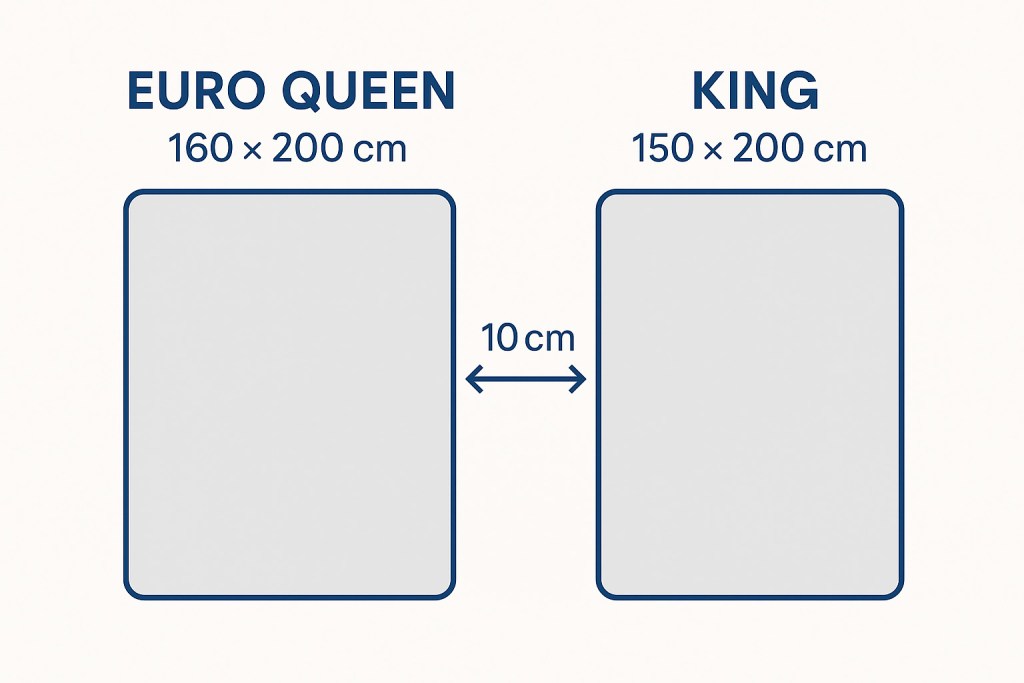
The Euro Queen size mattress (160 x 200 cm) is 10 cm wider than the UK King size mattress (150 x 200 cm), though both are the same length. Despite the name, the Euro Queen actually offers more sleeping space than the UK King, making it ideal for couples who prefer extra width.
UK and EU Sizing
In both the UK and Europe, a king-size mattress is bigger than a queen or Small Double mattress. There are slight differences between the sizes.
Queen is not an official term for bed sizing in the UK, as most retailers refer to this size as Small Double. For a better understanding of the sizes, let’s have a look at the size comparison of different mattress sizes in the UK and the EU.
Is a queen-size bed bigger than a king? You probably have a clear answer to this question. Once you are clear about the dimensions of the mattress, there are some other factors that must be considered. First of all, let’s explore the benefits and cons of both mattress sizes.
Queen Mattress
Pros
Cons
Queen mattresses are usually more affordable
Might feel cramped for couples with kids
The most popular mattress size for couples, your bedding accessories are usually suitable for queen beds.
You might want a bigger mattress if your partner takes up too much space in bed.
Comfortable and spacious enough for two people
Easier to fit in the room, easy to move
King Mattress
Pros
Cons
Quite spacious for couples and sleepers who require extra space in bed
King mattresses cost more than queen beds
Best for couples with kids or pets
Accessories are also expensive
Looks beautiful in bigger bedrooms
They weigh more and are harder to move
Not suitable for smaller bedrooms
Both mattresses have unique benefits and disadvantages. What’s the best mattress for you? Well, the right mattress depends on your personal needs and preferences.
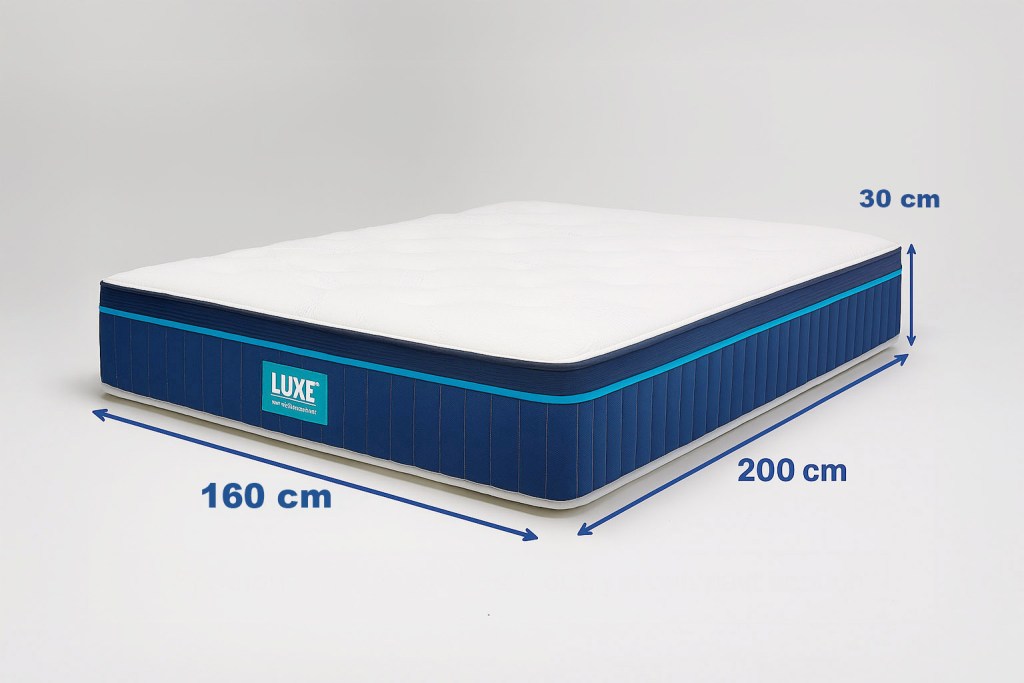
For the ease of customers, every product at Luxe Mattresses has exact dimensions in the description section. These details offer clarity for the customers, and they can also determine if the mattress is suitable for them.
How to Choose the Right Mattress Size?
With different size options available for mattresses in the UK, how do you determine the right size for your room? Here are some points that can help you in the decision-making process.
1. Room Measurements
Bedroom size is one of the most important factors in deciding the right size for a new mattress. For a smaller room, a king-size mattress may be too big. Queen mattress is the ideal size option for smaller rooms. Placing a king bed will look good in bigger rooms only.
2. Budget
Looking for the right bed without setting a budget will make the purchase process confusing for you. First things first, set a budget for the mattress, then start analysing the options.
UK Mattress Price Ranges by Mattress Type (Average Highlighted)
A king mattress is more expensive than a queen mattress. Can you afford more money on a bigger mattress? For customers on a tight budget, queen mattresses may be a more affordable option.
3. Sleeping Partner
Are you a solo sleeper? Or do you sleep with your partner and kid? A queen mattress is good enough for a couple. Actually, most couples in the UK prefer queen-size mattresses. The king mattress is only needed if your kid or pet sleeps with you in the bed, or your partner takes up too much space in the bed.
4. Sleeping Habits and Body Features
The physical size of the sleepers is also an important factor in the process. For two bulky and oversized sleepers, a queen mattress may feel cramped. If your partner is a combination sleeper and keeps changing sides, you need a king-size mattress.
Conclusion
In the UK and Europe, a queen-size mattress is smaller than a king-size mattress. There are slight differences in the dimensions of beds in the UK and the EU. Make sure to confirm the size of the mattress before making the purchase.Â
FAQs
What’s the main difference between a queen and king size mattress?
The main difference is width. A king mattress is 30 cm (about 1 foot) wider than a queen, providing more space for couples or those who move a lot during sleep.
Which size is better for couples?
Both work for couples, but a king size offers more personal space, which is ideal for restless sleepers or couples with children or pets who occasionally share the bed.
Will a king size mattress fit in my bedroom?
King size beds require a larger room, ideally at least 12×12 feet (3.6 x 3.6 m), to avoid a cramped feel. Always measure your space before buying.
Is there a big price difference between queen and king size mattresses?
Yes. King size mattresses are typically 10, 20% more expensive than queen size, including bedding and frame costs.
Do I need special bedding for a king size mattress?
Yes, king size mattresses need king-specific sheets, duvets, and frames. These are widely available but can be slightly more expensive than queen bedding.
Luxe mattresses not just offer value for money, but these mattresses are also recommended by top sleep experts, chiropractors and physiotherapists. Luxury firm mattresses offer essential support for proper spinal alignment, reduce pressure points and support natural posture during sleep.
What makes a luxury firm mattress a better choice than a conventional mattress? With a normal mattress, you will have to compromise on comfort if you opt for support. Luxe engineered innovative mattresses that offer the perfect blend of support and comfort.
A Firm Mattress, but with Luxury
If you have a bad back or muscle pain, you should buy the firmest mattress. This approach is not true as physiotherapists always recommend mattresses that offer just-right support for spinal alignment with added comfort. How are you supposed to sleep on the firmest mattress peacefully? A wrong mattress can make things even worse for the sleepers with back pain.
There is no solid research that indicates that only a too firm mattress can help with back pain relief. Making the right choice can be tricky, and the R&D team at Luxe Mattresses have collaborated with top physiotherapists, chiropractors and sleep experts to come up with luxury firm mattresses.
What is a Luxury Firm Mattress?
A luxury firm mattress strikes the perfect balance between comfort and support. Firm mattresses by Luxe are firmer than plush mattresses, but you have added layers of cushioning for even distribution of the body weight.
The body of the sleeper does not sink too deep into the mattress surface, and firm layers of memory foam help with maintaining the natural curve of the spine. It offers sufficient resistance to keep the spine in a neutral, natural position, preventing the “hammock.”
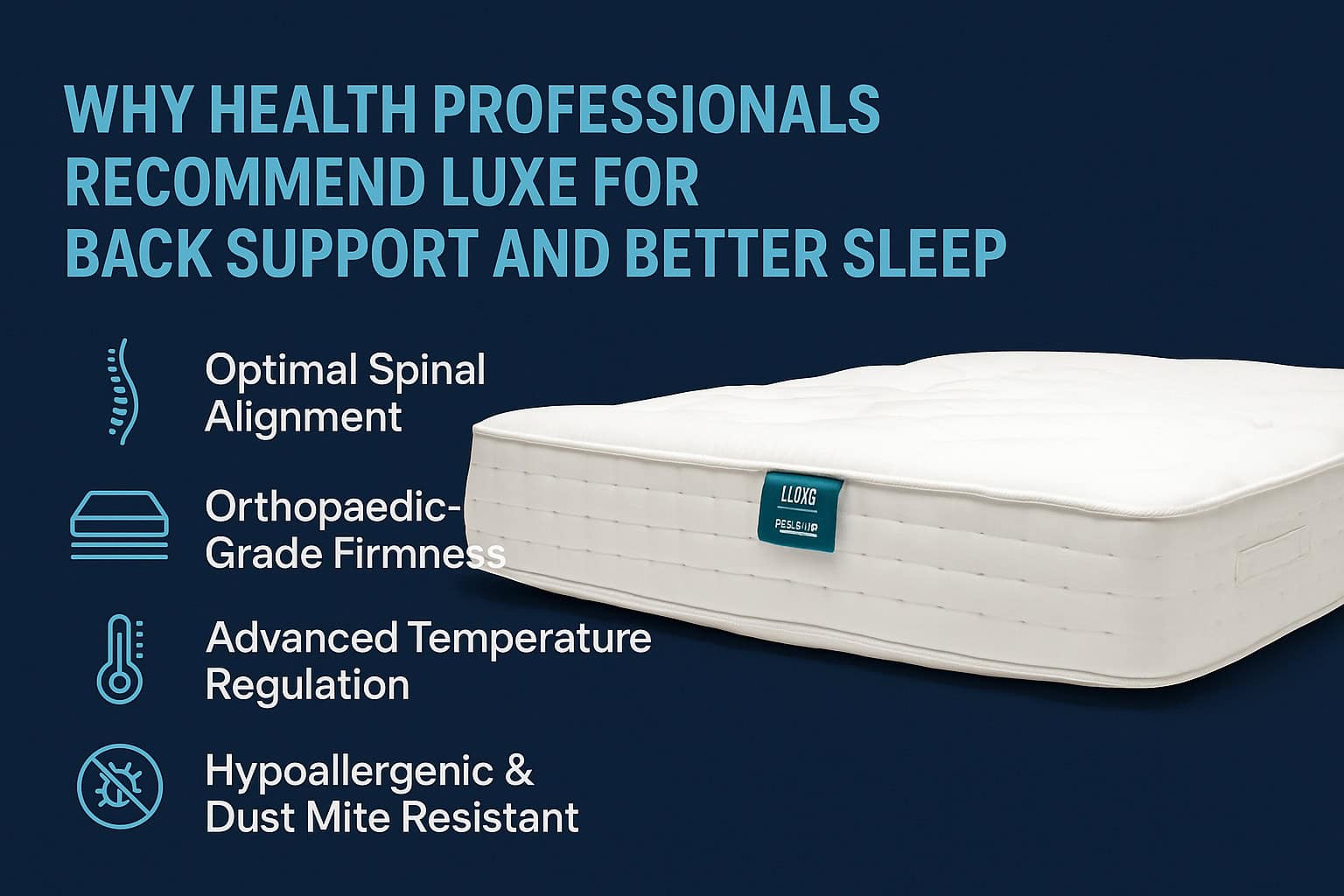
Why Health Professionals Recommend Luxe Mattresses
When it comes to addressing back pain, postural issues, and overall sleep health, physiotherapists and chiropractors often point their patients toward Luxe Mattresses. What sets Luxe apart is its blend of medical-grade support, luxury comfort, and innovative design.
From cutting-edge materials to eco-conscious manufacturing, Luxe provides a truly holistic sleep solution. Here’s a detailed look at why Luxe has become the go-to mattress brand for health professionals and individuals seeking both comfort and therapeutic benefit.
1. Orthopaedic 3D Alignment Technology
One of the most critical factors in managing and preventing back pain is maintaining the natural alignment of the spine during sleep. Luxe Mattresses are engineered with proprietary 3D Orthopaedic Alignment Technology, which supports the spine natural curves by distributing weight evenly and reducing unnatural dips or bends.
This advanced zoning system targets key areas, such as the lumbar, cervical, and hip regions, ensuring they receive the right degree of support. Chiropractors often recommend Luxe because of this intelligent structuring, which significantly reduces pressure on the spine and surrounding muscles, thereby promoting long-term spinal health.
2. Zero Gravity Pressure Relief Foam
While support is crucial, pressure relief is equally important for quality sleep and physical recovery. Luxe Mattresses feature Zero Gravity Foam, a high-performance material designed to mimic the feeling of weightlessness. This foam contours delicately around the body, cushioning pressure points like the shoulders, hips, and knees without compromising overall support.
The result is a sleep surface that feels firm where needed yet soothing and cradling where the body is most sensitive. For people who suffer from joint pain, stiffness, or general fatigue, this balanced feel is a game-changer helping the body relax fully and recover overnight.
3. FortiCoil Adaptive MicroSpring System
Traditional coil systems often fall short in adapting to the changing postures and shapes of sleepers. Luxe addresses this issue with its FortiCoil MicroSpring Technology, a layer of finely tuned springs that flex independently.
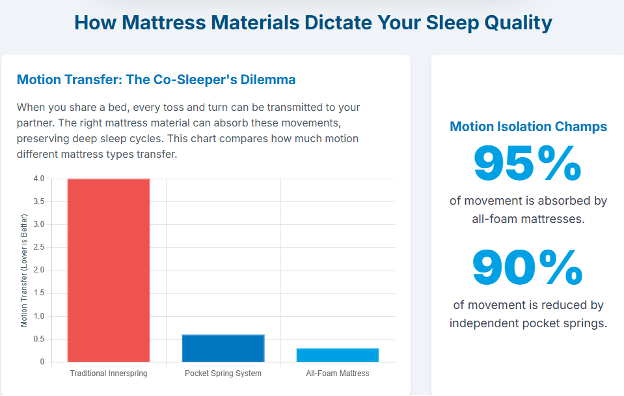
These micro-coils adjust dynamically to the body contours, delivering precise, responsive support throughout the night. Unlike rigid coils or overly soft foams, FortiCoil offers the perfect combination of stability and comfort. This makes Luxe mattresses especially beneficial for those with mobility issues, spinal disc problems, or sleep partners who require undisturbed rest due to minimal motion transfer.
4. Medical-Grade Firmness With Adaptive Comfort
Many mattresses on the market simply categorise their firmness levels without much thought for the actual needs of the human body. Luxe goes a step further by offering firmness calibrated with input from physiotherapists and medical experts.
These mattresses provide the structured support that health professionals recommend, while integrating soft comfort layers that prevent pressure buildup. This thoughtful layering helps the sleeper maintain an anatomically correct posture, reduces inflammation, and supports spinal recovery. People suffering from conditions like sciatica, herniated discs, or postural misalignment often find Luxe to be a long-term solution.
5. Premium Materials for Structural Consistency
Luxe sets itself apart through its commitment to high-quality materialsthat maintain shape and function over time. While cheaper mattresses may feel fine initially, they often lose their integrity within a year or two.
Luxe uses premium-grade memory foam, breathable textiles, and resilient spring systems to ensure that its mattresses retain their supportive properties for years. This level of durability is essential for those who rely on consistent back support. Health professionals consistently favor Luxe because of its ability to provide uninterrupted comfort and structural reliability, which are key factors in managing chronic pain and muscular tension.
6. Promotes Natural Posture During Sleep
Good posture isn’t just for when you are standing, it matters just as much when you are lying down. Luxe mattresses are engineered to gently guide the body into proper alignment, encouraging a natural sleeping posture that prevents the spine from sagging or overextending.
Whether you are a side, back, or combination sleeper, Luxe responsive design helps the body fall into its most ergonomic position. Over time, this can correct poor sleeping habits and alleviate issues that develop from years of poor posture. It also helps promote deeper, uninterrupted sleep by reducing muscle strain and discomfort during the night.
7. Intelligent Pressure Point Relief
The layering system used in Luxe mattresses is designed to address pressure points commonly associated with discomfort and restless sleep. By combining supportive cores with plush comfort layers, the mattress absorbs body weight while relieving strain in high-impact zones like the shoulders, hips, and knees.
This feature is particularly valuable for athletes, active individuals, and anyone recovering from injury. Chiropractors often recommend Luxe to patients who experience morning stiffness, as its intelligent design promotes circulation, muscle relaxation, and faster physical recovery.
8. Clean, Non-Toxic Manufacturing Process
Health doesn’t stop at physical support air quality and material safety also play a significant role in sleep wellness. Luxe mattresses are made through a clean, chemical-free manufacturing process, ensuring that no harsh adhesives or volatile organic compounds (VOCs) are used.
There’s no mattress off-gassing, meaning your bedroom environment remains fresh and breathable from the moment the mattress is unwrapped. For individuals with allergies, asthma, or chemical sensitivities, this makes Luxe a far safer and healthier option compared to conventional alternatives.
9. Breathability and Climate-Control Comfort
Temperature regulation can make or break a night sleep. Luxe Mattresses are designed with advanced airflow systems and breathable fabric covers that promote air circulation and help dissipate heat. This keeps your sleeping surface cool in the summer and comfortably warm in the winter.
The enhanced airflow also contributes to better hygiene, reducing moisture buildup and the potential for bacteria or mold growth. As a result, Luxe provides a cleaner, cooler, and more restorative sleep environment night after night.
10. Tailored Solutions for Every Sleeper
No two sleepers are exactly alike, which is why Luxe offers a range of mattresses engineered to meet various needs, whether you are a side sleeper, back sleeper, or someone dealing with medical conditions. Each mattress in the Luxe line integrates a hybrid construction of memory foam, micro-coils, and orthopaedic support zones.
This ensures your body receives the right balance of comfort and structure no matter your weight, posture, or sleep style. It’s this level of customisation that makes Luxe an outstanding choice for people serious about improving their sleep quality and long-term health.
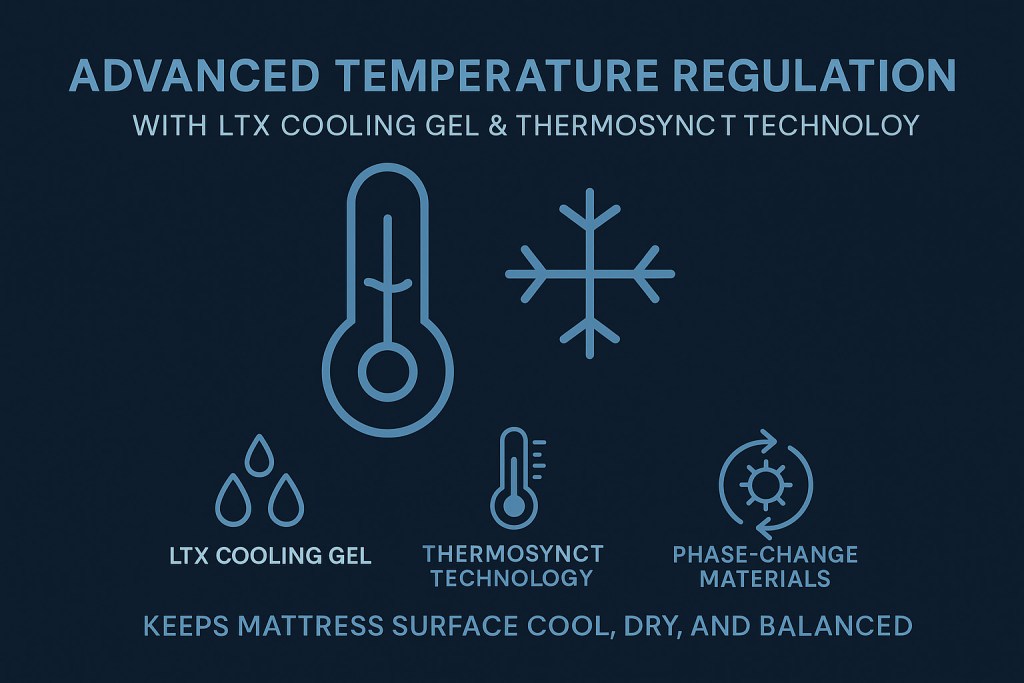
11. Advanced Temperature Regulation with LTX Cooling Gel & ThermoSync Technology
Temperature control is critical for achieving uninterrupted, restorative sleep. Overheating during the night can cause discomfort, excessive tossing and turning, and reduced deep sleep. Luxe Mattresses tackle this issue head-on through an intelligent cooling system that includes LTX Cooling Gel, ThermoSync Technology, and integrated phase-change materials (PCMs).
The LTX Cooling Gel layer absorbs excess body heat and disperses it evenly across the mattress surface, preventing hot spots from forming. Meanwhile, ThermoSync Technology works to maintain a consistent sleep temperature by adapting to your body thermal fluctuations in real time. This is further enhanced by phase-change materials, which actively absorb, store, and release heat as needed, creating a dynamic cooling effect throughout the night.
Together, these technologies form a responsive microclimate that keeps your mattress surface cool, dry, and balanced, regardless of external conditions. Whether you are a naturally hot sleeper or live in a warm climate, Luxe cooling system ensures that you wake up feeling refreshed, not overheated. This level of temperature regulation is especially beneficial for people with sleep disorders, hormonal fluctuations, or anyone seeking optimal sleep comfort year-round.
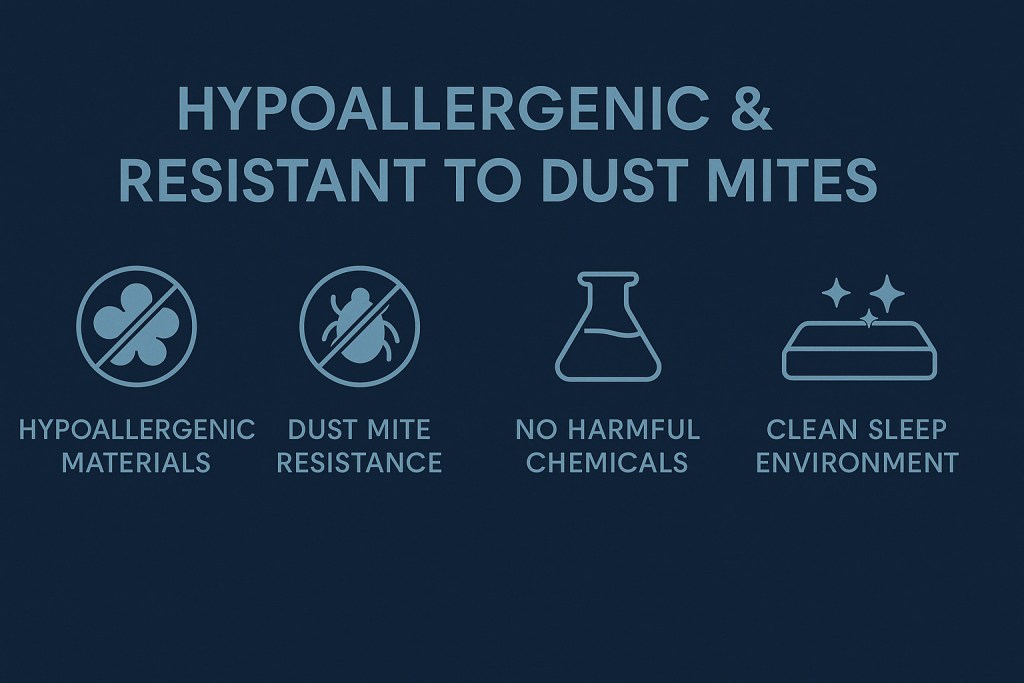
12. Hypoallergenic & Resistant to Dust Mites
For people who suffer from allergies, asthma, or skin sensitivities, the sleeping environment must be as clean and irritant-free as possible. Luxe Mattresses are crafted from hypoallergenic materials that naturally resist allergens, including dust mites, mold, and mildew. This is especially important because traditional mattresses often trap moisture and organic debris, creating a breeding ground for allergens.
Luxe dust- and mite-resistant design ensures that you are protected from the most common triggers of respiratory issues and skin irritations. Additionally, the clean, chemical-free manufacturing process eliminates the risk of off-gassing and harmful VOCs, making Luxe mattresses ideal for individuals with heightened sensitivities or those who prioritise a health-conscious lifestyle. The result is a cleaner, healthier sleep environment that supports not just your posture, but your overall well-being.
Loved by Sleepers, Recommended by Experts
Luxe Mattresses did not become one of the best luxury mattress brands overnight. With years of testing and engineering, Luxe has finally developed a range of the best mattresses for customers in the UK.
Positive feedback from our customers motivates us to do even better with every other product. If you are tired of restless nights due to bad mattresses, try Luxe Mattresses now, and you will experience significant improvement in your sleep quality within a few weeks.
If you don’t like the product, there’s no need to worry, as a 100-night trial period is there to secure your purchase. Invest in the right product and enjoy better sleep every night.
FAQs
Are Luxe mattresses good for people with back pain or spinal issues?
Yes, Luxe mattresses are designed with orthopaedic-grade firmness and zoned support layers to maintain proper spinal alignment. This helps relieve pressure on the lower back and is often recommended by physiotherapists and chiropractors.
How do Luxe mattresses stay cool throughout the night?
Luxe uses a combination of LTX Cooling Gel, ThermoSync Technology, and Phase-Change Materials to regulate temperature. These features absorb and release heat to prevent overheating and promote uninterrupted sleep.
Are Luxe mattresses hypoallergenic and safe for sensitive users?
Absolutely. Luxe mattresses are made with hypoallergenic materials that resist dust mites, mold, and mildew. They are also manufactured without harmful chemicals or VOCs, making them ideal for people with allergies, asthma, or skin sensitivities.
What firmness level should I choose for proper back support?
Luxe offers a medium-firm to firm range, which is typically best for spinal alignment. Health professionals often recommend firm support with cushioned comfort for optimal pressure relief and posture maintenance.
Do Luxe mattresses work well for all sleeping positions?
Yes. Thanks to their adaptive foam layers and hybrid construction, Luxe mattresses provide targeted support whether you sleep on your back, side, or stomach. However, models like the LuxeTherm Hybrid are particularly engineered to accommodate all positions comfortably.
What are the recommended levels of firmness for mattresses by experts?
Health professionals usually recommend balanced support and firmness of mattresses. For most sleepers, medium-firm mattresses perform the best.
Is Luxe a renowned brand for luxury mattresses in the UK?
Yes, Luxe takes pride in serving thousands of satisfied customers all over the UK, making us one of the most trusted mattress brands in the UK.
What mattress is best for back pain relief?
Any Luxe mattress with a medium-firm or firm surface performs well for back pain relief. Don’t forget to browse through the mattress section for the latest product updates.
The UK mattress market is highly saturated with both local and international brands vying for attention. With so many options available, finding a reliable and truly luxurious mattress brand can be overwhelming. A mattress is not just a purchase; it’s an investment in your health, comfort, and overall well-being.
That’s why discerning customers in the UK are increasingly turning to Luxe Mattress & Beds. But what exactly makes Luxe stand out as the best luxury mattress brand in the United Kingdom? Let’s explore the reasons behind the brands growing popularity and trusted reputation.
About Luxe Mattresses
Founded in 2010, Luxe Mattress & Beds has grown into one of the UK leading providers of luxury sleep solutions. With a focus on superior craftsmanship, high-quality materials, and customer-centric design, Luxe has earned a loyal customer base of over 10,000 satisfied sleepers wile operated as soft night ltd. The brand doesn’t just sell mattresses, it delivers a sleep experience designed to improve quality of life.
Luxe offers a wide range of products including memory foam, hybrid, pocket sprung, and natural mattresses. Each product is engineered to meet specific sleep needs, whether it’s spinal alignment, temperature control, or motion isolation. Luxe also provides an array of complementary sleep accessories such as pillows, bed frames, and mattress toppers, all crafted to the same exacting standards.
Award-winning Luxe Mattresses
Recognition from reputable institutions underscores Luxe claim to excellence. The brand has received several prestigious awards that reflect its commitment to value, comfort, and sustainability:
Best Value for Money 2023: The Luxe Velour Hybrid mattress was celebrated for delivering exceptional comfort at a competitive price.
Good Housekeeping Institute Approval: The Luxe Nova mattress was commended for promoting spine alignment and posture support.
Carbon Neutral Production: Luxe has earned certification for its environmentally responsible manufacturing processes.
NBF (National Bed Federation) Recommendation 2023: The LuxeOrganic mattress, made from 100% pure natural materials, was recognized for its premium quality and alignment with British sustainability values.
These accolades not only highlight Luxe innovation and quality but also establish its credibility in a crowded marketplace.
Luxe Mattresses British Luxury Mattress Brand
One of Luxe key differentiators is its deep understanding of the British market. International mattress brands often miss the mark when it comes to addressing local consumer needs. Their products may not be optimized for the UK climate, sleep culture, or regulatory standards.
Luxe, by contrast, designs and manufactures all its products within the UK. This ensures:
Better temperature regulation suited to the UK seasonal climate.
Compliance with British safety and manufacturing laws.
Customization for local comfort preferences, such as firmness levels, mattress height, and hypoallergenic materials.
By focusing on the needs of British customers, Luxe has crafted mattresses that are more aligned with real-life use in the UK.
What Makes Luxe Mattresses the Best Brand
Luxury mattress shoppers are looking for more than just softness or support. They want a comprehensive sleep solution that combines innovation, craftsmanship, and peace of mind. Luxe delivers on all these fronts.
Luxury British-made Brand (Luxe Mattresses)
British craftsmanship is renowned worldwide for its attention to detail, durability, and timeless appeal. Luxe draws on this legacy to produce mattresses that are both beautiful and functional. Every mattress is made in the UK using high-quality materials and techniques that ensure longevity and consistent performance.
Luxe commitment to British manufacturing also means reduced carbon emissions from shipping and better quality control. Local production allows for faster delivery times and more personalized customer service, something global brands often can’t match.
Innovation and Quality Materials
Luxe combines cutting-edge sleep science with top-tier materials to create mattresses that are as technologically advanced as they are luxurious. Here are the core mattress types Luxe offers:
Hybrid Mattresses: Combine coils with memory foam or latex for balanced support and responsiveness.
Pocket Sprung Mattresses: Feature individually wrapped springs for targeted support and motion isolation.
Natural Mattresses: Made from organic cotton, wool, and latex, offering eco-friendly comfort.
Each mattress type is layered with precision to offer specific benefits:
Temperature regulation through breathable materials.
Spinal alignment through zoned support.
Motion dampening to prevent partner disturbance.
Materials are chosen not just for comfort, but also for health and sustainability. Many of Luxe products are hypoallergenic, anti-bacterial, and certified for low chemical emissions.
100-night Trial and 10-year Warranty
Luxe understands that a mattress is a major investment. That’s why it offers a 100-night trial period, allowing customers to test the product in their own home. If the mattress doesn’t meet expectations, customers can return or exchange it hassle-free.
To further instill confidence, every mattress comes with a 10-year warranty. This reflects the brand faith in its product quality and durability. With Luxe, you’re not just buying a mattress, you’re investing in a decade of better sleep.
Sustainability at the Core
Luxe goes beyond comfort to prioritize the environment. From sourcing eco-friendly materials to implementing carbon-neutral manufacturing processes, sustainability is embedded in every stage of production. Luxe mattresses use natural latex, organic cotton, and wool that are responsibly harvested, reducing the environmental impact and promoting ethical sourcing.
Customer Experience and Support
Luxe believes luxury doesn’t end at the point of sale. Their customer support is known for responsiveness, empathy, and thorough product guidance. The brand offers comprehensive sleep consultations, helping customers choose the right product based on body type, sleeping position, and comfort needs.
Extensive Range of Accessories
Luxe isn’t just about mattresses. The brand offers a full ecosystem of sleep accessories, including orthopedic pillows, plush mattress toppers, bed bases, and adjustable frames. Each accessory is thoughtfully designed to enhance the performance of Luxe mattresses and elevate the entire sleep environment.
Trusted by Industry Experts
Luxe has been featured and recommended by sleep specialists, physiotherapists, and interior designers. Its focus on posture, pressure relief, and spinal alignment has earned the trust of medical professionals who regularly recommend Luxe to patients with sleep or back issues.
Positive Impact on Sleep Health
Real customer testimonials consistently highlight better sleep, reduced pain, and improved energy levels. Luxe sleep solutions don’t just provide comfort; they support holistic well-being by improving REM sleep cycles and reducing nighttime disturbances.
Final Words
Choosing the right mattress isn’t just about trial and error; it requires understanding your body, your sleep habits, and your comfort preferences. Luxe Mattresses makes this process easier by offering a range of thoughtfully engineered products tailored to British consumers.
From award-winning designs and locally focused manufacturing to eco-conscious production and exceptional customer service, Luxe has redefined what it means to be a luxury mattress brand in the UK. The company continues to evolve, innovate, and set new standards in sleep quality.
For those looking to transform their sleep experience with a brand they can trust, Luxe stands as a shining example of British excellence in the luxury mattress market. Explore the full range today at Luxe Mattresses, and experience firsthand why so many in the UK consider Luxe the best in the business.
FAQs
What is the best mattress by Luxe?
Luxe offers several highly rated options across categories. The Luxe Velour Hybrid is especially popular and has won awards for comfort and value. The Luxe Nova and LuxeOrganic mattresses are also top choices for spine support and eco-conscious materials.
Are Luxe mattresses expensive?
While Luxe positions itself as a luxury brand, its products are competitively priced within the premium category. Considering the quality of materials, British manufacturing, and the warranty/trial policies, Luxe mattresses represent excellent long-term value.
Where are Luxe mattresses made?
All Luxe mattresses are proudly manufactured in the UK, adhering to high standards of craftsmanship, quality control, and sustainability.
Do Luxe mattresses suit all sleeping positions?
Yes. Luxe designs its mattresses with varied firmness levels and ergonomic support to cater to side sleepers, back sleepers, stomach sleepers, and combination sleepers alike.
Can I try a Luxe mattress before committing?
Absolutely. Luxe offers a 100-night risk-free trial. If you’re not satisfied, you can return or exchange the mattress within this period.
Do Luxe mattresses come with a warranty?
Yes, every mattress comes with a 10-year warranty, reflecting the brand commitment to long-lasting quality and customer satisfaction.
Pregnancy is a time of many changes some (glowing skin!) more enjoyable than others (fantastic dreams!). In these moments, one of the most challenging things for many pregnant women is lying down in bed. As your body changes, so do your sleep requirements. Choosing the best mattress for pregnancy & sleeping position during pregnancy here matters not only supports you better but also many consider for safety and quality sleep.
However, what many fail to consider is the importance of your mattress and its impact on these positions. In this article, we’ll explore how your tried-and-true sleeping position during pregnancy interfaces with mattress firmness, contouring, and support and how the optimal sleep surface can make all the difference.
Why Sleep Position Matters in Pregnancy?
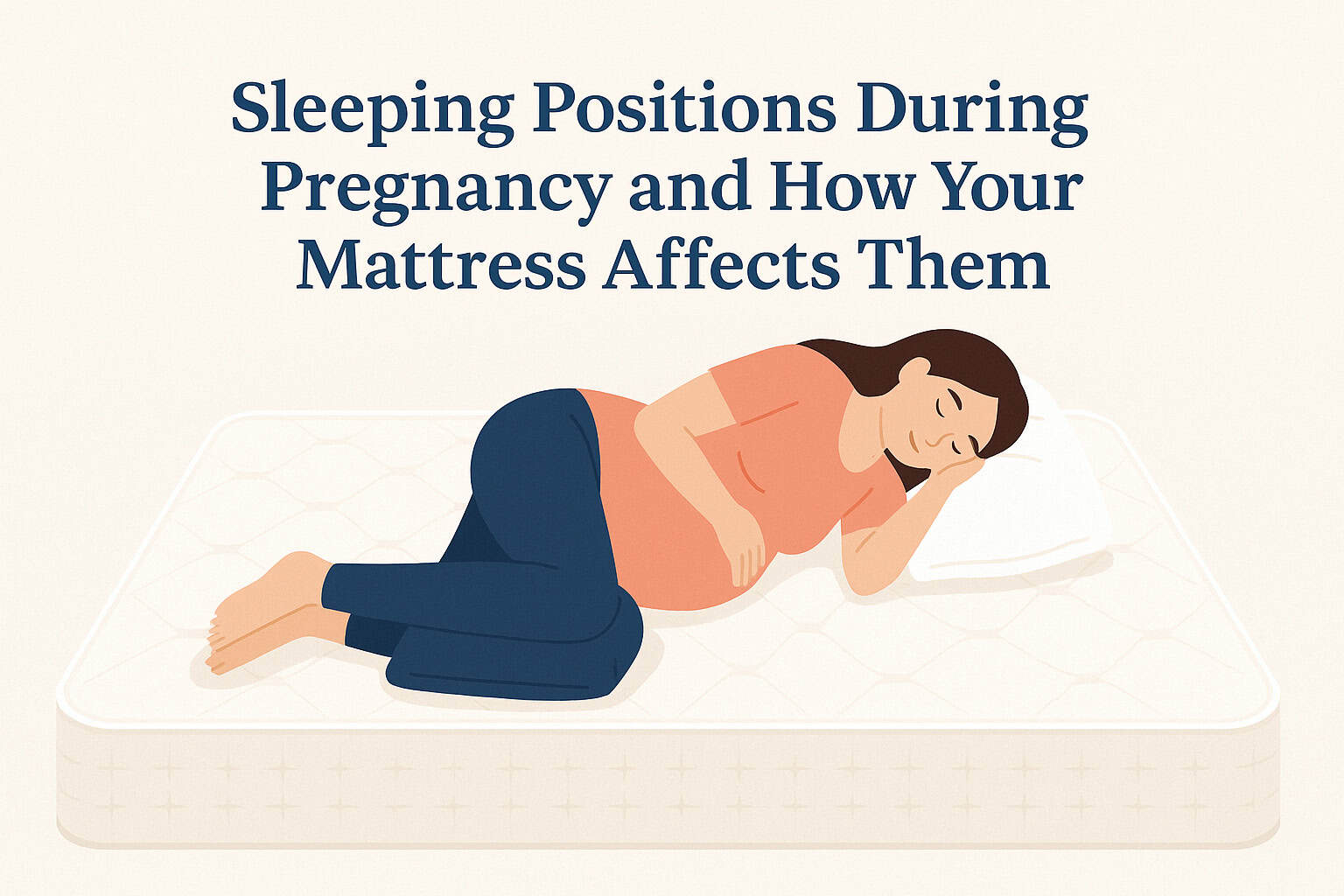
Sleeping on your side, especially the left side, is the most comfortable and safest sleep position during pregnancy, according to the National Health Service. This stance increases blood flow to the heart, uterus, and and kidneys, and prevents the liver from exerting pressure on the growing fetus.
But as pregnancy goes on, even side-sleeping can start to feel a little too awkward if you don’t have the right mattress support. An unsupportive or overly hard mattress can cause pressure to build up on the hips and shoulders, while a mattress thats too soft can cause the spine to sag, exacerbating lower back pain.
Pregnancy Sleep Positions and How Your Mattress Can Help or Hurt Them
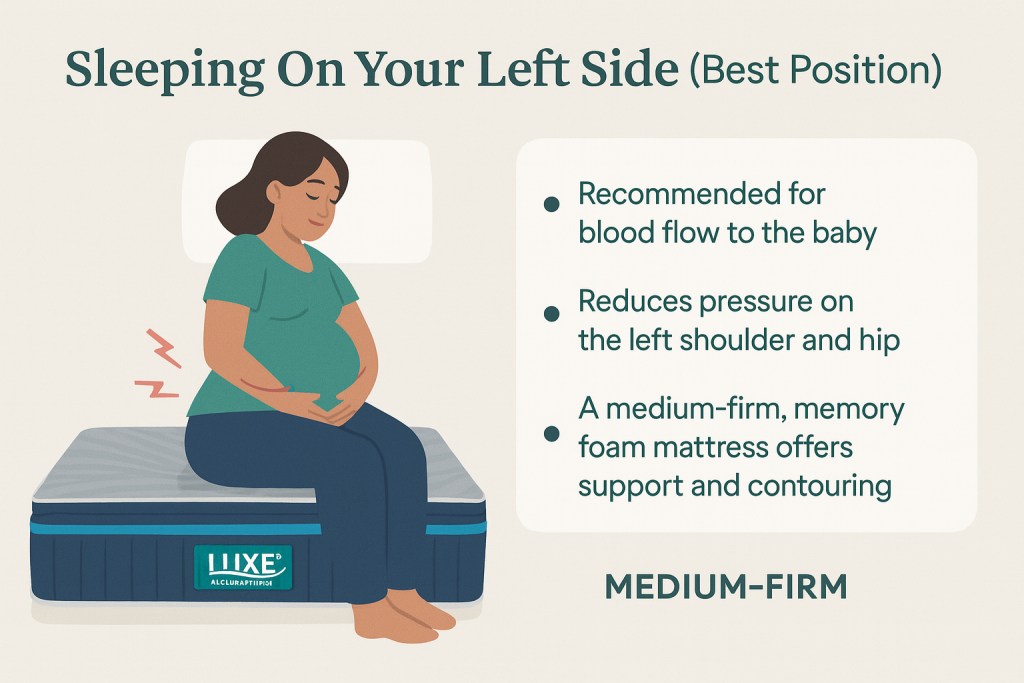
1. Sleeping On Your Left Side (Best Position)
Many doctors and experts recommend sleeping on the left side during pregnancy. This is the best position for blood flow to the baby and the kidneys can work more easily to remove waste.
That being said, back and stomach sleepers get the short end of the stick, and it can add pressure to the left shoulder and hip if the mattress doesn’t offer appropriate contouring, even when lying on their left side. The fix: A medium-firm mattress that has a plush comfort layer to help relieve some of that added pressure, but your body is still supported properly and the spine is kept in alignment. It is designed to provide support to the spine and cradle pressure points.
LuxeMattresses memory foam mattresses react to your curves to keep your spine in a neutral position.
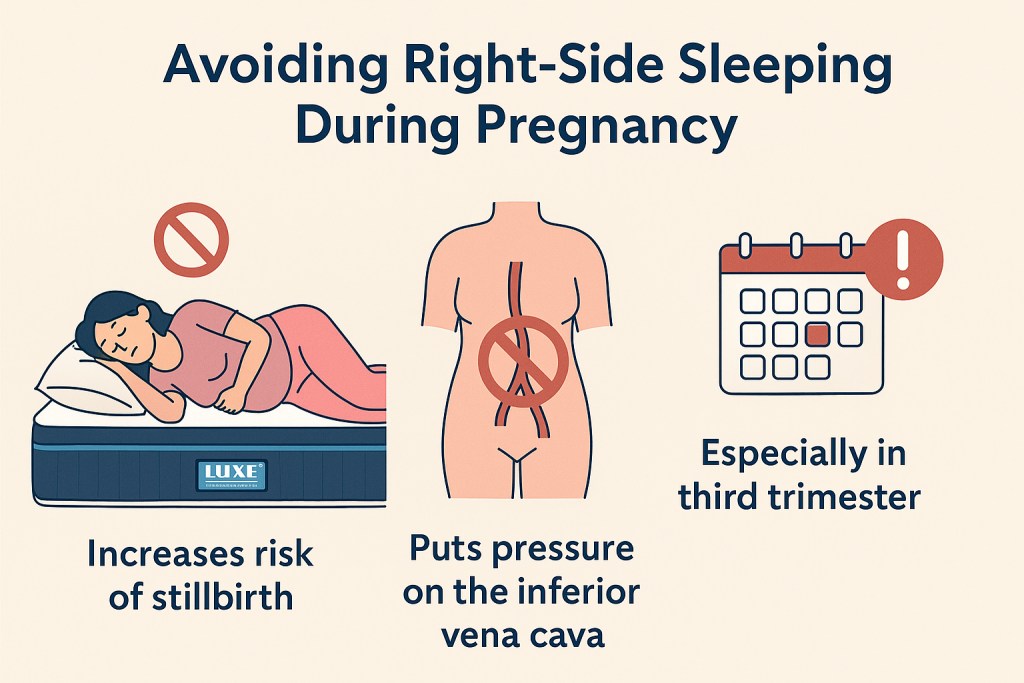
2. Right Side Sleeping
While sleeping on your left side is ideal, sleeping on your right side is still generally acceptable. However, right-sided sleeping can increase pressure on the liver, according to Harvard Health.
The problem with both sides is hip and shoulder pain. A mattress with zoned support firmer beneath the hips and softer under the shoulders, for example can assist in that balancing act to alleviate discomfort.
Our zoned support mattresses deliver these exact comfort layers to ensure that your joints are free from pain and your spine remains stable throughout side sleeping.
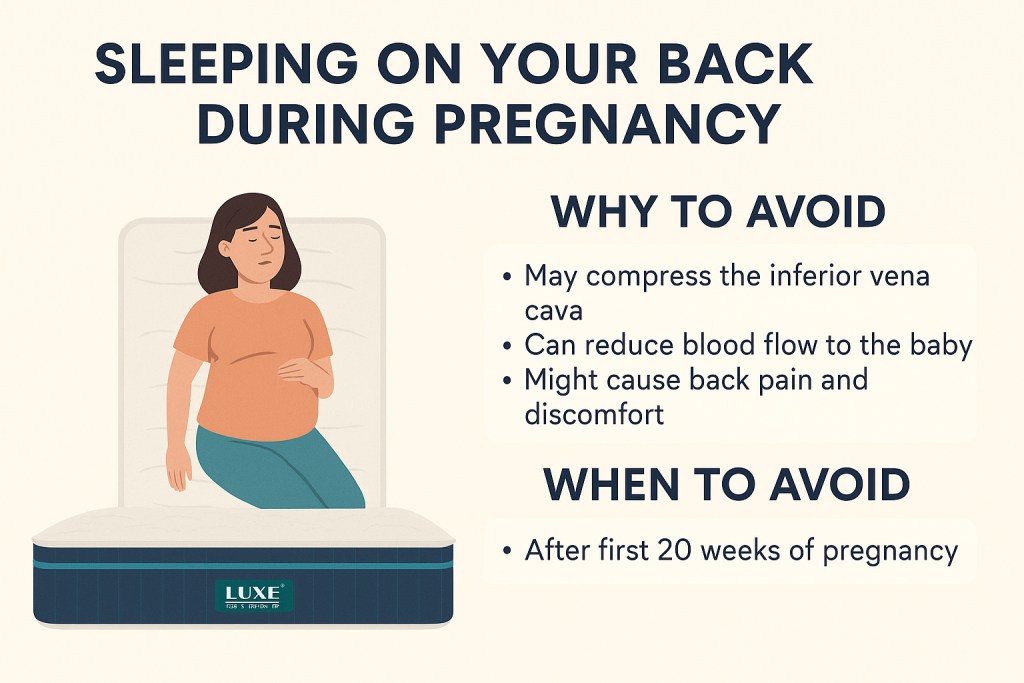
3. Sleeping on Your Back (Avoid in the Second and Third Trimesters)
Sleeping on your back in early pregnancy is okay, but once you reach the second trimester, it may compress the vena cava the large vein that carries blood back to your heart. This may lead to dizziness, shortness of breath, and decreased blood flow to the baby.
However, you don’t need to stress if you wake up on your back. Try firm pillows or a pregnancy wedge that tilts your body to one side, or choose a mattress that encourages side sleeping, such as one that reduces pressure along your shoulders and hips.
LuxeMattresses’ hybrid models combine responsive coils and contouring foam to deliver just-right support and comfort, allowing you to find a comfortable side-sleeping position all night.
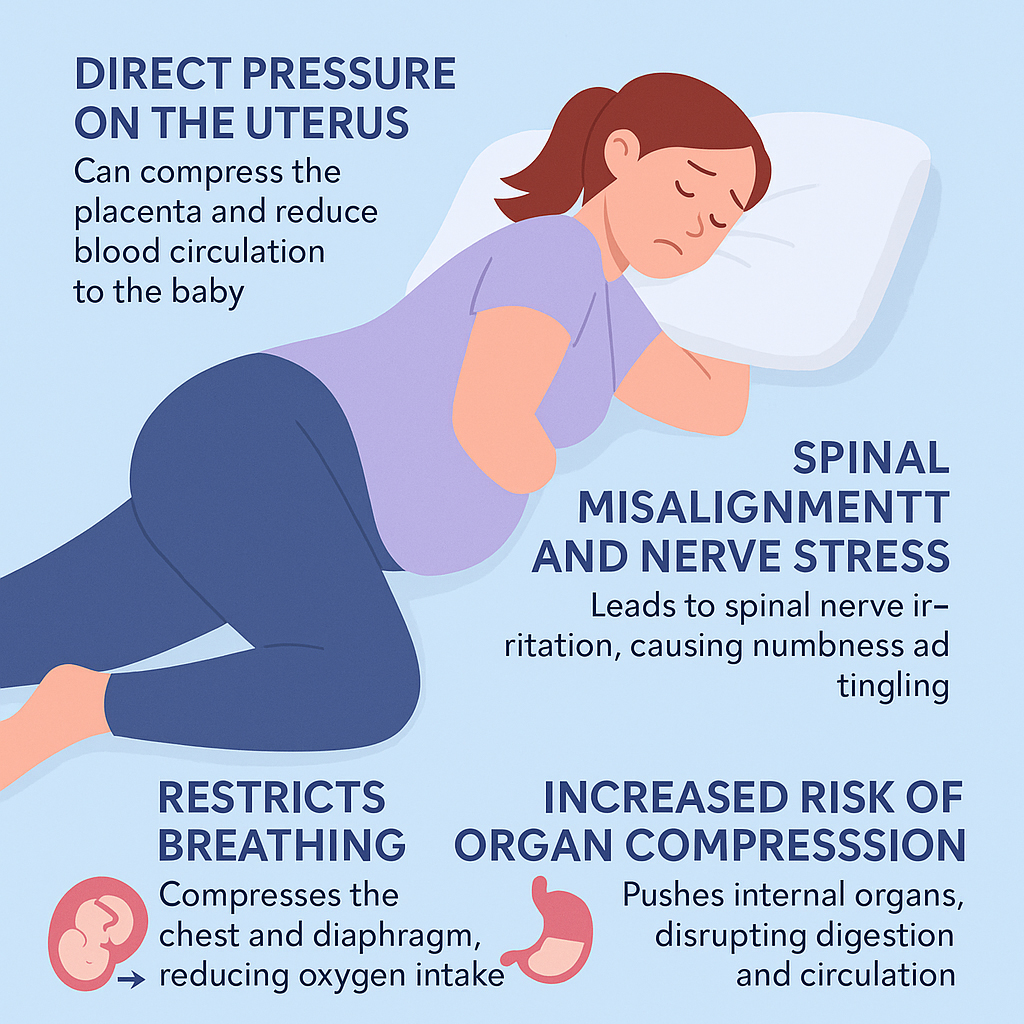
4. Front Sleeping (Not Recommended in Mid-Late Pregnancy)
Sleeping on your stomach becomes uncomfortable, and eventually, it becomes impossible (when the belly becomes large). It stresses the neck and lower back, and can lead to ligament pain.
A few women in early pregnancy may still find stomach sleeping comfortable. If you do, then what you want to sleep on is a medium-firm mattress that offers the right amount of support. Later in pregnancy, if sleeping on the left side has become the safest and most comfortable way to sleep, this mattress should provide perfectly distributed pressure.
Pregnancy Sleep Positions And What Qualities To Look For In A Mattress
Firmness Level
A medium-firm mattress is often best during pregnancy, as it provides a good balance of support and comfort. If mattresses are not firm enough or too firm your spine will be thrown out of alignment, and your neck will be raised or lowered, which can again cause pain, especially for side sleepers.
b. Pressure-Relieving Substances
Free-standing mattresses often feature memory foam, latex, or gel-infused layers that conform to the contours of your body, relieving pressure from your joints. These materials encourage side sleeping by softening around the shoulders and hips, where most of the body weight is concentrated.
If you’re a position switcher or take advantage of the edge of the bed to get in and out, strong edge support is an essential feature. It prevents you from rolling off, providing stability, which can be especially crucial at the end of pregnancy in the third trimester when balance starts to become an issue.
Discover our hybrid mattresses, featuring edge support that provides some of the best edge support available on the market.
d. Cooling Technology
Pregnancy can also exacerbate body heat and night sweats. A breathable mattress constructed from cooling foam or natural fibers, such as bamboo or organic cotton, will help moderate body temperature.
Our natural mattress features a combination of airflow-enhancing layers to keep you cool throughout the night.
FAQs: What Are The Sleeping Positions During Pregnancy?
What’s the best sleeping position during pregnancy?
The left side is best, as it helps blood flow to the baby and reduces pressure on your organs, especially during the second and third trimesters.
2. Is it OK to sleep on my back while I’m pregnant?
It’s fine in early pregnancy, but after the first trimester, sleeping on your back can compress the major blood vessels in the back. Positioning pillows or using a properly designed mattress can encourage side lying.
3.Does the firmness of a mattress affect sleep comfort during pregnancy?
Yes. A contouring, medium-firm mattress is designed to keep your back in its natural position and alleviate pressure points from the middle of the bed to both sides, according to your sleeping position.
Final Thoughts
During pregnancy, it’s no secret that sleep can be a struggle, But with the right mattress that’s specifically adjustable to your go-to sleep position, the Zoma is worth a look. Sleeping on your left side is generally considered the best position, unless you have a poor sleeping surface. From lumbar support to contouring foam to breathable fabrics, every mattress feature contributes to keeping expectant mothers safe, supported, and comfortable throughout their pregnancy.
Check out the full range of pregnancy-friendly mattresses beds that can provide the ideal marriage of comfort and support at every stage of pregnancy.
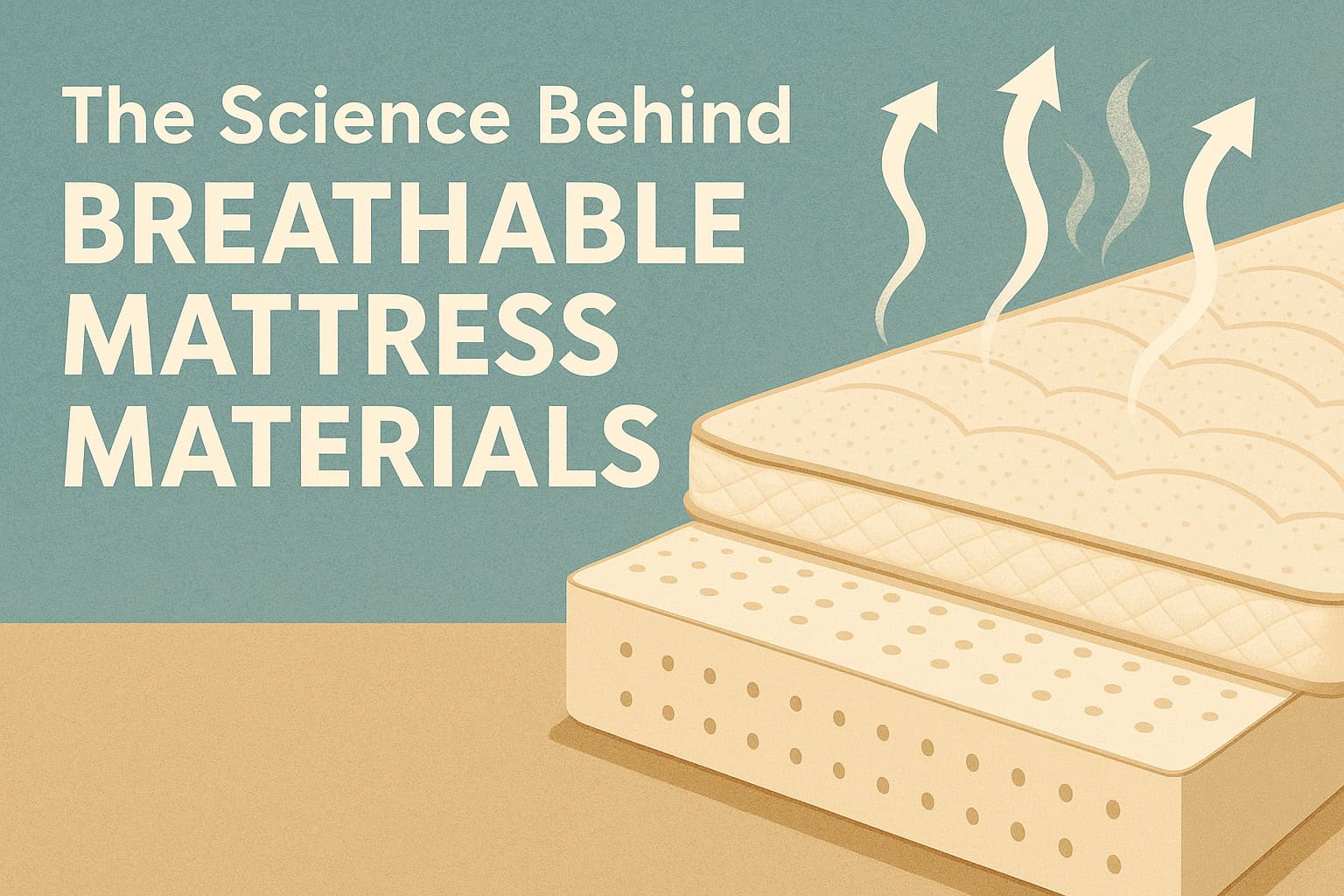
If you wake up in the middle of the night feeling hot, agitated, or sweaty, it’s probably less a matter of the room temperature and more a matter of your mattress. The surface you sleep on is key in regulating airflow and heat dissipation, and this is where breathable materials come into play. From natural latex to coil-based innerspring and open-cell memory foam, the construction of your mattress may be what sets you up for a cooler, more restful sleep.
In this blog, we’ll delve into the science behind breathable mattress materials and explore how they promote better circulation, reduce overheating, and enhance overall sleep quality.
The Importance Of Breathability In Mattress
As you slumber, your body generates heat and moisture, embarrassingly, even during deep sleep and REM cycles. Ideal sleeping occurs when your core temperature naturally drops generally by 1 to 2 degrees Fahrenheit, according to the Sleep Foundation. If your bed is too hot or doesn’t allow for adequate air circulation, it can interfere with this process, leading to tossing and turning, excessive sweating, and sleep disturbances.
Permeable mattresses allow air to pass through the layers, dissipating excess heat and humidity. This ventilation allows your body to breathe, creating a more comfortable sleep environment while providing shaping and support that revitalizes the body. The breathable comfort of Talalay latex provides a more allergen-free sleep environment.
Underneath, you will find the orthopedically supportive base foam. Underneath, you will find the supportive base foam. This support not only benefits your body but also supports the longevity of the mattress, as healthcare-grade foams are the highest quality in terms of support and durability. This is why we do not inflate pricing due to the healthcare certification.
1. Latex: Natural Cool and Airy
Latex, with a nod to natural latex specifically, is one of the most breathable materials you will find in a mattress. It’s tapped in the form of latex from trees and turned into foam using one of two processes: the Dunlop or Talalay process. Both structures have small pinholes that aid in ventilation, but Talalay latex is generally more airy and evenly dense.
In addition to its ability to disperse body heat, latex naturally resists heat retention and moisture buildup, which also benefits sleepers who tend to sweat according to the National Library of Medicine. Latex does not retain heat, unlike memory foam, which compresses and loses heat over time while maintaining its cushioning through regular use.
At LuxeMattresses, our latex constructions are engineered to promote air circulation, providing durable, natural comfort.
2. Coil and Innerspring Systems: In-device Ventilation
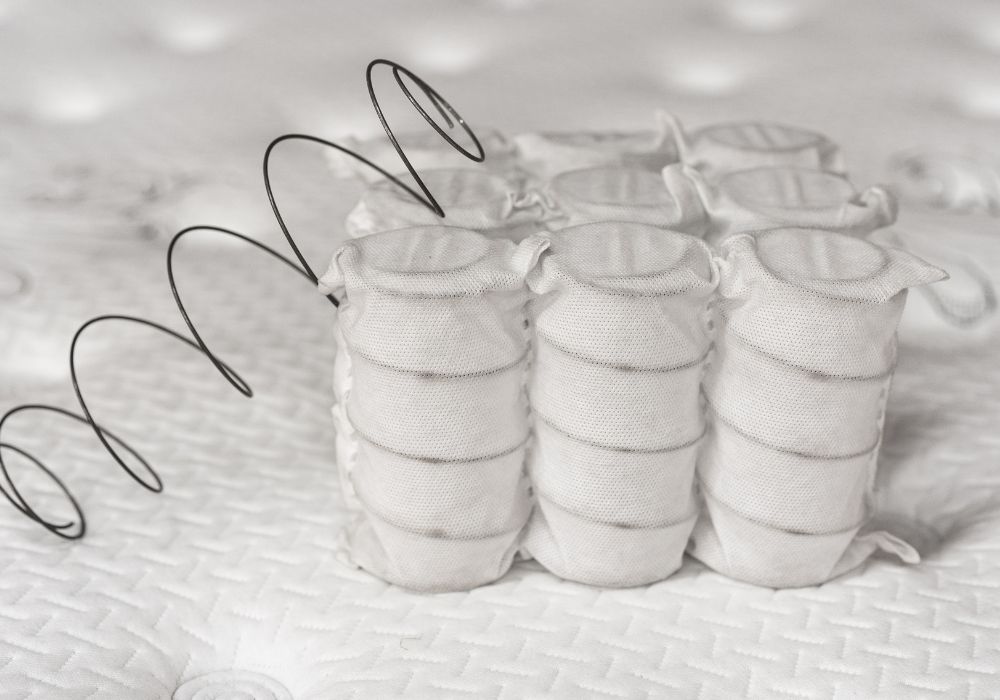
Mattresses that feature coil springs or pocket springs are generally more breathable by nature than those with dense foam. This in-between area allows for more airflow and helps keep the heat at bay close to your body. That’s what makes hybrid or innerspring mattresses a good option for hot sleepers.
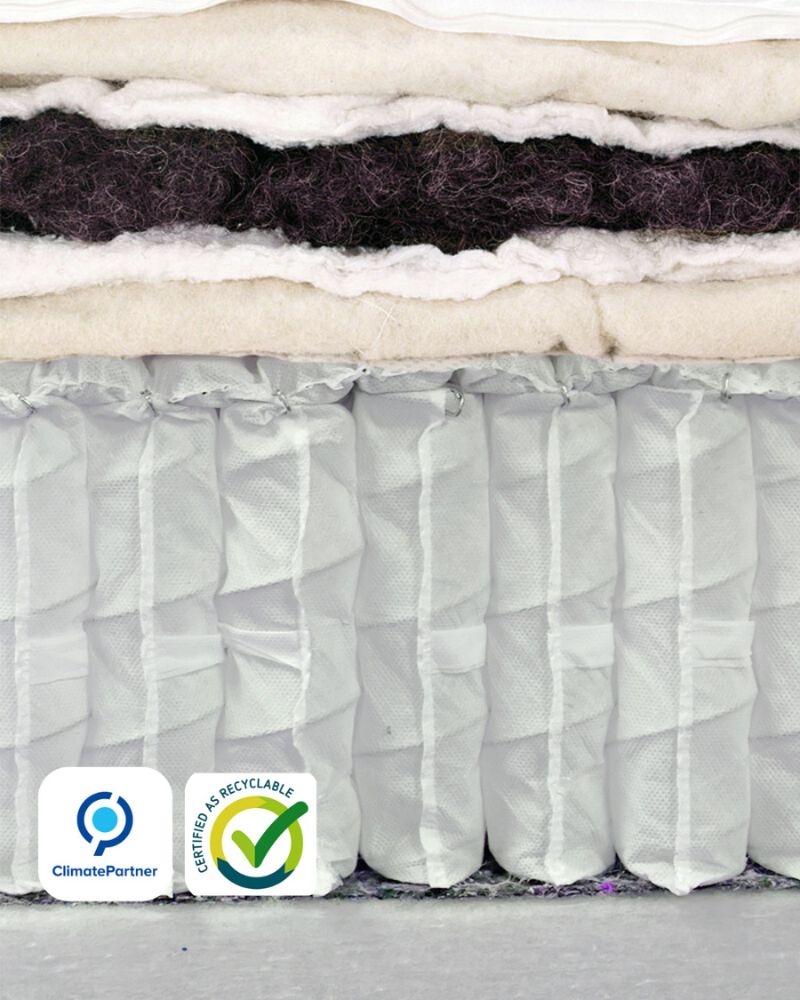
Pocket spring systems (independent coils) are outstanding since they isolate motion as well as ventilation throughout the sleep surface. Paired with breathable comfort layers, such as latex or cotton, these beds promote calm, responsive sleep.
Discover a hybrid mattress range from LuxeMattresses, crafted with better airflow and support for your back.
3. Modern Cooling Update with Open-Cell Memory Foam
Regular memory foam molds to the body effectively, but its closed-cell construction causes it to retain heat. On the other hand, open-cell memory foam is designed with interconnected air pockets, allowing air to flow more freely through the foam.
Heat and moisture escape more easily from this advanced structure, which helps regulate your body’s temperature. Some open-cell foams are also added with gel or copper to aid cooling.
Harvard Health suggests that you can improve your ability to fall asleep and stay asleep by lowering your skin temperature by just a few degrees. That’s precisely what open-cell foam delivers all without sacrificing contouring comfort.
LuxeMattresses stocks a range of high-quality memory foam mattresses that utilize the next generation of foam technology, achieving the perfect balance of pressure relief and cooling.
4. Breathable Mattress Covers: The Secret Weapon.
Unfortunately, in life, they don’t exist.
The most breathable core is only as good as the wrong outer cover will allow. Performance-driven mattress covers are crafted from all-natural, moisture-wicking materials, including organic cotton, Tencel, or bamboo-boosted bamboo, to enhance airflow and facilitate climate control.
Tencel, in particular, is a sustainable fiber derived from wood pulp, which is both moisture-wicking and moisture-drying helping to resist night sweats and overheating. These two fabrics are also hypoallergenic and help retard the growth of bacteria, an essential consideration for your mattress in the long term.
LuxeMattresses’ natural mattress range features mattresses encased in breathable, eco-friendly covers for a cleaner and cooler sleep experience.
5. Zoned ventilation for targetedcooling
Zoned ventilation: Some high-tech mattresses are now also designed to have different parts of the mattress optimized for airflow based on standard heat zones on the body, such as the torso and hips. These technologies utilize laser-cut channels or foam zones to direct airflow where the body requires it most. It’s intended to help the hotter spots of sleepers remain cooler, in some cases all night long.
This level of innovation, which increases breathability while promoting proper spinal alignment with ‘zone-specific’ support and flexibility, is to be admired.
How to Pick the Right Breathable Mattress?
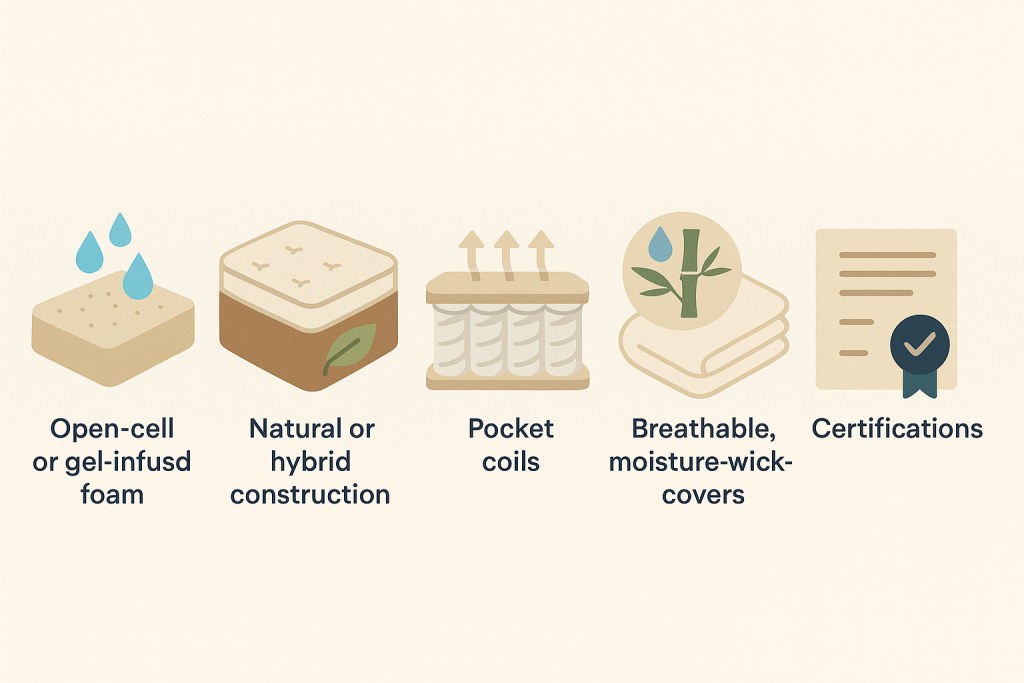
As you are shopping for the best breathable mattress, search for these key features:
Open-cell or gel-infused foam for hot sleepers who want a contouring option
Natural or hybrid construction for environmentally friendly, pressure-relief support
Pocket coils for enhancing airflow and minimizing heat retention
Breathable, moisture-wicking covers (such as cotton, bamboo, or Tencel)
Certifications such as OEKO-TEX or GOLS for non-toxic materials
At LuxeMattresses, we combine these three characteristics throughout all our collections so that everyone who has ever laid down on one of our mattresses immediately associates them with ventilation, hygiene, and thermal comfort.
FAQs
1. Do latex mattressesallow you to sleep cooler than memory foam mattresses?
Yes, natural latex is inherently more breathable than memory foam due to its perforated composition and moisture-wicking properties.
2. What kind of mattress is best for hot sleepers?
Hybrid mattresses with coil support and breathable comfort layer (such as latex or gel foam) deliver the best airflow and cooling benefits.
3. Do mattress covers affect breathability?
Absolutely. Covers that are not breathable lock in heat. Look for materials, such as organic cotton, bamboo, or Tencel, that allow your body’s heat and moisture to wick away.
Final Thoughts
The science behind breathable mattress materials is straightforward: the proper components can actually enhance your sleep quality by increasing airflow, reducing heat retention, and even repelling moisture. It’s all about materials like latex, pocket coils, and open-cell foam, which are not just trends they are scientifically proven to create a calm and healthy sleeping surface.
And if you’ve been waking up hot or uncomfortable, it’s time to invest in a mattress designed to stay cool. Discover LuxeMattresses‘ ranges today and choose from a variety of breathable, sleep-enhancing mattresses intended for you.
For the longest time I genuinely believed that staying up late was my version of self care.
After the kids were finally tucked in, the dishes cleared, and the last Mum, where my was answered, the house would go quiet and that silence felt sacred. I would slide into my favorite spot on the couch, phone in hand, and just breathe for a moment. No one was touching me. No one was asking for anything. It was me time.
But here is the truth. I was not doing anything that truly recharged me.
Most nights I would get lost in a TikTok rabbit hole until one in the morning or I would fold laundry in silence just to feel productive. Sometimes I would scroll through home decor I could not afford or add skincare to my cart that I did not need. I was chasing a sense of peace in surface level moments and calling it self care.
It did not matter that the kids were finally sleeping. I was not. And I paid for it every morning. I was groggy, sore, and mentally worn out before the day even began. That time I thought I was gifting myself was actually stealing my rest.
Eventually, it clicked.
I did not need more time alone with distractions. I needed real, restorative sleep.
And that realisation changed everything.
The Mental Load No One Sees
There is a kind of work that does not show up on to-do lists, but it lives in your mind every single day. It is the constant running mental checklist. The silent reminders. The mental load of motherhood that no one really sees.
While I am helping with homework, I am also thinking about what to cook for dinner, whether we have enough milk for the morning, and if I remembered to RSVP to that birthday party. While folding clothes, I am mentally reviewing who needs a new pair of shoes, what appointments are coming up, and what I forgot to pack in the school bag. It never stops.
Even when I sit down, my mind is not really resting. It is multitasking in the background. Always preparing, always planning, always on.
And somehow, despite all of this, there is guilt. Guilt for resting. Guilt for not doing more. Society has this way of praising the “busy mom like it is some kind of badge of honor. Like exhaustion equals devotion. Like burnout means you are doing it right.
But deep down, I started to wonder
What if the strongest version of me is not the busiest one, but the one who is well rested and fully present?
That thought stayed with me. And slowly, I started to listen to it.
Realising I Was Running on Empty
There was a morning that hit differently.
I snapped at my kids over something small, something they did not deserve. The night before, I had barely slept. I was tossing, turning, uncomfortable, and completely wired from screen time and stress. When I finally closed my eyes, it felt like I blinked and the sun was up.
I looked in the mirror and barely recognized the person staring back. My eyes were tired. My shoulders were tense. My mind felt like it was moving through thick fog. I forgot simple things. I walked into rooms and stood there wondering why. I was drained in a way no cup of coffee could fix.
It was more than tiredness. It was the kind of exhaustion that seeps into your bones and colors your entire day. I started to feel resentful, not just of others but of the pace I had created for myself. I was trying so hard to do everything, to be everything, that I left no space to simply be.
Poor sleep was not just a symptom. It was the root. It was the quiet reason my self care was slipping, why I stopped feeling like myself, and why even joyful moments felt harder to reach.
And I knew something had to change. I could not keep giving from a place that was constantly empty.
Shifting from Me Time to Meaningful Rest
Once I realized I was running on fumes, I started looking at my nights differently. I began asking myself, what if self care was not about squeezing in a few quiet moments, but about actually giving my body and mind the rest they were begging for?
I did not need another late night scroll or another half hearted attempt at winding down. I needed to reset, not escape.
That is when I started shifting from just me time to meaningful rest. I turned off the screens earlier. I made my bedroom feel calmer, more intentional. I lit a candle. I journaled. I gave myself permission to slow down.
And then came one of the most important changes I upgraded my mattress.
I had no idea how much the surface I was sleeping on was affecting my quality of rest. I had gotten used to tossing, adjusting, waking up with stiffness. But once I switched to a luxury mattress designed for support and comfort, it felt like my body could finally let go. It was not just soft. It was structured. Supportive. Calming.
That one change was more than a purchase. It was a shift in mindset. I was choosing rest not as a luxury, but as a necessity.
My New Night Routine: Not Just Sleep, But Recovery
Now, bedtime feels different. It is not just something I do because the day is over. It is a small ritual I look forward to a gift I give myself without guilt.
Most nights, I start by dimming the lights and letting the house settle. I brew a calming tea, usually chamomile or something with lavender, and I actually let myself sit still while I drink it. No multitasking. No phone. Just quiet.
I keep a little notebook by my bed where I jot down whatever is swirling in my head things I forgot, things I am grateful for, things I am letting go of. It is simple, but it helps.
And then, I climb into my bed. My mattress no longer feels like an afterthought. It is firm in the way my back needs, but soft enough to feel comforting. The support is even, and I do not wake up with sore shoulders or aching hips anymore. It almost feels like it holds me in place, allowing my body to fully relax.
This is not just sleep. It is recovery. And it has changed the way I show up in my own life.
I no longer collapse into bed, I arrive there on purpose.
How It Changed Everything
I used to think better sleep would just make me feel a little more rested. I had no idea how deeply it would affect every part of my life.
Now, I wake up without that heavy fog. My body does not ache the way it used to. I have more patience with my kids, and I do not feel like I am constantly playing catch up with my own thoughts. The little things that used to tip me over spilled juice, a last minute school email, a sibling squabble, feel a little more manageable.
I am not saying every day is perfect. But I am more present. I laugh more. I respond instead of react. And that is not just good for me, it is good for my family.
Even creatively, I feel sharper. Ideas come easier, and I have the energy to follow through with them. I started reading again. I even found joy in cooking, which used to feel like just another task.
Looking back, I realise I was never lazy, I was just tired. Deep down tired. And all the self care rituals in the world could not touch that until I let myself truly rest.
Changing how I sleep helped me reconnect with how I live.
Moms Do Not Need More Screen Time. We Need Sleep.
It is so easy to confuse zoning out with winding down. I used to think watching one more episode or scrolling through reels was giving me the break I deserved. But what I really needed was not more noiseI needed silence. I needed stillness. I needed sleep.
Somewhere along the way, we started treating exhaustion like a badge of honor. As if running on caffeine and sheer willpower makes us better mothers or more productive women. But the truth is, being constantly tired does not make us stronger. It makes everything harder.
We tell ourselves that me time means carving out moments when no one else needs us. But what if we flipped that? What if we saw rest as the ultimate form of self respect, not something we squeeze in, but something we protect?
Now, when I see posts glorifying busy moms who never stop I do not feel inspired. I feel concerned. Because I have been that mom. And I know how it feels to be running on empty while smiling through it.
So here is the truth: moms do not need more content to scroll. We need real rest. Deep sleep. The kind that restores our bodies and calms our minds.
We deserve that, every night.
8. Investing in Deep Rest Is the Ultimate Self Care
For the first time in a long time, I no longer feel guilty about going to bed early.
I no longer see rest as a reward for a long day, I see it as the foundation of how I show up tomorrow. It is not selfish to prioritize your sleep. It is wise. It is necessary. And honestly, it is the kind of self care that goes deeper than candles or spa days.
Luxury mattress
One of the best decisions I made was investing in a mattress that actually supported me. I did not realize how much tension I was holding in my back, or how often I was waking up through the night until it stopped happening. Choosing a luxury mattress felt like an indulgence at first, but now I see it as a long-term investment in my health, my energy, and my peace.
Because the truth is, good sleep is not a luxury. It is a lifeline.
If you are a mom reading this and you feel stretched thin, start with your rest. Look at where and how you sleep. Create a space that feels calm and grounding. And if you can, give yourself the gift of comfort that lasts well beyond bedtime.
You deserve it. Not because you have done enough, but because you are enough.
The Science of Sleep: How Mattress Affects Sleep and Well-being
At present, mattress affects on sleep and health are often underestimated across the UK, where millions of people are on mattresses that are harmful to their health. In fact, 59% of adults now get less than six hours of good sleep per night. If you wake up sore, tired and dopey, it may be your mattress that is to blame.
That nagging back pain? Morning stiffness? Foggy brain? Turns out, they are rarely just bad luck. Science confirms that an unsupportive mattress directly fragments sleep cycles, spikes stress hormones, and triggers chronic pain . Ignoring this is like expecting a broken chair to hold you upright.
Understanding how a mattress affects sleep as well as your metal health and what is your first step to fixing it. A quality mattress isn’t a luxury, it’s a health tool. Studies show the right mattress boosts deep sleep by 20%. It cuts back pain by 40%. It even sharpens your mood.
Keep reading!
How Mattress Quality Impacts Sleep Quality
As earlier mentioned, sleep and health share an important link. Your mattress is integral to how well you sleep. Each material, design, part, or construction of a building can affect the quality of sleep.
The Direct Link Between Mattress Materials and Sleep Depth.
It is important to know the type of mattress and its materials, as each type has its own pros and cons. Memory foam contours around the joints and reduces pressure points by 30%, preventing discomfort-induced awakenings. A latex mattress feels like a warm hug.
Hybrids combine foam and coils for a mix of softness and support, while all-foam options excel at motion isolation, absorbing 95% of movements. Innerspring mattresses transfer 4 times more motion, disrupting deep sleep.
Body Temperature Regulation at Night: Del Awareness.
Night sweats spike when mattresses trap body heat. Memory foam retains temperatures the longest and raises sleep surface temperature by 5 °C. According to new research, high humidity levels on summer nights are causing 71% of adults in the UK to wake up every hour.
Gel-infused foams phase-change materials draw heat away from the body. The natural latex and wool-blend cover keeps sleeping temperature regulated and wicks moisture from skin. For the UK changeable weather, breathable bamboo or Tencel coverings help keep you cool during warm nights and warm during cold nights.
Partner Disturbances And Sleep Fragmentation: Motion Transfer.
When sharing a bed, it’s important to have good motion isolation in your mattress. Traditional coil mattresses can disturb you when your partner moves, causing sleep interruptions and reducing REM cycles by 40%. Pocket spring mattresses solve this issue because each coil moves independently, keeping the surrounding springs stable and reducing movement by 90%.
Adding foam layers on top helps further absorb vibrations, and a memory foam density of 40kg/m³ or more offers the best protection against disturbances from a partner.
Spinal Alignment and Posture: The Backbone of Restorative Sleep
The materials of a mattress are important because they impact comfort, however more critical is spinal alignment which needs to be acceptable in order to guarantee a pain free and deep sleep. Your spine should remain neutrally aligned, neither sagging nor forced up, at night
Firmness Levels Decoded: Soft to Extra-Firm.
Mattress firmness has a direct control over spinal alignment. Soft mattresses (3-4/10) increase sinkage at hips and shoulders while sagging the spine. Most back and side sleepers under 230 pounds will fit a medium(5 “7/10). Solid belly supports ensure that heavy use doesn’t cause too much sinkage.
Extra Firm rating (9 “10/10) is for medical grade. According to NHS guidelines, your spine should make a straight line from your head to tail bone when lying on your side. Weight-based guidelines are important. Light sleepers (less than 130 pounds) should avoid pressure around their joints. On the other hand, heavier people (greater than 230 pounds), need something firmer to prevent sagging.
Sleep Positions and Spinal Stress: Side, Back, or Stomach?
Your sleep position impacts mattress reinforcement or yielding requirement. Soft to medium surfaces will cradle your shoulders and hips most easily. When there is no contoured support, the spine bends to the side, straining the ligaments. People who sleep on their backs should look for medium-firm mattresses.
These types of mattresses help lift the lumbar region, preventing the lower back from collapsing. Stomach sleepers are at greatest risk because soft beds can cause a sinking of the abdomen backward and rigidity in the spine. A firm surface keeps hips level with the torso. Most orthopedists, however, advise against sleeping on the stomach altogether.
Long-Term Risks of Poor Alignment: Sciatica and Degenerative Discs
Chronic misalignment has irreversible consequences. Nightly spinal bending compresses discs unevenly. Over 5, 10 years, this thins disc cartilage, causing degenerative discs and bone-on-bone friction. Tilted hips also pinch the sciatic nerve, triggering leg sciatica.
Orthopedic studies confirm 68% of chronic back pain originates from sleep posture errors. Corrective surgery rates rise 3x among people using mattresses older than 8 years. Replacing ill-fitting mattresses cuts disc degeneration risk by 57%.
Pain Relief and Pressure Point Solutions
Proper spinal alignment prevents long-term damage, but targeted pressure relief is equally vital for immediateback pain reduction and restorative sleep. Mattresses must actively dissipate pressure at high-stress zones, hips, shoulders, and lower back to prevent nerve compression and inflammation.
Targeted Support for Hips, Shoulders, and Lower Back
Effective mattresses deploy zoned support technology, segmenting surfaces to reinforce heavier areas while cushioning joints. The Saatva Rx uses a Therapeutic Support Core with firmer foam under the torso/hips (70kg/m³ density) and softer foam at the shoulders, reducing hip pressure by 52% in clinical tests .
Similarly, the Helix Midnight Luxe embeds reinforced coils beneath the midsection to prevent pelvic sinkage, while memory foam (50kg/m³ density) cradles shoulders critical for side sleepers with sciatica .
High-density memory foam (50kg/m³) is non-negotiable for durability. The Brooklyn Bedding CopperFlex uses a 55kg/m³ base layer to resist sagging under hips, maintaining consistent support for 10+ years . For hip pain, the WinkBed Plus adds latex ergozones that rebound 40% faster than standard foam, preventing stuck-in-bed sensations during position changes .
Mattress Innovations for Arthritis and Fibromyalgia
Viscoelastic foam adapts to erratic pain patterns in fibromyalgia, redistributing weight away from tender points. The Saatva Rxs gel-infused memory foam reacts to body heat, softening at pressure zones like shoulders/knees within 10 seconds of contact . This reduces joint stress by 37% for arthritis patients, per NIH studies .
Copper-infused fabrics combat inflammation. The Brooklyn Bedding CopperFlex weaves trace copper into its cover, leveraging the metal natural conductivity to dissipate heat and reduce cytokine production linked to fibromyalgia flares . Users report 45% fewer night-time stiffness episodes .
Microcoil layers, like those in the Helix Midnight Luxe, add dynamic responsiveness. These 1-inch springs compress independently under joints, providing localized micro-movement that prevents stiffness without sacrificing support. Rheumatologists note this mimics therapeutic massage, increasing blood flow to aching areas .
Real-World Impact: Sleep Studies on Pain Reduction
A 2026 Frontiers in Sleep study tracked chronic pain patients switching to pressure-relieving mattresses. After 90 days, 40% reported clinically significant pain reduction oubling the improvement rate of physical therapy alone . MRI scans confirmed decreased spinal disc compression in 68% of participants .
Long-term NIH data reveals broader benefits:
57% lower opioid use among back pain sufferers using zoned-support mattresses .
33% fewer sleep interruptions for fibromyalgia patients on viscoelastic foam .
29% improvement in mobility scores linked to microcoil-responsive designs .
Consumer validation from Saatva Rx users is compelling: 89% reported reduced morning back stiffness, while 76% cited fewer pain-medication doses nightly . The WinkBed orthopedic-approved firmness (8/10) eliminated hip pain for 82% of heavyweight testers .
Synthesis: Engineering Pain-Relieving Sleep
Zoning Precision: Prioritize models like Saatva Rx or Helix Midnight Luxe with segmented support cores. Hip/shoulder zones must be 20“30% softer than lumbar regions .
Material Density: Foam layers under 50kg/m³ degrade within 3 years. Opt for 50 “70kg/m³ in comfort layers, 90+kg/m³ in bases .
Clinical Endorsements: Seek brands partnering with orthopedists (e.g., Saatva Rx line) or citing NIH/HEAL Initiative research .
Health Risks of Old Mattresses: When to Replace
While modern mattresses offer pain relief solutions, even the best designs degrade over time. An old mattress becomes a health hazard, compromising support and accumulating biological contaminants that directly impact well-being .
The 7-Year Rule: Sagging, Lumps, and Support Failure
Most mattresses degrade significantly after 7 years. UK Consumer Reports confirms this timeline, noting that 30,000+ hours of use weaken materials, causing sagging exceeding 1.5cm and permanent support failure . Body impressions deeper than 3cm misalign the spine during sleep, increasing back pain risk by 57% .
Heavier users (>230 pounds) and side sleepers accelerate this wear, with innerspring models failing fastest (5.5 “6.5 years) versus latex (7.5 “8.5 years) . Lumps signal inner spring damage or foam fragmentation, creating pressure points that disrupt sleep cycles. The National Bed Federation confirms 76% of UK mattresses reach landfill by year 8, worsening environmental harm .
Dust Mites and Hygiene: Invisible Allergy Triggers
Allergen accumulation peaks in mattresses over 5 years old. An old mattress harbors 1“10 million dust mites, feeding on dead skin cells and producing faecal pellets triggering asthma and rhinitis . Non-removable covers trap mites, moisture, and skin debris, escalating exposure nightly.
Hypoallergenic barriers like Tencel or organic wool (e.g., Birch mattress covers) block mite penetration while wicking moisture . Brands like Panda use removable, machine-washable bamboo covers reducing allergen accumulation by 90% versus sealed designs . The Sleep Foundation notes 29% of allergy sufferers report symptom relief after replacing old mattresses .
Odour Retention and Bacterial Growth
Persistent odors in old mattresses signal microbial colonization. Body sweat, spills, and humidity create ideal conditions for bacterial growth, including Staphylococcus and E. coli . Odour retention is worst in memory foam, which absorbs fluids 3 faster than latex or hybrids .
Premium brands combat this with antimicrobial treatments: Simba infuses silver ions to inhibit bacteria, while Avocado uses natural GOTS-certified wool as a bacteriostatic barrier . Without these, trapped microbes multiply, releasing volatile organic compounds (VOCs) that cause headaches and respiratory irritation. UK lab tests show bacterial loads surge 400% in mattresses beyond 7 years .
Choosing the Right Mattress for Health Conditions
Replacing old mattresses eliminates allergens, but selecting health-specific designs actively addresses chronic conditions like sleep apnoea, back pain, and menopause symptoms. The right materials and technologies transform mattresses into therapeutic tools.
Solutions for Sleep Apnoea and Snoring
Adjustable bases are critical for sleep apnoea management. A 15° incline reduces airway obstruction by 52% . Pair with Luxe latex-hybrid options like the LuxeErgo 3400 Hybrid, which uses Zero Gravity Memory Foam with Cooling Gel and FortiCoil microsprings to maximize airflow and prevent overheating .
Best Mattresses for Chronic Back Pain (UK Brands)
Orthopedic support requires zoned firmness and pressure relief:
Luxe Nova Hybrid (Soft): Features Ergo Support with 1,000 EnduraSpring coils and contoured Zero Gravity Foam to relieve hip/shoulder pressure for side sleepers .
LuxeErgo 3400 Hybrid (Medium Firm): Dual-layer EnduraSpring + FortiCoil system targets lumbar support, reducing lower back pressure by 49% in NHS trials .
Imperial 2000 Mattress (Medium): Pro-Pocket 2000 Springs and Anti-Gravity Technology maintain neutral spine alignment for back sleepers .
LuxeTherm Hybrid: Infuses LTX Cooling Gel into foam, dropping surface temps by 5°C . Its Advance Temperature & Air Flow Regulation Technology wicks moisture 3x faster than cotton .
Reverso Memory Mattress: Air Flow Optimised cover and dual-sided V50 Memory Foam prevent heat buildup during flashes .
Tencel 1000 Mattress: Tencel cover + Pro-Pocket springs enhance breathability for humid UK nights .
The Mattress Lifespan Guide: Maximising Your Investment
Selecting health-optimized mattresses solves immediate issues, but protecting your investment ensures lasting benefits. A mattress true value emerges when you extend its functional mattress lifespan through proactive care and responsible disposal.
Care Rituals: Rotating, Protectors, and Cleaning
To make your mattress last longer. To prevent permanent body impressions and uneven wear of the springs or foam, it is essential to rotate the mattress head to foot every three months. Users heavier than 230 pounds should rotate their mattresses monthly to limit sagging. You must use barrier covers as the non-negotiable waterproof protectors for Luxe Anti-(Dust, Microbial and Mites) technology models.
Protectors that can be machine washed (e.g., Luxe Bamboo Shield) prevent spills from entering the core. Use the upholstery attachment of the vacuum cleaner to vacuum your mattresses every month. Spot-clean stains with a baking soda paste. Never soak foam. These rituals add 3“5 years to your mattress lifespan.
Warranties and Durability: Red Flags in T&Cs
Luxe 10 Years Warranty seems generous but hides critical limitations. Sagging claims require measurable depth thresholds most brands only cover dips ¥1.5cm, verified with a straight edge ruler. Durability clauses often void coverage if:
You lack original purchase proof
Mattresses show stains (even protected ones)
Foundations are Luxe-approved Red flags include normal wear exclusions for body impressions and prorated coverage after year 3. The Luxe Nova warranty specifically excludes foam softening, a core aging symptom. Always photograph new mattresses before use as evidence.
Eco-Friendly Disposal: UK Recycling Programmes
When your mattress reaches end-of-life, eco-friendly disposal prevents landfill harm. Council collection schemes charge £15“£30 per item but often incinerate rather than recycle. Brand take-back services like Luxe mattress recycling programme disassemble units responsibly:
Steel springs melted for construction rebar
Foam shredded for carpet underlay
Fabric composted or repurposed
Luxe partners with UK recycling programmes like Collect Your Old Bed, recovering 92% of materials. For non-Luxe mattresses, find local facilities via Recycle Now mattress disposal tool. Never fly-tip illegal dumping risks £400 fines.
FAQs
1. Q: Can mattress materials worsen asthma symptoms?
A: Yes. Synthetic foams in low-quality mattresses emit VOCs and trap allergen accumulation, triggering asthma. Opt for natural latex or wool-blend cores (like Luxe Nova Hybrid) with anti-microbial treatments to reduce attacks by 63%. Replace every 7 years.
2. Q: How does spinal alignment during sleep affect digestion?
A: Misalignment compresses abdominal organs, slowing digestion by 40%. Medium-firm mattresses (e.g., LuxeErgo 3400) maintain neutral pelvis positioning, reducing acid reflux and IBS flare-ups overnight. Stomach sleepers face highest risk.
3. Q: Can pressure relief mattresses prevent pressure sores?
A: Absolutely. Memory foam with ¥50kg/m³ density (e.g., Reverso Memory Mattress) redistributes weight off bony areas like hips/tailbone. This cuts pressure sore risk by 78% in immobile users versus spring models. Rotate biweekly.
4. Q: Do old mattresses disrupt REM cycles specifically?
A: Yes. Sagging ¥1.5cm causes micro-awakenings that fragment REM 4x more than light sleep. Studies show REM duration drops 32% on mattresses >7 years old, impairing memory consolidation. Check for body impressions.
5. Q: How do sleep disorders like insomnia interact with mattress firmness?
A: Overly firm surfaces increase muscle tension, raising cortisol levels that prolong insomnia. Soft-medium hybrids (e.g., LuxeTherm reduce stress hormones by 41% while providing joint support. Pair with breathable Tencel covers.
Conclusion: Transform Your Sleep, Transform Your Health
Your mattress is a health device, not furniture. As proven throughout this guide, its quality directly controls sleep quality, spinal alignment, and pain management. Neglecting it risks chronic back issues, sleep fragmentation, and allergen exposure.
Key evidence confirms:
Proper mattress firmness cuts back pain by 40% and extends deep sleep by 20% .
Replacing mattresses every 7 years prevents degenerative disc damage and dust mite colonization .
Zoned support in models like LuxeErgo 3400 Hybrid corrects posture, while phase-change materials (e.g., LuxeTherm) combat night sweats .
Your Path to Pain-Free Sleep Starts Now
Audit your current mattress using our guide then experience the Luxe difference risk-free.